

Union Minister for Environment, Forest and Climate Change, Shri Bhupender Yadav, chaired a high-level review meeting to assess the air pollution mitigation action plans of municipal bodies in Delhi and Sonipat, marking the third structured review in an ongoing series focused on improving air quality across the Delhi–NCR region.
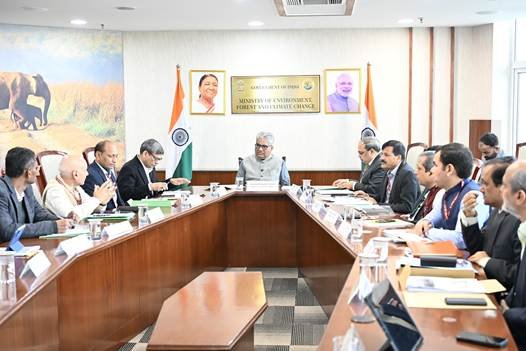
The review evaluated preparedness and implementation against predefined parameters, following directions issued during an earlier meeting held on December 3, 2025. Emphasising a results-oriented approach, the Minister urged officials to remain connected with ground-level realities, identify major pollution sources, and adopt practical and implementable solutions. He reiterated the need for a “Whole-of-Government” and “Whole-of-Society” approach to improve the global environmental image of the National Capital.
Strict Directions on Construction, Demolition, and Enforcement
Issuing specific instructions, Shri Yadav stated that construction and demolition (C&D) activities must not be permitted unless adequate C&D waste handling and processing infrastructure is available within a 10-kilometre radius of the site. He also directed that demolition activities be prohibited during the peak pollution period from October to December, with immediate enforcement pending amendments to existing rules.
Inspection drives across NCR cities were ordered to begin immediately, with strict action against violators. Stressing that penalties alone are insufficient, the Minister called for enforcement strategies that target major polluters without inconveniencing the general public, urging authorities to motivate stakeholders while acting firmly against defaulters.
Traffic, Urban Planning, and Waste Management Measures
To address traffic-related emissions, the Minister instructed authorities to ensure proper siting of multi-level parking facilities so they do not create congestion. Removal of illegal parking and encroachments from 62 identified traffic hotspots in Delhi was prioritised. A coordinated plan with Delhi Police is to be prepared to enable signal-free corridors during peak hours, restricting entry of vehicles below BS-IV emission standards.
The review also highlighted the need to check unplanned urban expansion, improve last-mile connectivity to public transport hubs, and reduce reliance on private vehicles. Expansion of waste-to-energy plants at municipal solid waste dump sites and identification of open spaces for urban greening through public participation were also encouraged.
Legacy Waste, Clean Fuel Transition, and Public Participation
The Municipal Corporation of Delhi was asked to adopt a 360-degree strategy combining legislative reforms, enforcement, and alternative solutions for residents affected by encroachments. Fast-tracking the remediation of Okhla, Bhalswa, and Ghazipur legacy waste dump sites was directed, with a target to achieve tangible outcomes by the end of 2026.
The Commission for Air Quality Management (CAQM) was requested to analyse PNG production and consumption data of industrial units to assess the actual shift to cleaner fuels. The Minister also called for enhanced awareness and IEC programmes, focusing on industries and construction stakeholders, and encouraged CSR initiatives to provide heating devices to workers to prevent biomass and waste burning.
Concluding the meeting, Shri Yadav urged citizens and institutions to work in mission mode, aiming for a 40 per cent reduction in Air Quality Index (AQI) over the next year.
The meeting was attended by senior officials from the Ministry of Environment, Forest and Climate Change, CAQM, CPCB, DPCC, GNCTD, and municipal authorities of Delhi and Sonipat.
Source: Press Information Bureau, Ministry of Environment, Forest and Climate Change, Government of India
Also Read: Union Environment Minister Reviews Air Pollution Action Plans for Ghaziabad and Noida