

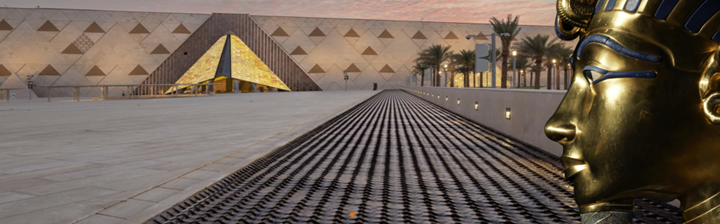
Giza, Egypt — In the shimmering desert landscape, where the ancient pyramids have stood for 4,500 years, a new icon of human creativity has emerged. The Grand Egyptian Museum (GEM), one of the largest and most ambitious cultural projects in modern history, is set to redefine how the world experiences Egypt’s heritage. Seamlessly blending cutting-edge engineering with timeless history, the GEM is more than a museum—it is a national vision cast in stone, glass, and desert light.
A Dream Decades in the Making
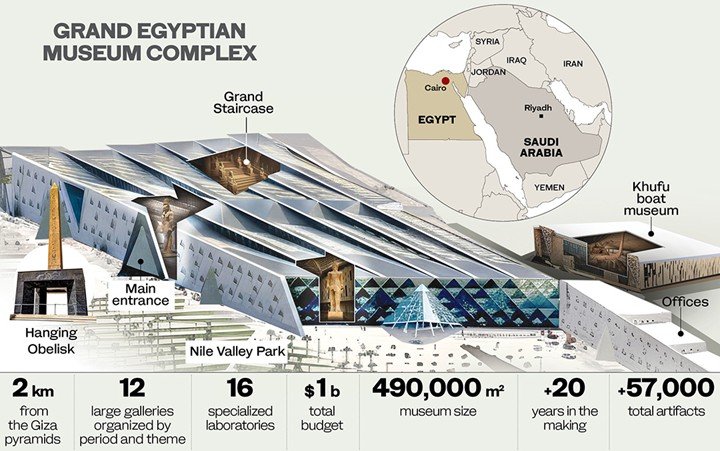
The origins of the Grand Egyptian Museum trace back to the late 1990s, when the Egyptian government envisioned a cultural institution capable of preserving, exhibiting, and celebrating the world’s richest archaeological collection. With more than 100,000 artifacts, many too delicate to be displayed in the century-old Egyptian Museum in Cairo, a larger, modern, and technologically advanced facility became a necessity.
An international architectural competition in 2002 brought forward hundreds of proposals. The winning design, submitted by the Dublin-based firm Heneghan Peng Architects, reimagined the museum as a monumental gateway between Cairo’s urban edge and the ancient Giza Plateau.
Also Read: National Museum, New Delhi — History, Architecture, and the Road Ahead
A Triangle Inspired by Eternity
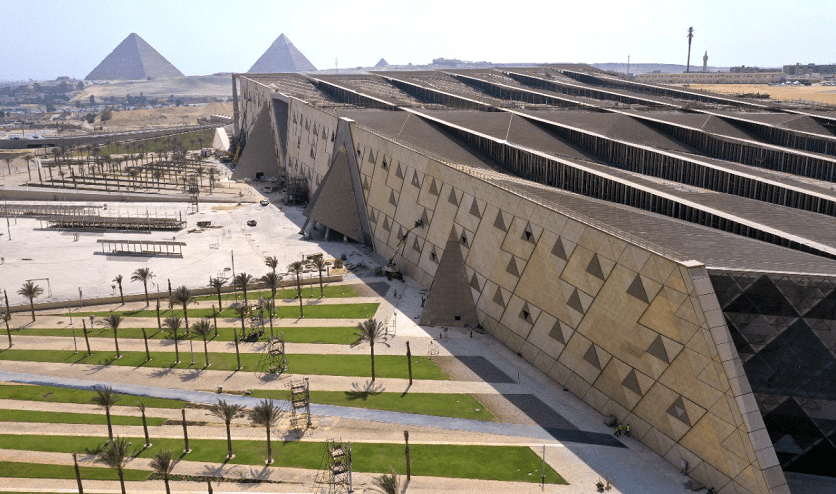
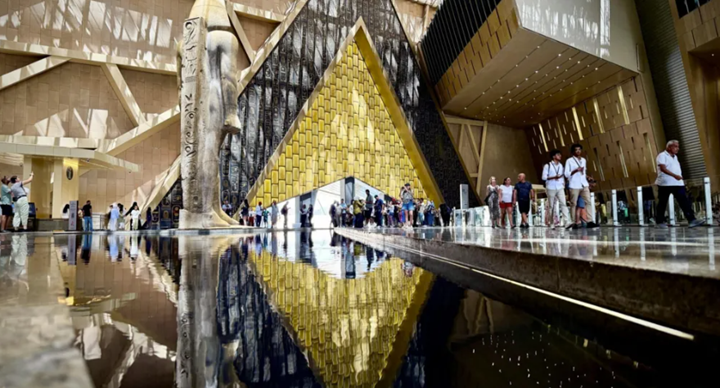
At first glance, the GEM’s architecture pays subtle homage to its legendary neighbors. The museum’s form is shaped by a triangular grid—reflecting Egypt’s symbolic geometry. Its façade is clad in translucent alabaster-toned stone, allowing the desert sun to create gentle shifts of color throughout the day.
The architects placed the museum’s main entrance so that visitors enjoy a direct, uninterrupted view of the Great Pyramid of Khufu. This alignment was no accident; it was meant to create a dialogue between the ancient and the contemporary.
Engineering on an Unprecedented Scale
Constructing a museum at the edge of the desert, on shifting sands and an active tourist landscape, demanded extraordinary engineering innovation:
1. The Grand Staircase
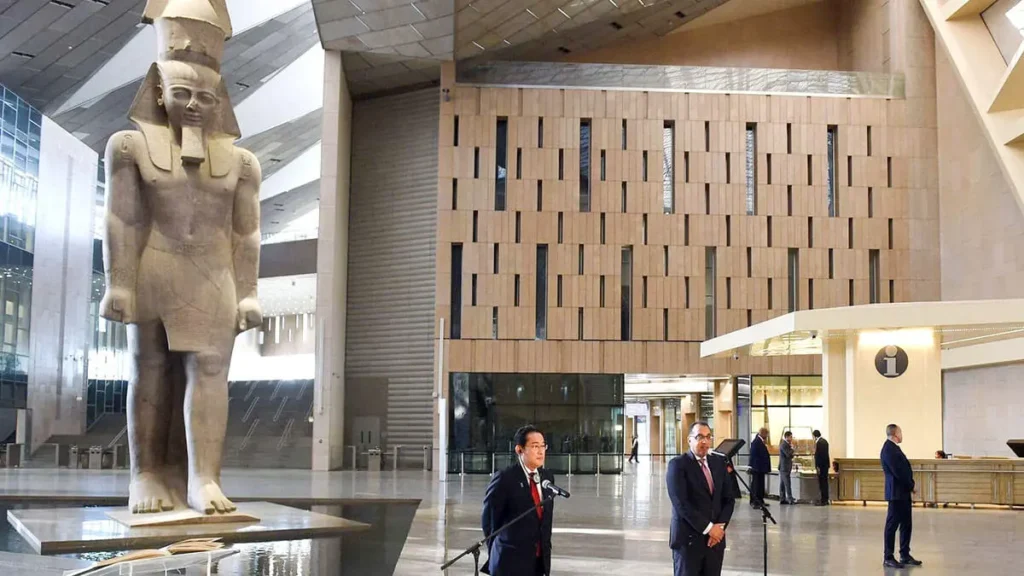
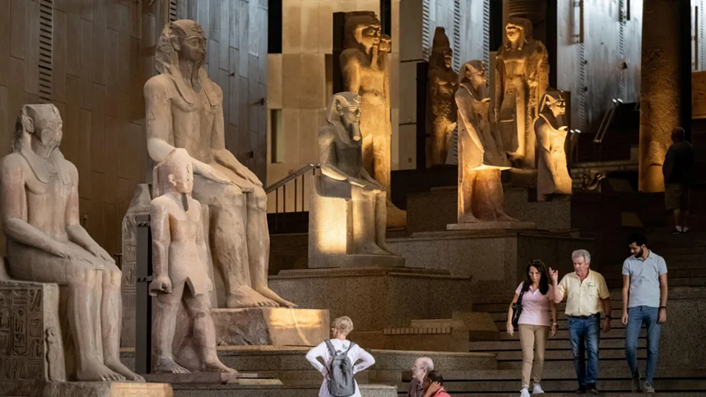
A 60-meter-long staircase—almost ceremonial in scale—leads visitors upward through time. Flanked by colossal statues from various dynasties, it embodies Egypt’s ascent from antiquity to the future.
2. Climate-Controlled Conservation Labs
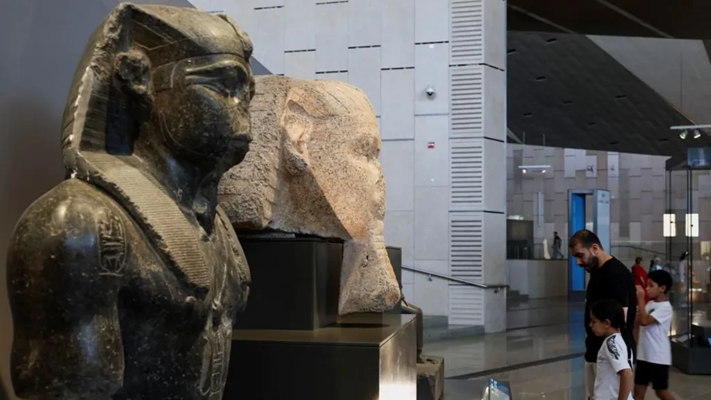
The GEM houses one of the world’s largest archaeological conservation centers, equipped with state-of-the-art labs that protect fragile artifacts from humidity, pollution, and biological decay. Over 50,000 items have been restored here, many never seen by the public before.
3. A Home for King Tutankhamun
For the first time in history, the complete collection of Tutankhamun’s treasures—more than 5,000 objects discovered in his tomb—will be displayed together. Engineers and conservators used advanced 3D scanning, micro-climate cases, and custom-built mounts to ensure long-term preservation.
4. Seismic Protection and Smart Design
Given the region’s exposure to earthquakes, engineers incorporated modern seismic-resistant technologies into the museum’s foundation. The triangular geometry also increases structural stability while enhancing visual harmony.
A Collaboration Across Continents
The creation of the GEM involved global cooperation on an unprecedented scale:
- Funding from Japan through the Japan International Cooperation Agency (JICA)
- Expertise from hundreds of archaeologists, conservators, engineers, and designers
- Contributions from European and American research institutions
- Thousands of Egyptian workers, craftsmen, and specialists
This convergence of cultures and disciplines transformed the project into a truly international endeavor, while keeping Egyptian heritage at its heart.
A Museum for the Future
The GEM is not just a repository of ancient artifacts; it is a new model for cultural tourism and national identity. With immersive digital galleries, landscaped gardens inspired by ancient flora, and educational spaces for researchers and students, the museum is designed to serve generations to come.
Experts expect the museum to boost Egypt’s tourism sector significantly and reposition Giza as a global cultural hub.
Also Read: First Gallery of Yuge Yugeen Bharat Museum Set to Open by 2026-End
Where Past Meets Future
Standing beside the pyramids, the Grand Egyptian Museum reminds the world that Egypt’s story is not frozen in time. It continues—boldly, brilliantly, and with renewed vision. From the precision of its architecture to the reverence felt within its halls, the GEM is a testament to what can happen when innovation honors tradition.
In the shadow of the world’s oldest wonders, a new wonder has been born.
REFERENCES:
- Grand Egyptian Museum – Official Website
“About the GEM,” Grand Egyptian Museum Authority. - The Guardian
“Grand Egyptian Museum: The Largest Museum Dedicated to a Single Civilization,” The Guardian, UK. - National Geographic
“Inside the New Grand Egyptian Museum,” National Geographic Feature. - The New York Times
“Egypt Builds a Giant Museum to Showcase Its Ancient Past,” NYT – International Reports. - BBC News
“Grand Egyptian Museum Near Completion,” BBC Africa & Middle East Desk. - Egyptian Ministry of Planning
Project budgets, development updates, and annual progress reports.