
Birthday Feature

Every year on November 24, the architectural world pauses to celebrate the birth of a visionary architect—Raj Rewal, a man who did not merely design buildings but crafted living philosophies in brick, concrete, and light. Born in 1934 in Hoshiarpur, Punjab, and shaped by his education in Delhi and London, Rewal returned to an India eager to define its identity in the post-Independence era. Instead of importing Western ideals, he carved a path uniquely its own, blending modernity with the spirit of Indian tradition (Rewal, 2012; Jadhav, 2019).
A Philosophy Rooted in People and Place
What makes Rewal’s work truly timeless is his belief that architecture must first serve people. His designs respond to the human scale, climate, and social needs—creating interconnected environments rather than isolated structures. Inspired by the organic spatial patterns of cities like Jaisalmer and Jaipur, he reinterpreted courtyards, clusters, and shaded pathways into modern, efficient, and deeply humane built forms (Kazi, 2004).
Masterpieces That Shaped the Indian Skyline
Each of Raj Rewal’s works stands as a testament to his ability to blend cultural memory with contemporary functionality:
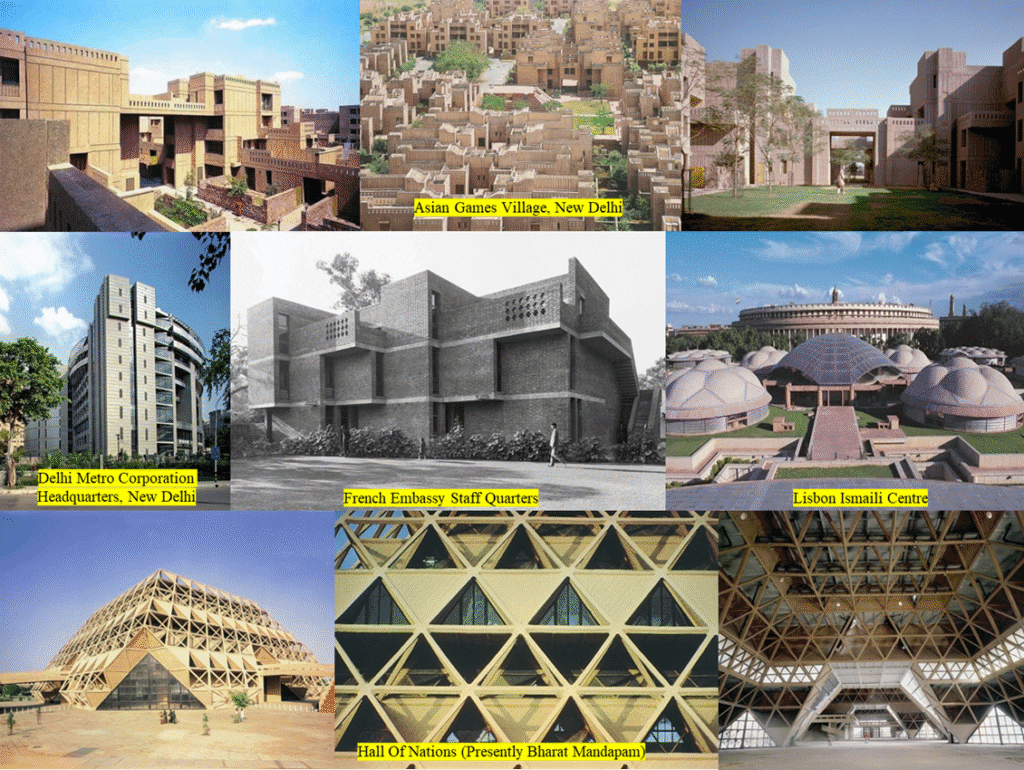
- Hall of Nations, New Delhi (1972): A pioneering space-frame structure that symbolised India’s scientific and industrial confidence (Rewal, 1972).
- Asian Games Village (1982): A living tapestry of terraces, courts, and pedestrian streets—an enduring example of climate-responsive community housing (Urban Design Review, 1983).
- Parliament Library Building (2003): A contemplative institution organised around a luminous central courtyard, representing knowledge at the heart of democracy (CPWD Archives, 2003).
- National Institute of Immunology, New Delhi: A modular brick ensemble that seamlessly aligns scientific purpose with India’s tropical climate (Architecture+Design, 1990).
A Legacy Etched in Time
Raj Rewal’s legacy is not just architectural—it is cultural, environmental, and deeply human. He taught India that modernity need not erase memory; it can grow from it. His work continues to guide young architects in designing cities that honour heritage while embracing the future (Indian Architecture Journal, 2015).
Honouring the Master Builder
As we celebrate Ar. Raj Rewal’s birthday, we honour not just an architect, but a storyteller—one who taught us that spaces shape society, and that true architecture is an emotion, a responsibility, and a bridge across time.