

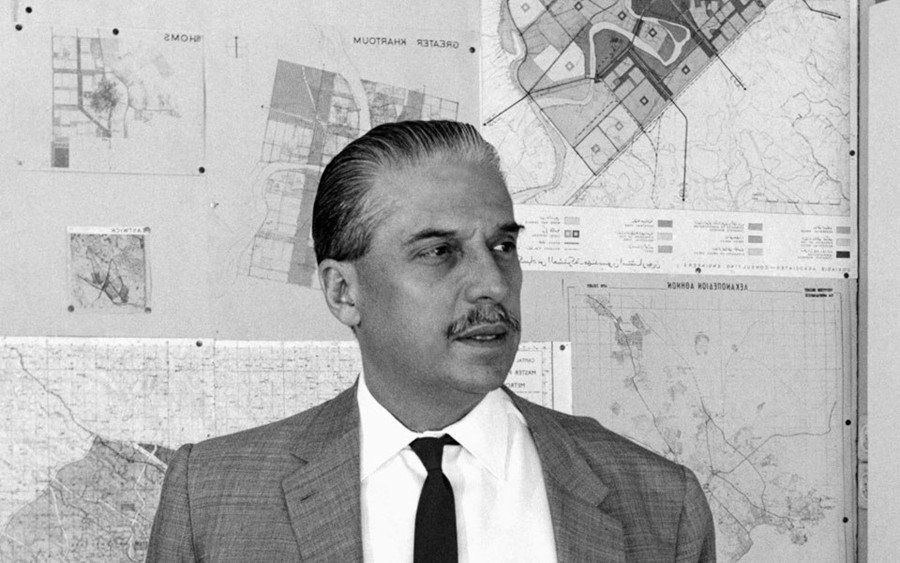
Urban planning history is often narrated through iconic designers and monumental cities. Yet, some of the most transformative thinkers worked not by shaping isolated projects, but by redefining how we understand human settlements. Among them, Constantinos Doxiadis stands out as a pioneer who attempted something extraordinarily ambitious: to create a universal science of cities. His work bridged architecture, engineering, sociology, geography, and ecology—long before interdisciplinary planning became standard practice.
Early Life: Intellectual Roots in a Changing World
Constantinos Apostolos Doxiadis was born in 1913 during a period of intense geopolitical transformation in Europe. Although born outside Greece, he grew up deeply connected to Greek intellectual and political traditions. His father, a public official, exposed him early to governance, administration, and the spatial implications of policy decisions. This upbringing cultivated in him a sensitivity to how cities are shaped not only by design but also by political and social forces.
His formal education at the National Technical University of Athens was rigorous, combining architecture and engineering. Later, his studies in Germany introduced him to European modernist ideas, but he did not adopt them uncritically. Instead, he began questioning the limitations of purely form-based planning approaches. While many modernists were preoccupied with geometry and aesthetics, Doxiadis was already asking deeper questions: How do cities grow? What governs their evolution? Can their development be predicted?
This curiosity about systems and processes became the foundation of his life’s work.
War, Reconstruction, and the Formation of a Planner
The outbreak of World War II and its aftermath proved निर्णય in shaping Doxiadis’ thinking. Greece, like much of Europe, faced widespread destruction, displacement, and economic instability. Doxiadis was directly involved in reconstruction efforts, particularly in housing and regional planning.
This experience was transformative. He encountered the limitations of conventional planning approaches when faced with urgent, large-scale problems. Rebuilding was not simply about constructing houses—it required understanding migration patterns, economic recovery, infrastructure networks, and community needs. These challenges pushed him toward a more holistic and systemic understanding of settlements.
During this period, he began to see cities not as static designs but as dynamic organisms, constantly evolving in response to internal and external forces. This realization marked a turning point in his intellectual journey.
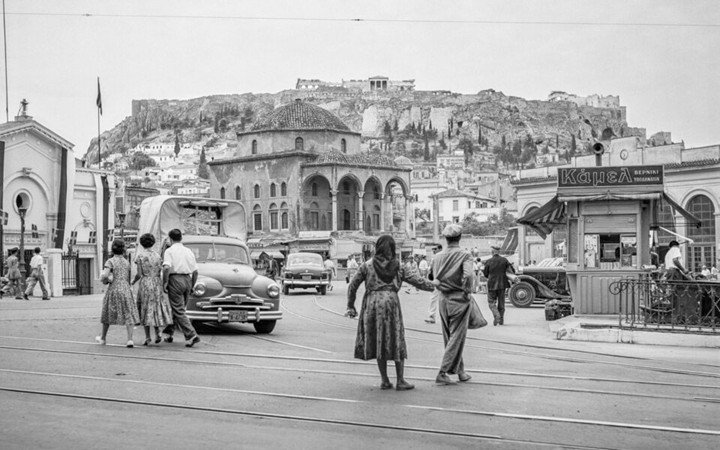
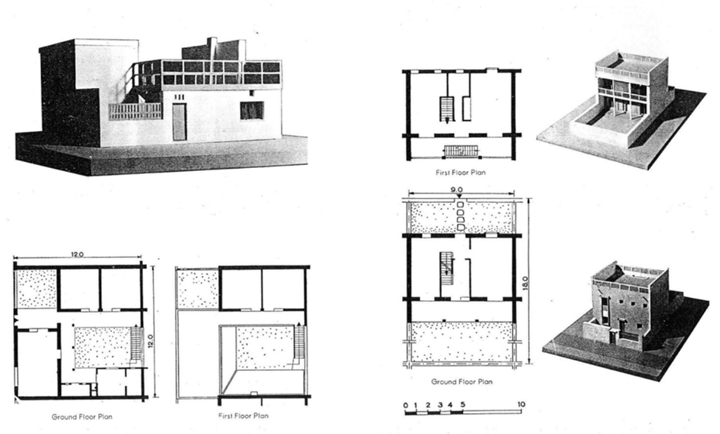
Global Practice: Doxiadis Associates and International Influence
In the 1950s, Doxiadis established Doxiadis Associates, which quickly became one of the most influential planning firms in the world. Unlike many firms that focused on specific regions, his practice operated globally, undertaking projects in over 40 countries.
His work spanned a wide range of scales and contexts, including:
- National development plans
- Regional planning frameworks
- New towns and capital cities
- Housing and infrastructure systems
This global engagement exposed him to diverse urban conditions—from rapidly urbanizing regions in Asia to developing economies in Africa. Rather than applying a single model, he refined his belief in adaptable frameworks grounded in universal principles.
Also Read: Le Corbusier: Architect and Pioneer of Modernism
Islamabad: A Laboratory of Ideas
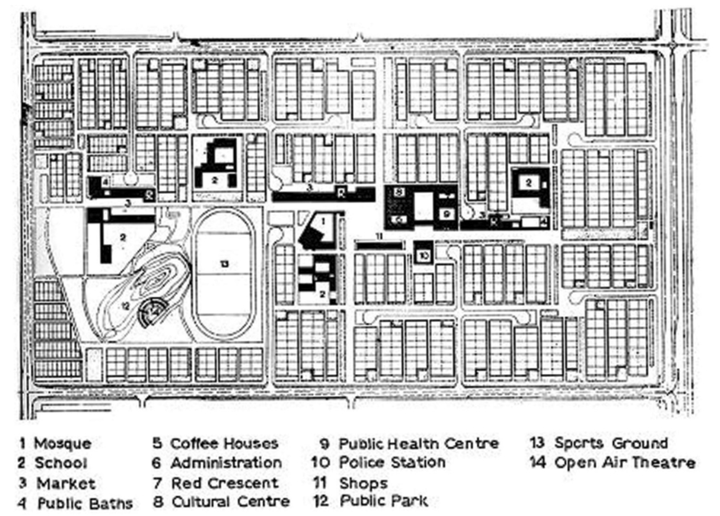
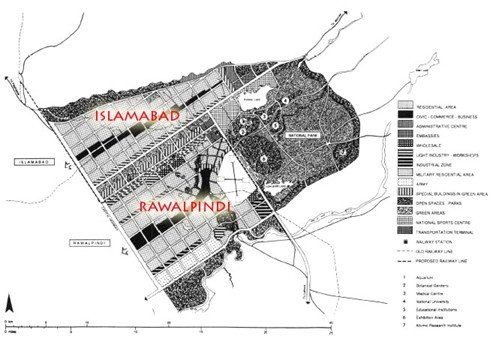
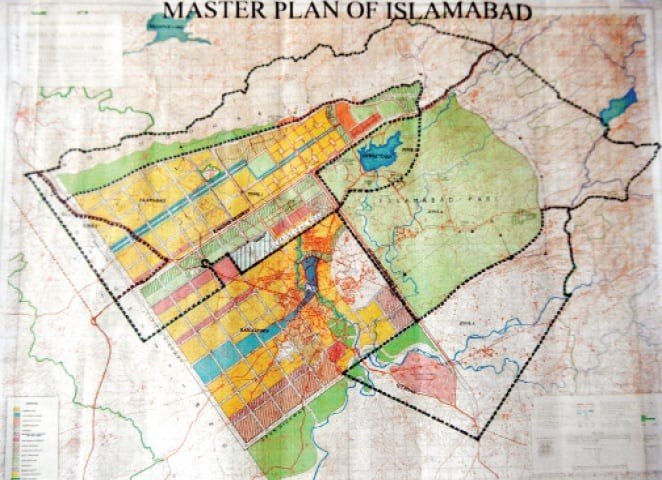
One of his most significant projects was the planning of Islamabad, the new capital of Pakistan. Designed in the 1960s, the city exemplified Doxiadis’ theoretical approach in built form. The plan was based on a hierarchical sectoral system, where each sector functioned as a self-contained neighborhood with access to services, green spaces, and infrastructure.
The layout emphasized:
- Human-scale development
- Clear functional zoning
- Integration with the natural landscape
- Efficient transportation networks
Islamabad was not just a city—it was a prototype of Ekistic planning, demonstrating how theory could guide real-world urban development.
Ekistics: Toward a Unified Science of Settlements
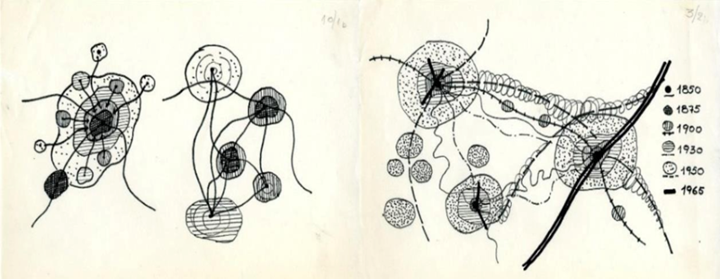
Doxiadis’ most enduring contribution is his formulation of Ekistics, which he defined as the science of human settlements. At a time when urban studies were fragmented across disciplines, Ekistics sought to create a unified framework.
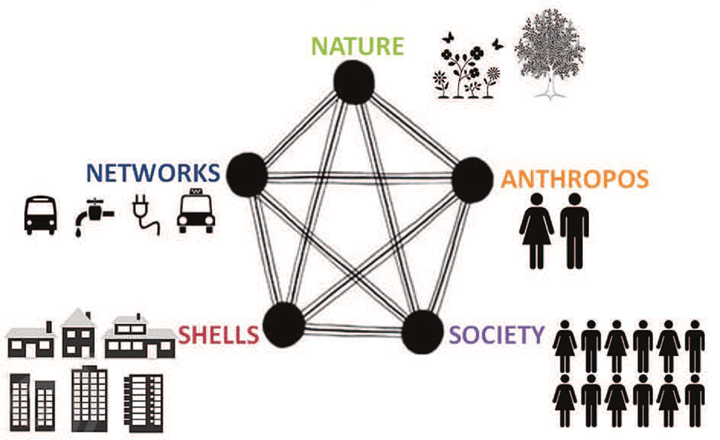
At its core, Ekistics identified five fundamental elements that shape any settlement:
- Nature (the environmental context)
- Humans (individual needs and behaviors)
- Society (collective organization and institutions)
- Shells (physical structures such as buildings)
- Networks (infrastructure systems like transport and communication)
What made this framework revolutionary was its emphasis on interdependence. Doxiadis argued that no element could be understood in isolation; the functioning of a city depends on the relationships between these components.
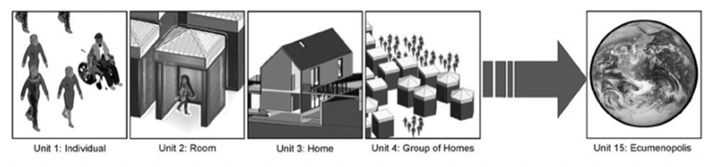
He also introduced a scale-based approach, analyzing settlements from:
- The smallest unit (a room)
- To the largest possible system (global urbanization)
This multi-scalar thinking anticipated contemporary planning approaches that integrate neighborhood design with regional and global systems.
Ecumenopolis: Predicting the Urban Future
Perhaps the most visionary aspect of Doxiadis’ work was his concept of Ecumenopolis, or the “world city.” He predicted that urbanization would continue expanding until cities merged into a continuous global network.
This idea was based on careful observation of trends such as:
- Rapid population growth
- Industrialization
- Increasing mobility and connectivity
Doxiadis envisioned a future where urban regions would no longer be isolated entities but part of an interconnected planetary system. While this concept initially seemed speculative, it resonates strongly with present-day realities.
Today, we observe:
- Megaregions like the Delhi–Mumbai Industrial Corridor
- Continuous urban corridors in China
- Global economic networks linking major cities
These developments reflect patterns that Doxiadis anticipated decades earlier. His work demonstrates a rare ability not only to analyze the present but to forecast long-term urban evolution.
Philosophy and Planning Approach
Doxiadis’ philosophy was rooted in a belief that cities must be designed for people while remaining adaptable to change. He rejected rigid master plans that imposed fixed structures on dynamic systems. Instead, he advocated for flexible frameworks that could evolve over time.
He also emphasized the importance of balancing human needs with environmental constraints. Long before sustainability became a central concern, he argued for integrating natural systems into urban planning. His work reflects an early understanding of what we now call resilience and ecological urbanism.
Another key aspect of his approach was the use of data and scientific methods. He believed that planning should be informed by empirical research, including demographic analysis, economic trends, and spatial patterns. This emphasis on evidence-based planning aligns closely with contemporary practices in GIS and urban analytics.
Also Read: Baron Haussmann: The “Slasher of Paris” Who Reimagined the Modern City
Institutional and Intellectual Contributions
Beyond his projects, Doxiadis played a significant role in shaping the intellectual discourse of urban planning. He founded the journal Ekistics, which became a platform for interdisciplinary research on human settlements. He also organized international conferences that brought together experts from diverse fields.
Through these initiatives, he helped establish urban planning as a global and collaborative discipline. His work influenced generations of planners, architects, and researchers, even if his name is not always prominently recognized.
Relevance in Contemporary Urban Planning
The relevance of Constantinos Doxiadis has only increased over time. In the context of climate change, rapid urbanization, and technological transformation, his ideas provide valuable guidance.
His systems-based approach aligns closely with:
- Circular economy models
- Integrated infrastructure planning
- Nature-based solutions
- Smart and data-driven cities
For contemporary planners, especially those working in rapidly urbanizing regions like India, his emphasis on adaptability, scalability, and human-centered design offers critical insights. His work encourages us to move beyond isolated interventions and think in terms of interconnected systems.
Conclusion: Rediscovering a Forgotten Pioneer
Doxiadis was not merely an urban planner; he was a thinker who sought to understand the fundamental principles governing human settlements. His work transcended disciplinary boundaries and geographic contexts, offering a framework that remains relevant in addressing today’s urban challenges.
In revisiting his ideas, we are reminded that cities are not fixed entities but evolving systems shaped by complex interactions. Doxiadis’ vision challenges us to think beyond immediate problems and consider the long-term future of human habitation on a global scale.
His legacy lies not only in the cities he helped design but in the questions he asked—questions that continue to shape the future of urban planning.
References
- Doxiadis, C. A. (1968). Ekistics: An introduction to the science of human settlements. Oxford University Press.
- Doxiadis, C. A. (1970). Ecumenopolis: The inevitable city of the future. Athens Center of Ekistics.
- Hall, P. (2014). Cities of tomorrow: An intellectual history of urban planning and design. Wiley-Blackwell.
- Tyrwhitt, J. (1972). Constantinos Doxiadis. Ekistics, 33(198), 1–10.
- Wegener, M. (2004). Overview of land-use transport models. In Handbook of Transport Geography and Spatial Systems (pp. 127–146).
Also Read: Kongjian Yu: Reimagining Urbanism Through Ecological Intelligence