

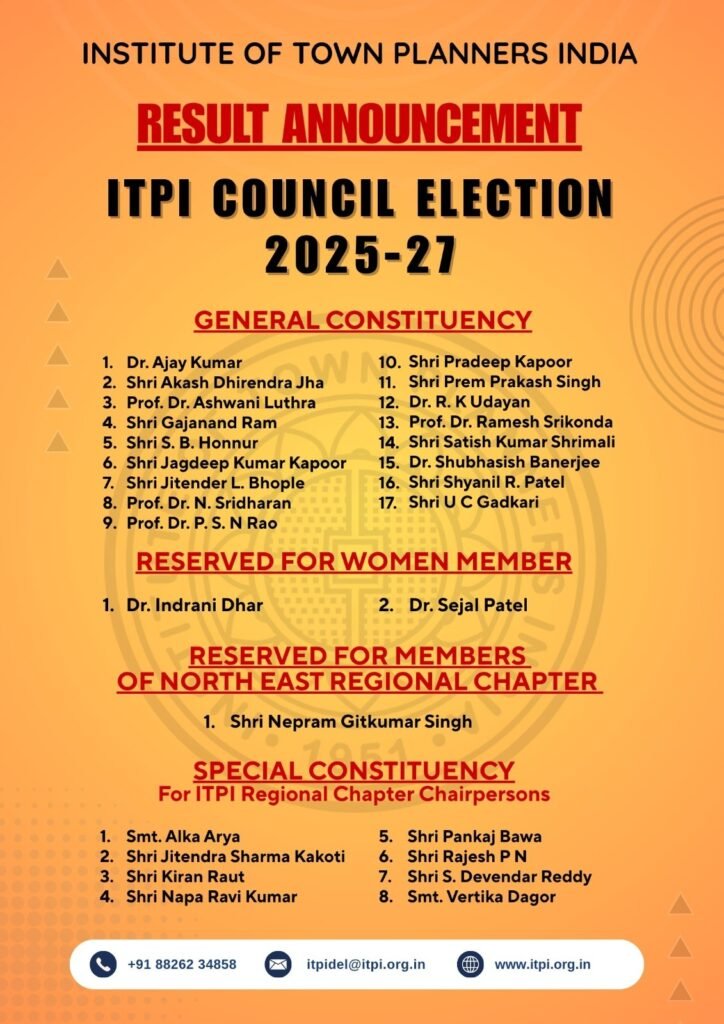
The Institute of Town Planners, India (ITPI) has officially declared the results of its Council Election for the term 2025–27, marking an important step in strengthening leadership within the planning profession. The newly elected council includes members from the general constituency, reserved seats for women, the North-East Regional Chapter, and special constituencies of regional chapter chairpersons. Among the elected representatives are eminent planners and academicians such as Dr. Ajay Kumar, Prof. Dr. Ashwani Luthra, Dr. Indrani Dhar, Dr. Sejal Patel, Shri Nepram Gitkumar Singh, and Shri Napa Ravi Kumar, reflecting a broad spectrum of professional expertise. The inclusion of women members and representation from the North-East region underlines ITPI’s commitment to inclusivity and balanced governance. The council is expected to play a vital role in advancing urban and regional planning practices, enhancing professional standards, and addressing contemporary challenges such as sustainable development, infrastructure growth, and resilient city planning across India.
Also Read: ITPI Council Elections 2025–27: Shaping India’s Urban Future


The point about the Institute of Town Planners declaring the results of its Council Election for the term 2025–27 marking an important step in strengthening leadership within the planning profession is well taken. As someone who has worked in university admissions, I’ve seen how leadership elections can impact the direction of academic programs. In my experience, around 30% of students considering programs in urban planning and architecture are influenced by the reputation and leadership of professional bodies like the Institute. The parallel between this election and the emphasis on strong digital presence in education is something I have been thinking about because it highlights the need for institutions to balance traditional professional development with modern marketing strategies to attract students. I wonder how the newly elected council will navigate this balance, especially given the changing landscape of education and admission cycles.