

Ministry of Fisheries, Animal Husbandry & Dairying has officially launched the Access Pass for Fishing in India’s Exclusive Economic Zone (EEZ), marking a major reform aimed at unlocking the vast potential of India’s deep-sea fisheries sector. The national launch was held on 20 February 2026 at Veraval, Gujarat, where Union Minister Shri Rajiv Ranjan Singh distributed Access Passes to representatives of 24 fisheries cooperative societies from all 13 coastal States and Union Territories.
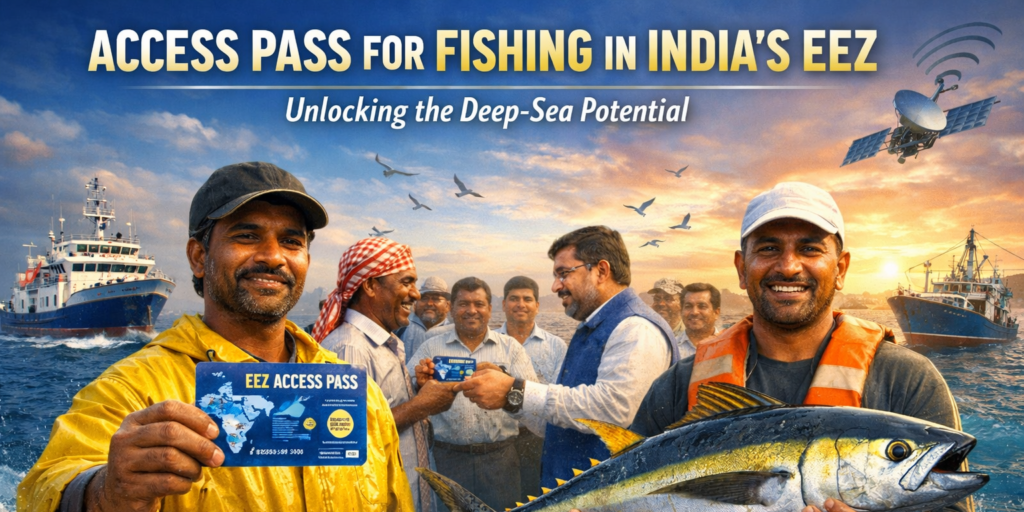
India possesses a coastline of approximately 11,099 km and an EEZ spread over 24 lakh sq km. However, most fishing operations currently remain confined to 40–50 nautical miles from the shore, leaving deep-sea resources—particularly high-value tuna and tuna-like species—largely underutilized. Recognizing this gap, the Government announced in the Union Budget 2025–26 an enabling framework for sustainable fisheries in the EEZ and high seas, especially focusing on the Andaman & Nicobar Islands and Lakshadweep, which together account for nearly 49% of India’s EEZ.
Legal Framework Strengthened Under EEZ Rules, 2025
The initiative is backed by the Sustainable Harnessing of Fisheries in the Exclusive Economic Zone Rules, 2025, notified on 4 November 2025 under the Territorial Waters, Continental Shelf, Exclusive Economic Zone and Other Maritime Zones Act, 1976. These Rules establish a robust regulatory architecture to promote responsible fishing, marine ecosystem conservation, and compliance with international maritime obligations.
The Access Pass is mandatory for mechanized fishing vessels (approximately 64,000) and large motorized vessels above 24 metres, while traditional non-motorized fishing crafts remain exempt—ensuring protection for small and artisanal fishers.
ReALCRaft Portal: Digital Backbone of the Reform
The Access Pass is issued free of cost through the upgraded ReALCRaft (Registration and Licensing of Fishing Craft) portal, developed by NIC in collaboration with the Department of Fisheries. The fully online, zero-fee system delivers passes digitally to registered mobile numbers or emails, ensuring transparency and time-bound approvals.
The portal is integrated with:
- Marine Products Export Development Authority (MPEDA) for Catch Certificates
- Export Inspection Council (EIC) for Health Certificates
This single-window digital integration enhances traceability, sanitary compliance, eco-labelling, and export competitiveness of Indian seafood in premium international markets National Launch of Access Pass ….
Capacity Building and Cooperative Strengthening
To support the transition from near-shore to deep-sea fishing, structured training programs will be rolled out through:
- Central Institute of Fisheries Nautical and Engineering Training (CIFNET)
- Fishery Survey of India (FSI)
A Joint Working Group with the Ministry of Cooperation has also been constituted to strengthen fisheries cooperatives and promote small-scale fisher participation in deep-sea fishing and export value chains.
Enhanced Welfare and Safety Measures
Complementing regulatory reforms, the government is installing one lakh vessel transponders free of cost for real-time tracking and distress alerts. Over 50,000 devices have already been installed. Additionally:
- Nearly 6 lakh fisher families receive annual livelihood support during fishing bans.
- Accident insurance coverage has been enhanced to ₹5 lakh, benefiting over 33 lakh fishers nationwide.
The Access Pass initiative signals a structural shift toward regulated deep-sea fishing, export-led growth, and improved fisher incomes, positioning India to better harness its oceanic resources while safeguarding sustainability and marine ecology.
Also Read: NITI Aayog Releases Apprenticeship Ecosystem Report 2026