

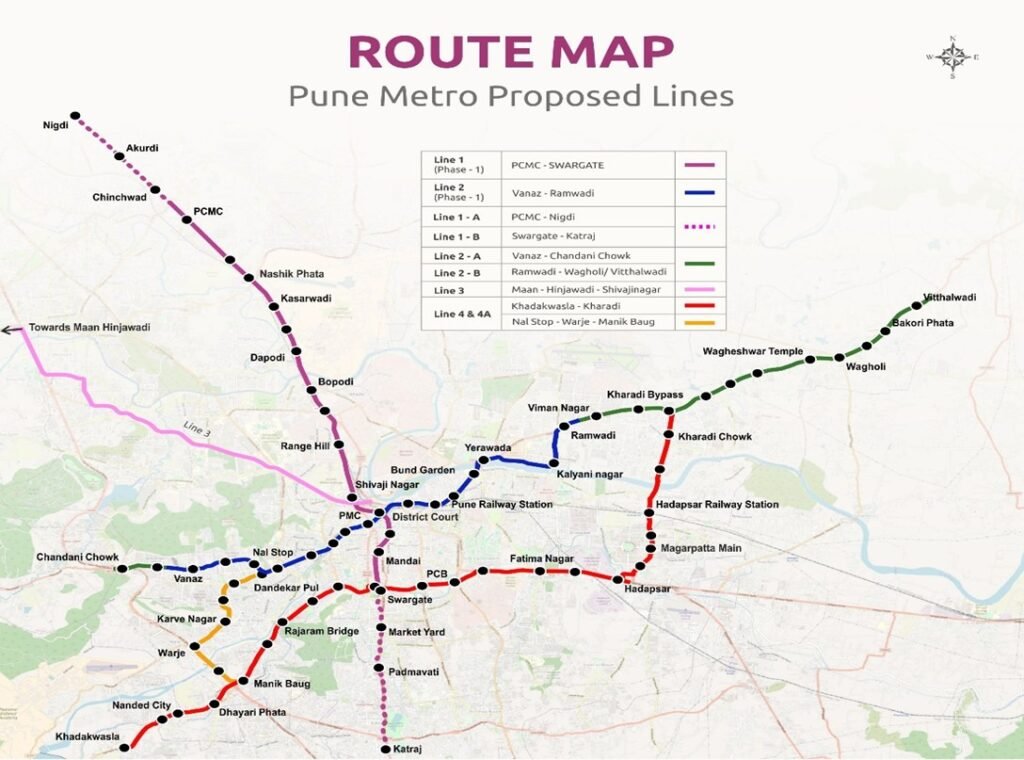
The Union Cabinet has approved two key corridors under Pune Metro Phase-2, marking a major step toward strengthening the city’s public transport network. The decision, chaired by Prime Minister Narendra Modi, clears the development of Line 4: Kharadi–Hadapsar–Swargate–Khadakwasla and Line 4A: Nal Stop–Warje–Manik Baug.
Project Highlights
- Total length: 31.636 km
- Total stations: 28 (all elevated)
- Estimated cost: ₹9,857.85 crore
- Completion timeline: 5 years
- Implementing agency: Maharashtra Metro Rail Corporation Limited (Maha-Metro)
The project will be co-funded by the Government of India, Government of Maharashtra, and bilateral/multilateral funding agencies.
Enhanced Citywide Integration
The new metro corridors will connect major IT hubs, commercial districts, educational institutes, and residential areas across East, South, and West Pune.
They will integrate with:
- Line 1 at Swargate
- Line 2 at Kharadi Bypass & Nal Stop
- Hadapsar Railway Station (future interchange)
- Proposed metro extensions toward Loni Kalbhor and Saswad Road
By connecting routes such as Solapur Road, Magarpatta Road, Sinhagad Road, Karve Road, and the Mumbai–Bengaluru Highway, the project aims to ease peak-hour congestion and support greener mobility.
Ridership Projections
The combined daily ridership of Line 4 and 4A is expected to rise significantly:
- 2028: 4.09 lakh passengers
- 2038: ~7 lakh
- 2048: 9.63 lakh
- 2058: 11.7 lakh+
The Kharadi–Khadakwasla route alone is expected to grow from 3.23 lakh (2028) to 9.33 lakh (2058), while Line 4A (Nal Stop–Warje–Manik Baug) may expand from 85,555 daily users to 2.41 lakh.
Progress Underway
Pre-construction activities—including surveys and detailed design work—have already begun. With this approval, Pune Metro’s network will cross the 100 km mark, positioning the city for a modern and well-integrated mobility system.
A Step Towards a Greener Future
Once operational, the new corridors will offer faster, safer, and more reliable public transport, cutting travel time and reducing urban congestion. The government expects Phase-2 to become a key driver in Pune’s long-term sustainable mobility and urban development goals.
Reference: PIB
Also Read: GRIHA Launches New Sustainability Rating Framework for Metro Stations at 17th GRIHA Summit