

Prime Minister Narendra Modi on February 21, 2026, inaugurated India’s first Namo Bharat Rapid Rail Transit System (RRTS) and dedicated the Delhi–Meerut Namo Bharat Corridor to the nation in Meerut, marking a major milestone in the country’s high-speed regional connectivity network. The inauguration also included the launch of the Meerut Metro, making it the first time in India that both a rapid rail and metro service were launched from the same platform on the same day.
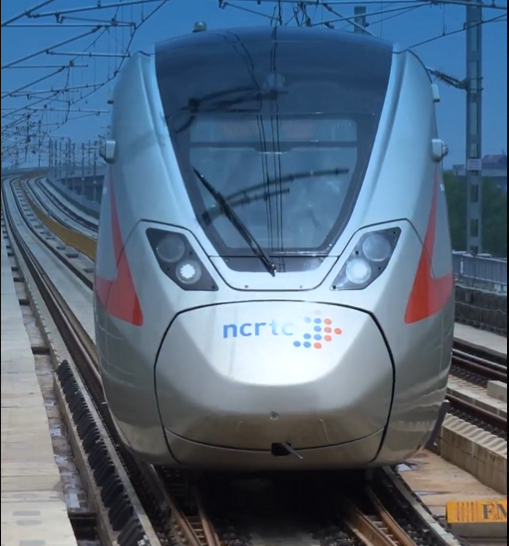
According to the official release issued by the Prime Minister’s Office, the integrated system represents a new era of world-class infrastructure and reflects the government’s commitment to delivering large-scale projects on time.
Integrated Urban-Regional Mobility Model
The project introduces a unique mobility model that integrates metro services for intra-city travel and Namo Bharat trains for high-speed regional connectivity between Delhi and Meerut. Notably, for the first time in India, Namo Bharat and Metro trains will operate on the same track and share stations, enabling seamless travel from city centers directly to the national capital.
Key interchange nodes include Sarai Kale Khan, Anand Vihar, Ghaziabad, and Meerut, where integration with Indian Railways and bus terminals has been established. This multi-modal design is expected to significantly reduce travel time and ease commuter pressure on Delhi’s housing and transport infrastructure.
Boost to NCR’s Economic Ecosystem
During the event, the Prime Minister stated that enhanced connectivity would accelerate economic activity across the National Capital Region (NCR). He emphasized that infrastructure investments—including expressways, freight corridors, and the upcoming Jewar International Airport—are generating employment opportunities and attracting industrial investment to western Uttar Pradesh.
The corridor is also aligned with the “Twin Cities” vision, strengthening the economic integration of Delhi and Meerut while improving daily mobility for workers, students, and businesses.
Women-Led Operations and Social Messaging
Highlighting the project’s social dimension, the Prime Minister noted that a majority of train operators and station control staff are women, describing the initiative as a symbol of ‘Nari-Shakti’. During his visit, he traveled on the Meerut Metro and interacted with students and passengers.
MSME and Farmer Outreach Announcements
Addressing the MSME sector, the Prime Minister referred to a ₹10,000 crore special fund announced in the Union Budget aimed at improving credit access for small enterprises. He also mentioned policy relaxations allowing small entrepreneurs to export goods directly via online platforms without the earlier ₹10 lakh courier restriction.
On the agricultural front, he stated that nearly ₹95,000 crore has been transferred to farmers in Uttar Pradesh under the PM Kisan Samman Nidhi scheme.
Strategic Importance for Uttar Pradesh
The Prime Minister underscored that Uttar Pradesh’s transformation—from infrastructure deficits to becoming a manufacturing and industrial hub—is central to achieving the vision of a ‘Viksit Bharat.’ He referenced the state’s growing prominence in defense production, mobile manufacturing, and tourism, as well as the recent foundation for its first semiconductor facility.
Project Significance
- India’s first operational Namo Bharat Rapid Rail corridor
- First instance of Metro and RRTS operating on the same track and platform
- Multi-modal integration with railways and bus networks
- Major connectivity upgrade for NCR region
- Expected reduction in travel time between Delhi and Meerut
- Catalyst for regional industrial and real estate growth
The launch of the Delhi–Meerut Namo Bharat Corridor positions India among nations advancing high-speed regional transit infrastructure and signals a new phase in integrated urban planning and transport-led development.
Also Read: Delhi Renames Nine Metro Stations to Reflect Local Identity and Public Sentiment