

A major engineering milestone has been achieved in the Mumbai–Ahmedabad High-Speed Rail (MAHSR) project with the successful breakthrough of the second mountain tunnel in Palghar district, Maharashtra. The achievement was announced on 3 February 2026 by the Ministry of Railways.

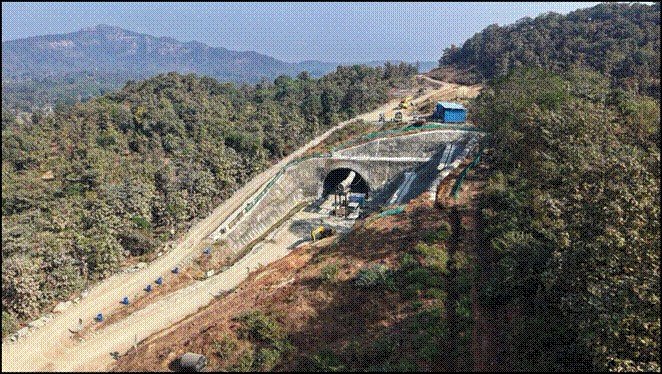
The newly completed tunnel, identified as Mountain Tunnel–6 (MT-6), is 454 metres long and 14.4 metres wide, designed to accommodate both up and down tracks of the bullet train corridor. This marks the second mountain tunnel breakthrough in Palghar within a month, following the completion of MT-5 near Saphale on 2 January 2026.
Advanced Tunnelling Technology Used
The tunnel was excavated simultaneously from both ends using the New Austrian Tunnelling Method (NATM), a drill-and-controlled blasting technique well-suited for complex geological conditions such as those found in Palghar. The excavation work for MT-6 was completed within 12 months, demonstrating significant progress in high-speed rail construction in challenging terrain.
NATM allows real-time adaptation to varying rock conditions through the use of shotcrete, rock bolts, lattice girders, and continuous geotechnical monitoring, ensuring structural stability and worker safety. The project has also incorporated advanced ventilation systems, fire safety measures, and controlled access inside tunnels.
Progress in Maharashtra Section
With this breakthrough, two of the seven mountain tunnels planned in Palghar district have now been completed. Construction is progressing on the remaining tunnels at varying stages. In parallel, work is advancing on major infrastructure components, including:
- The longest river bridge over the Vaitarna River, which has reached pier level
- Foundation works on bridges over Ulhas and Jagani rivers
- Construction of all four bullet train stations in Maharashtra
- A 21-kilometre underground tunnel between Bandra Kurla Complex and Shilphata
Project Timeline and Corridor Impact
According to the Ministry of Railways, the Gujarat section of the bullet train corridor is expected to begin commercial operations next year, while high-speed rail services are planned to extend up to Thane by 2028 and Mumbai by 2029.
The 508-kilometre MAHSR corridor—spanning 352 km in Gujarat and Dadra & Nagar Haveli and 156 km in Maharashtra—is expected to significantly boost regional connectivity, economic activity, and infrastructure-led development along the route.
As of 27 January 2026, approximately 334 km of viaducts, 17 river bridges, and 12 major crossings have been completed, with track-laying and electrification gaining momentum in the Gujarat section.
Also Read: Amit Shah Lays Foundation Stone for New Assam Legislative Assembly Building in Dibrugarh