

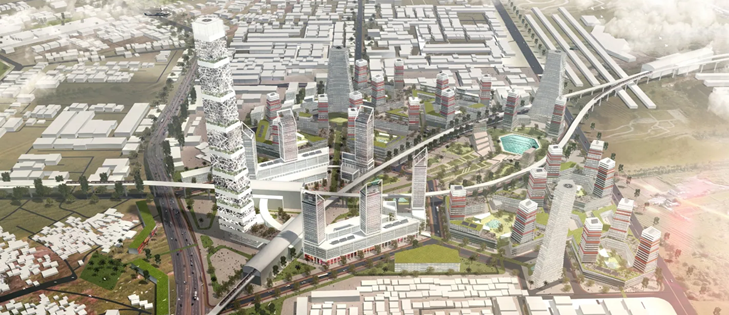
In a milestone for India’s urban transformation, Delhi Development Authority (DDA)’s Transit-Oriented Development (TOD) project at Karkardooma—the first of its kind in the country—is finally taking shape. Almost a decade after its conception, the project stands as a symbol of integrated, sustainable urban growth for Delhi.
A Policy Vision Ahead of Its Time
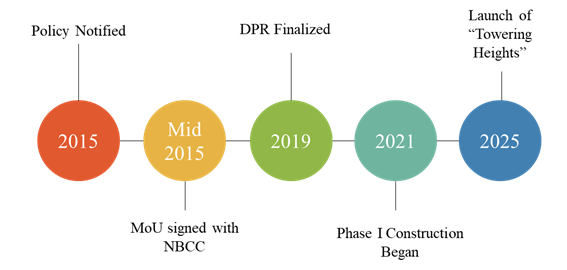
The DDA notified India’s first Transit-Oriented Development Policy in 2015, marking a historic step towards compact, mixed-use, and pedestrian-friendly urban development. The policy aimed to integrate residential, commercial, and recreational spaces around transit hubs like metro stations, promoting walkability and reducing dependence on private vehicles (The Indian Express, 2015).
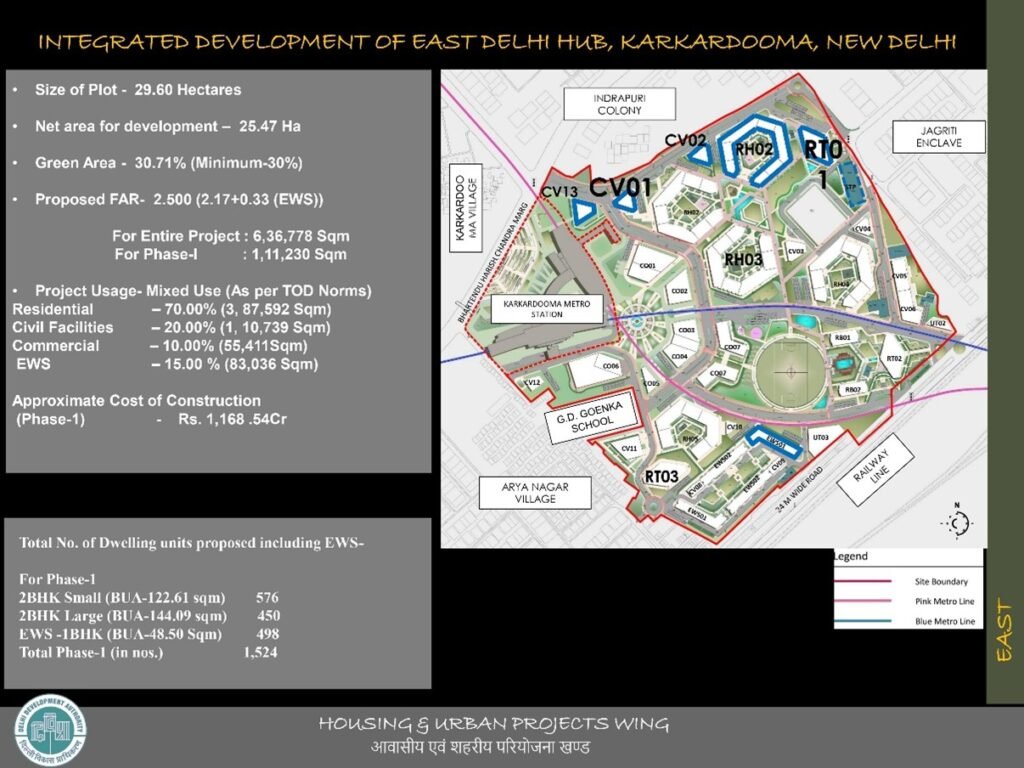
Under this visionary framework, the Karkardooma TOD project was proposed on 70 hectares (approx. 175 acres) of prime land in East Delhi. This project was conceptualized as part of the “East Delhi Hub” — an integrated urban center planned around the Karkardooma Metro Station on Delhi Metro’s Blue and Pink Lines (Hindustan Times, 2024).
The Landmark MoU
To translate policy into practice, DDA signed a Memorandum of Understanding (MoU) with NBCC (India) Limited on February 27, 2015, to undertake the planning and construction of the project. The collaboration aimed to set a national benchmark for TOD-based development by integrating housing, offices, retail, civic amenities, and open spaces within a high-density urban fabric (Realty & More, 2015).
At the time, the DDA envisioned a population density of over 1,000 persons per hectare, supported by transit corridors, affordable housing, and green linkages—making it one of the most ambitious urban restructuring exercises ever undertaken in Delhi (Times of India, 2016).
Construction and Implementation
Although the project faced several administrative and policy delays between 2016 and 2020 due to revisions in the Delhi Master Plan and alignment with the 2021 TOD regulations, construction work gained momentum after 2019, when the detailed project report and layout were finalized (Hindustan Times, 2024).
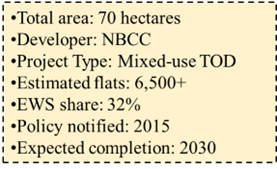
By September 2021, NBCC initiated on-ground development under Phase I, comprising 1,524 flats, including 498 EWS (Economically Weaker Section) units, at an estimated cost of ₹1,168.54 crore (Times of India, 2025). The complete East Delhi Hub is expected to deliver over 6,500 housing units, alongside commercial, institutional, and recreational facilities.
In October 2025, DDA launched its premium housing scheme “Towering Heights at East Delhi Hub,” inviting applications for registration—marking a major milestone in India’s first TOD-based housing development (Times of India, 2025).
Why It Matters
- First TOD Project in India: Pioneered under DDA’s 2015 policy, a first-of-its-kind initiative in the nation.
- Integrated Urban Model: Combines housing, employment, transit, and open space in one ecosystem.
- Policy to Practice: Demonstrates how urban design frameworks can evolve into built realities.
- Public Sector Leadership: Marks a successful collaboration between DDA and NBCC in shaping sustainable city models.
As Delhi witnesses this vision come alive, the Karkardooma TOD project stands as a living laboratory for future cities—proving that long-term urban dreams, when backed by persistent planning and vision, truly do come true.
References:
- (The Indian Express, 2015)
- (Realty & More, 2015)
- (Times of India, 2016)
- (Hindustan Times, 2024)
- (Times of India, 2025)
Also Read: Cabinet Approves Pune Metro Phase-2: New Corridors to Boost Citywide Connectivity