

Indian Railways has approved a ₹398.36 crore project for the deployment of an advanced Optical Fibre Cable (OFC) backbone across the Ahmedabad and Ratlam divisions under the Western zone.
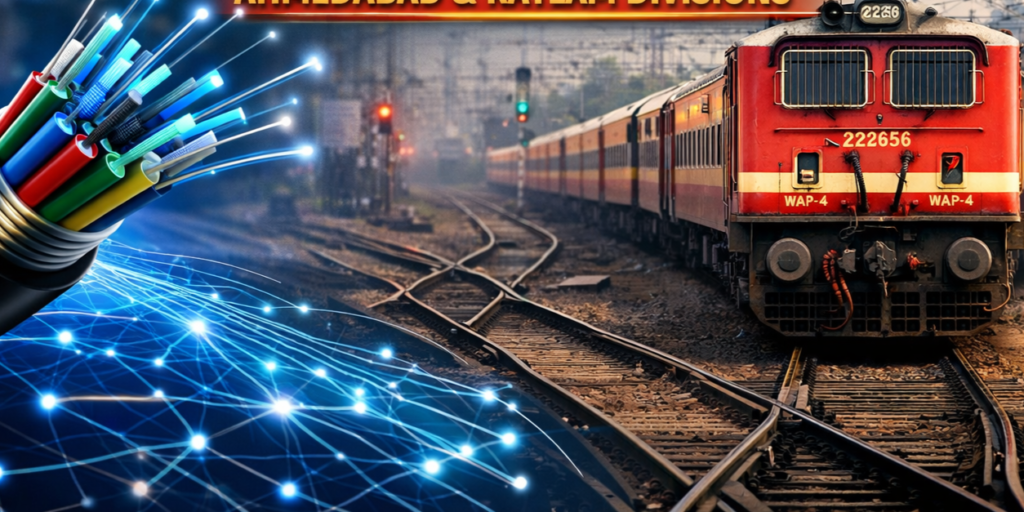
The project involves the provision of a 4×48 Optical Fibre Cable backbone, aimed at enhancing communication systems within the Western Railway network. It forms part of a broader national initiative under the “Provision of Kavach with communication backbone of Long Term Evolution (LTE)” programme, which has an overall sanctioned budget of ₹27,693 crore for 2024–25.
Under this initiative, a dedicated sub-allocation of ₹2,800 crore has been earmarked for Western Railway, with the Ahmedabad–Ratlam OFC project being a key component.
Project Scope and Coverage
The approved infrastructure will span 1,929 Route Kilometres (RKm), including:
- 1,456 RKm in Ahmedabad Division
- 473 RKm in Ratlam Division
The network will deploy 2×48 fibre OFC cables, ensuring high-capacity data transmission across critical railway corridors.
Boost to Safety and Modern Signalling
The upgraded communication backbone will directly support the implementation of Kavach, India’s indigenous train collision avoidance system. By enabling seamless, real-time data exchange, the project is expected to significantly improve operational safety, reduce human error, and enhance signalling efficiency.
Digital Transformation of Railways
This initiative aligns with Indian Railways’ broader strategy of digital transformation and modernization, focusing on:
- Improved network reliability
- Enhanced communication capacity
- Better integration of advanced signalling systems
- Increased efficiency in passenger and freight operations
The OFC backbone will serve as a foundational infrastructure layer, supporting future technologies such as LTE-based railway communication and centralized traffic control systems.
Strategic Significance
The Ahmedabad and Ratlam divisions are critical nodes within Western Railway, handling substantial passenger and freight traffic. Strengthening their communication infrastructure is expected to streamline operations and improve service delivery across the region.
This project marks another milestone in Indian Railways’ ongoing efforts to build a technology-driven, safe, and efficient rail network, reinforcing its commitment to modernization and infrastructure resilience.
Also Read: Pune Metro Line 3 Nears Completion, Likely to Open by May-End 2026