

New Delhi: In a major policy and infrastructure reform initiative aimed at controlling road dust pollution in the National Capital Region (NCR), the Union Minister for Environment, Forest and Climate Change, Shri Bhupender Yadav, presided over the signing of four Memoranda of Understanding (MoUs) for implementing a Standard Framework and Road Asset Management System (RAMS) for sustainable urban roads.
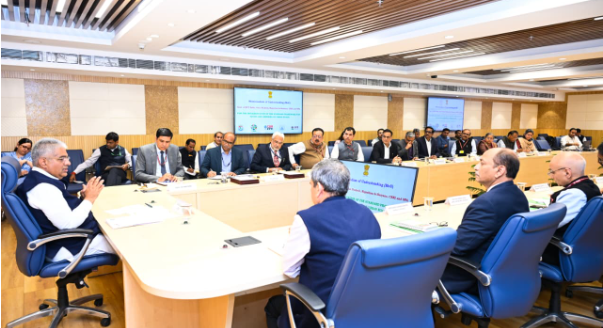
The MoUs were signed at Indira Paryavaran Bhawan, New Delhi, between the Public Works Departments (PWDs) and Urban Development Departments of Delhi, Haryana, Uttar Pradesh, and Rajasthan, along with CSIR–Central Road Research Institute (CSIR-CRRI) and the School of Planning and Architecture (SPA), New Delhi.
Addressing Road Dust – A Major Contributor to PM10
Highlighting that dust remains a major contributor to PM10 pollution in Delhi-NCR, the Minister emphasized that road dust management must move beyond short-term mitigation toward structured, data-driven and technology-enabled solutions. Delhi alone has identified 448 action points under its annual pollution control plan.
He stressed the need to:
- Scientifically map high-dust and congestion-prone corridors
- Establish a special task force to evaluate social impact
- Integrate greening measures using low-water native species (around 30 species identified by MoEFCC)
- Ensure time-bound implementation with digital monitoring
What the Standard Framework Covers
The initiative builds upon the Standard Framework issued by the Commission for Air Quality Management (CAQM), along with its guidance document dated 07 January 2025.
The framework focuses on:
1. Standardised Road Cross-Sections
- Optimised Right-of-Way (RoW) utilisation
- Improved geometric design
- Integrated pedestrian and green components
2. Dust Mitigation Through Greening
- Plantation in medians, footpaths, under flyovers, and traffic hotspots
- Structured green buffers within RoW
- Native, low-water vegetation for sustainable maintenance
3. Web-GIS Based Road Asset Management System (RAMS)
- Preventive and predictive maintenance planning
- Pavement Condition Index (PCI) evaluation
- Scientific road inventory and digital mapping
- Real-time monitoring through data platforms
4. Adoption of Modern Technologies
Use of advanced assessment tools including:
- Network Survey Vehicles (NSV)
- Falling Weight Deflectometer (FWD)
- Ground Penetrating Radar (GPR)
- Automatic Vehicle Counter and Classifier (AVCC)
Institutional Framework & Implementation
The MoUs extend a previous tripartite agreement signed on 10 June 2025 between CAQM, CSIR-CRRI and SPA for setting up a Project Monitoring Cell (PMC).
Under the new agreements:
- NCR States will implement road development and greening works as per CAQM guidelines
- CSIR-CRRI and SPA will function as technical advisors
- Each State will establish a Nodal Agency and dedicated Paving & Greening Cell
- Separate project agreements may define financial and technical scopes
The MoUs are valid for three years, with phased implementation.
Scale of Road Coverage
The initiative covers approximately:
- Delhi: 10,099 km
- Haryana: 10,133 km
- Uttar Pradesh: 6,891 km
- Rajasthan: 1,747 km
Targeted action plans will be executed over a three-year horizon.
Expected Outcomes
The structured deployment of RAMS and standardised road development practices is expected to:
- Significantly reduce road dust emissions (a major PM10 contributor)
- Improve durability and service life of urban roads
- Promote sustainable corridor design
- Strengthen technology-enabled maintenance regimes
- Enhance inter-agency coordination across NCR
With the summer season approaching—when dust pollution typically intensifies—the initiative is expected to deliver tangible on-ground improvements in air quality and urban mobility infrastructure.
The Minister described the initiative as a “whole-of-government” approach, calling it not merely a procedural agreement but a collective commitment to achieving measurable environmental and infrastructural impact in the NCR region.
Also Read: Delhi Renames Nine Metro Stations to Reflect Local Identity and Public Sentiment