

New Delhi | The Government of India has announced a comprehensive Transit Oriented Development (TOD) Policy and Regulations 2026 aimed at transforming urban growth patterns in the National Capital Territory (NCT) of Delhi. The policy, aligned with the Master Plan of Delhi 2021, seeks to promote high-density, mixed-use, and transit-linked development along metro and regional transit corridors, with a strong emphasis on affordable housing.
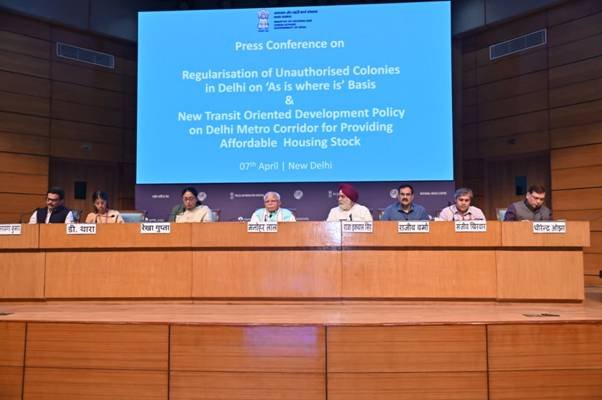
Union Minister for Housing and Urban Affairs, Shri Manohar Lal, stated that the initiative marks a significant step toward planned and sustainable urban expansion. By leveraging existing and upcoming metro and RRTS infrastructure, the policy aims to enhance accessibility while addressing housing shortages, particularly for economically weaker and middle-income groups.
A key highlight of the policy is the adoption of a corridor-based approach, covering approximately 207 sq. km within a 500-metre radius of metro and transit corridors. Notably, around 80 sq. km of previously excluded areas, including land pooling zones and unauthorized colonies, have now been brought under TOD provisions, opening new opportunities for redevelopment and planned growth.
The policy allows high Floor Area Ratio (FAR) up to 500 for plots as small as 2000 sq. m, a significant relaxation compared to earlier norms. Of the permissible FAR, 65% is reserved for residential use, with a focus on smaller dwelling units (up to 100 sq. m), ensuring the creation of affordable housing stock along transit corridors. The remaining FAR includes provisions for commercial spaces, amenities, and flexible usage such as office spaces and studio apartments.
To improve urban livability, the policy also proposes enhanced pedestrian connectivity, including underground and elevated walkways linking residential areas to transit stations. Additionally, public and semi-public infrastructure will benefit from increased FAR, supporting better service delivery in TOD zones.
In a move to streamline approvals and promote Ease of Doing Business (EoDB), the government has introduced a single-window clearance system. The earlier multi-layered approval process has been replaced with a centralized mechanism, reducing delays and simplifying compliance for developers. Furthermore, multiple charges have been consolidated into a single TOD charge, covering various approvals and infrastructure-related costs.
Officials emphasized that the TOD 2026 policy is expected to increase metro ridership, optimize land use, and create compact, walkable urban environments. By integrating housing, transport, and infrastructure planning, the policy aims to position Delhi as a future-ready, inclusive, and sustainable city.
Also Read: CRSPL and IIT Roorkee Sign MoU to Advance Ropeway Technology for Urban Mobility