

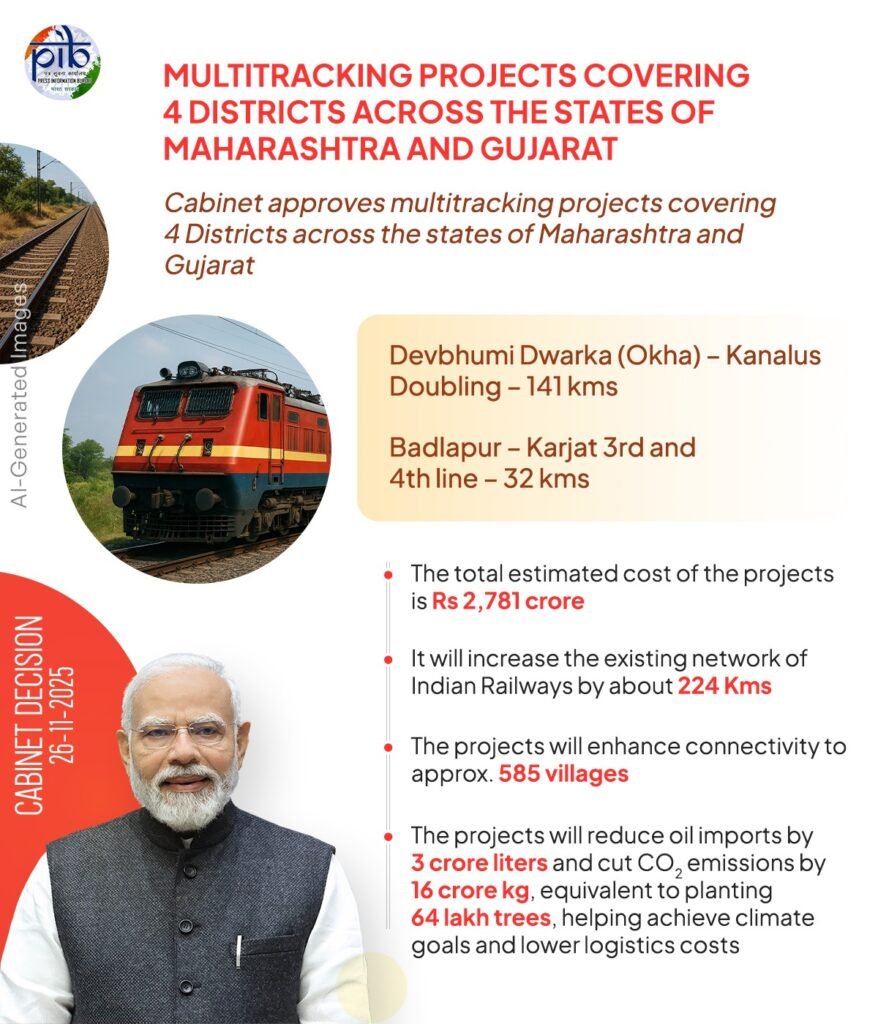
The Union Cabinet has approved two significant multi-tracking projects across Maharashtra and Gujarat, aiming to boost capacity, improve connectivity, and reduce congestion on key rail corridors. Together, these projects will expand the Indian Railways network by approximately 224 km, with a combined investment of ₹2,781 crore.
Projects Approved
- Devbhumi Dwarka (Okha) – Kanalus Doubling (141 km)
- Badlapur – Karjat 3rd & 4th Line (32 km)
Both initiatives, approved by the Cabinet Committee on Economic Affairs chaired by Prime Minister Narendra Modi, align with the national goal of modernizing rail infrastructure and improving multi-modal connectivity under the PM Gati Shakti National Master Plan.
Connectivity Boost Across 4 Districts
The two projects span four districts across the two states, enhancing access for nearly 585 villages with an estimated population of 32 lakh people. The enhanced rail capacity is expected to significantly improve passenger mobility and freight operations.
Key Project Benefits
1. Okha–Kanalus Doubling (Devbhumi Dwarka)
This corridor plays a crucial role in connecting pilgrims to the Dwarkadhish Temple, one of Gujarat’s most important spiritual destinations. Doubling the line will:
- Improve travel reliability and reduce delays
- Support tourism and economic development in the Saurashtra region
- Enhance freight movement across western India
2. Badlapur–Karjat 3rd & 4th Lines
Part of the busy Mumbai Suburban Railway, this section is vital for daily commuters. The new lines will:
- Decongest the suburban corridor
- Meet rising passenger demand
- Strengthen connectivity between Mumbai and Southern India
- Improve movement of key commodities such as coal, cement, and container traffic
Economic & Environmental Impact
The capacity expansion is expected to generate 18 million tonnes per annum (MTPA) of additional freight potential. As a greener transport mode, the upgraded lines will contribute to:
- Reduced oil imports by 3 crore litres
- Lower CO₂ emissions by nearly 16 crore kg
- Environmental gains equivalent to planting 64 lakh trees
The projects are expected to create new opportunities for employment and self-employment, supporting the vision of building a more Atmanirbhar Bharat through integrated infrastructure development.
Also Read: Cabinet Approves Pune Metro Phase-2: New Corridors to Boost Citywide Connectivity