

Union Minister for Environment, Forest and Climate Change Shri Bhupender Yadav on Monday underlined the critical role of wetlands in sustaining not only ecosystems but also communities, culture and livelihoods, as India observed World Wetlands Day 2026.
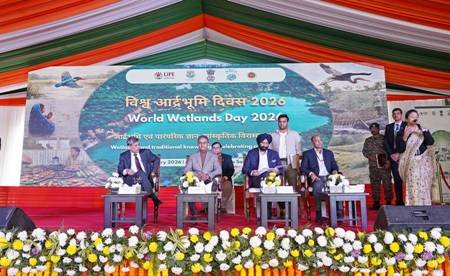
Highlighting India’s conservation efforts, Shri Yadav noted that under the environmentally conscious leadership of Prime Minister Narendra Modi, India’s network of Ramsar Sites has expanded significantly—from 26 sites in 2014 to 98 sites in 2026, making India the country with the highest number of Ramsar wetlands in Asia.
Community-Centric Conservation Approach
To commemorate the occasion, the Ministry of Environment, Forest and Climate Change organised a national-level event at Asola Bhatti Wildlife Sanctuary, New Delhi. Addressing the gathering, Union Minister of State for Environment, Forest and Climate Change Shri Kirti Vardhan Singh said wetlands are deeply embedded in people’s social and cultural lives, serving as spaces for festivals, traditions and everyday community interactions.
He stressed that environmental protection cannot rely solely on regulations and policies, and must evolve into a people’s movement, especially with the active participation of younger generations. Shri Singh also highlighted the ecological and cultural importance of Parvati Arga Bird Sanctuary in Gonda, Uttar Pradesh—one of India’s Ramsar Sites supporting native and migratory bird species.
Urban Challenges and Restoration Targets
Delhi Environment Minister Sardar Manjinder Singh Sirsa drew attention to the growing threats faced by wetlands due to rapid urbanisation, encroachments and human activities. He announced that the Delhi government has set a two-year target to restore the capital’s water bodies.
Echoing the importance of public participation, Secretary (Environment) Shri Tanmay Kumar said community involvement is indispensable for environmental protection. He noted that the increasing number of Ramsar sites reflects rising public awareness and the success of community-driven conservation initiatives such as Wetland Mitras.
Cultural Heritage and National Initiatives
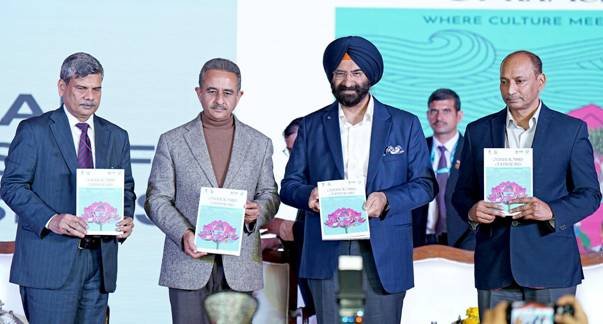
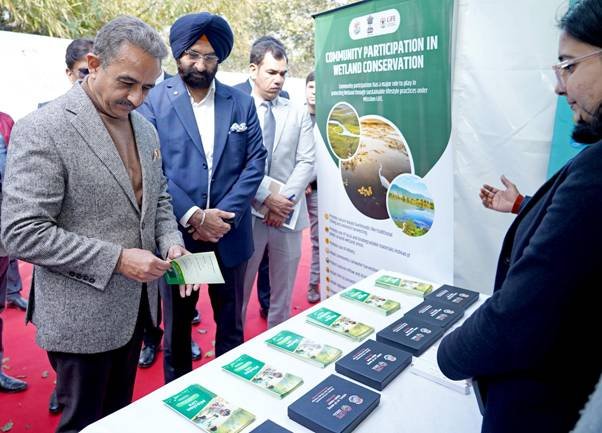
During the event, the Ministry released a publication titled “Cultural Wonders of Ramsar Sites”, documenting the lesser-known cultural and intangible heritage associated with wetlands across India. An exhibition showcasing institutions and organisations working in wetland conservation and biodiversity was also inaugurated.
Awards under Swachhata Pakhwada 2025 were presented to the National Museum of Natural History (New Delhi), Botanical Survey of India (Kolkata), and Zoological Survey of India (Kolkata) for exemplary cleanliness initiatives. The programme concluded with a plantation drive under the ‘Ek Ped Maa Ke Naam’ campaign, reinforcing the message of environmental responsibility. Wetlands nurture not just Ecosy…
World Wetlands Day is observed annually on 2 February, marking the adoption of the Ramsar Convention on Wetlands in 1971. India became a signatory in 1982 and continues to play a leading role in global wetland conservation.
Also Read: Le Corbusier’s Capitol Complex Faces New Test as High Court Expansion Plan Advances