

Kolkata | The Calcutta High Court has expressed serious concern over the state government’s inability to remove 505 unauthorised constructions within the East Kolkata Wetlands (EKW). The court has now directed that the Union government be impleaded in the matter, observing that deployment of paramilitary forces may be necessary to enforce demolition and safeguard the notified wetland area.
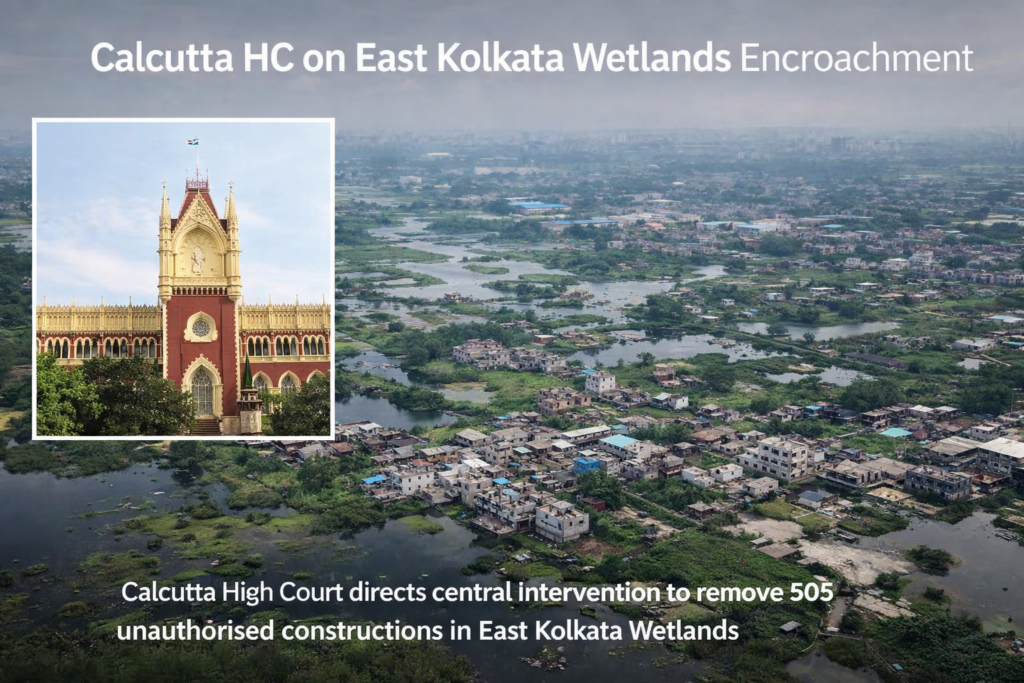
The order was passed by Justice Amrita Sinha, who sharply criticised the lack of on-ground action despite repeated reports submitted by the East Kolkata Wetlands Management Authority (EKWMA). The court noted that although violations had been identified, effective enforcement measures had not followed. The authority reportedly cited inadequate infrastructure and an inability to handle potential mass agitation during disconnection of electricity or demolition drives.
Justice Sinha observed that the failure was two-fold — first, in preventing illegal constructions from coming up, and second, in dismantling them after detection. She remarked that the state machinery lacks the operational capacity to execute demolition, prompting the court to consider assistance from central agencies.
The petitioners have been directed to implead the Union government along with key ministries, including environment, housing and urban development, and home affairs. The court also took note that a constitutional bench of the Supreme Court of India has sought clarification on how encroachments on the wetlands are being addressed.
During the hearing, the court expressed dissatisfaction over what it described as “piling up of reports” without tangible field-level action. It stated that further paperwork would not substitute enforcement and emphasised the need for visible compliance on the ground.
Counsel for EKWMA submitted that public notices had been issued in newspapers cautioning against construction within the wetland area. It was further stated that illegal boundary walls and constructions are being dismantled where feasible. However, the authority pointed out coordination gaps, noting that a joint inspection with the Kolkata Municipal Corporation (KMC) could not proceed due to the absence of KMC representatives. Additionally, several demolition notices have become subject to litigation and are currently pending before the High Court.
Responding to allegations of inaction, Kolkata Mayor Firhad Hakim stated that the municipal corporation has not remained passive. He claimed that many encroachments date back to earlier administrations and asserted that recent efforts include demolition of illegal walls constructed within wetland zones.
The East Kolkata Wetlands, a Ramsar-recognised ecological zone, serve as a critical urban ecological infrastructure supporting wastewater recycling, fisheries, flood buffering, and biodiversity. The High Court’s strong observations underline the growing judicial scrutiny over environmental governance and enforcement mechanisms in rapidly urbanising metropolitan regions.
Also Read: NBCC Recruitment 2026: 58 Vacancies for Engineers, Architects & Managers | Apply by 5 April