

Union Minister for Environment, Forest and Climate Change Bhupender Yadav on Wednesday inaugurated the National Conference on Eco-restoration of the Aravalli Landscape: Strengthening the Aravalli Green Wall in New Delhi. The conference brought together policymakers, forest officials, experts, practitioners and civil society representatives to deliberate on the ecological significance of the Aravalli range and strategies for its large-scale restoration.
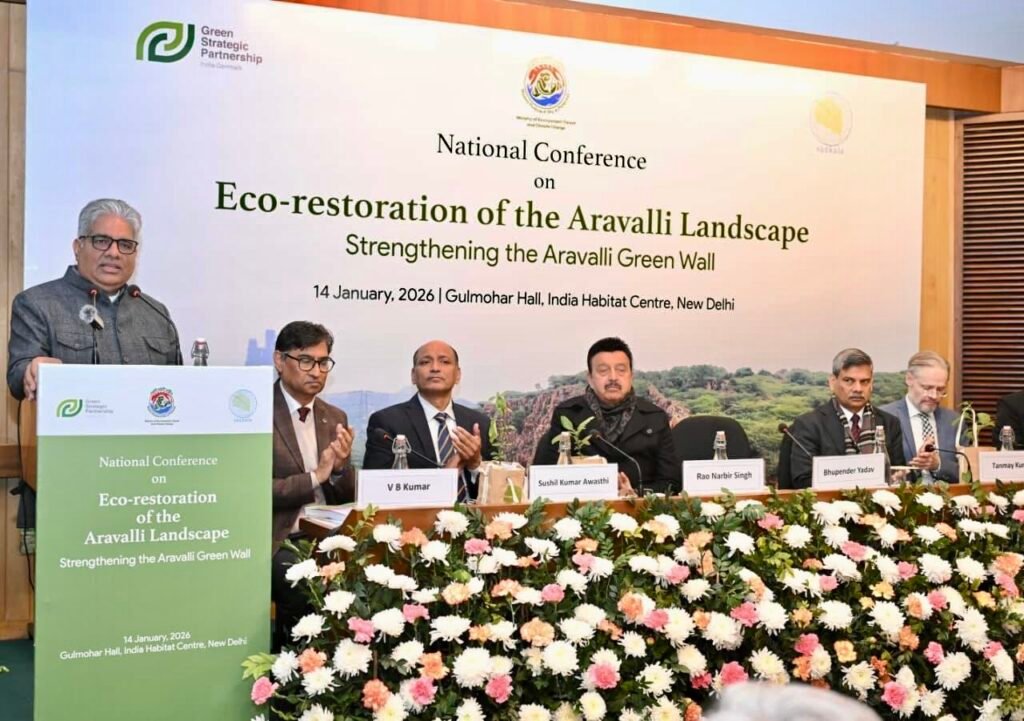
During the inaugural session, the minister released a report titled “Eco-restoration of the Aravalli Landscape”, prepared by the Sankala Foundation. Addressing the gathering, Shri Yadav said the Aravalli Green Wall Project was launched as part of the Prime Minister’s vision and India’s commitment under the UN Convention to Combat Desertification to restore 26 million hectares of degraded land. Under the initiative, 6.45 million hectares of degraded land in the Aravalli region have been identified, with greening work initiated over 2.7 million hectares across Gujarat, Delhi, Haryana and Rajasthan.
Highlighting a major conservation decision, the minister noted that about 97 square kilometres of degraded Aravalli revenue land in Haryana, stretching from Naurangpur to Nuh, has been identified for afforestation and declared a Protected Forest. He described this as one of the most significant policy interventions for Aravalli conservation since Independence.
Emphasising the ecological and historical importance of the region, Shri Yadav said the Aravallis are India’s oldest mountain range and have supported human civilisation for thousands of years. He added that the ecosystem is safeguarded by multiple protected areas and tiger reserves, while restoration efforts continue in other vulnerable stretches. The minister reiterated that India is pursuing a balanced development approach that places ecological stability at the centre of economic growth and reaffirmed the government’s long-term commitment to conserving the Aravalli landscape and similar ecosystems nationwide.
Senior officials from the Ministry of Environment, Forest and Climate Change, representatives of state governments, international partners and the Sankala Foundation also addressed the inaugural session. The report released at the conference outlines a scientific, community-driven and scalable framework to strengthen the Aravalli Green Wall Project, stressing that restoration must be landscape-scale, data-driven and multidisciplinary to address the extent of degradation in the region.
Also Read: Aravallis at the Crossroads: Law, Landscape and the Responsibility of Choice