

The Department of Transport Planning at the School of Planning and Architecture (SPA) Bhopal) has launched a National-Level Student Competition inviting Planning, Architecture, Engineering, Geography, Economics, and Sociology students to develop innovative solutions for managing the massive crowds expected during Simhastha 2028 in Ujjain.
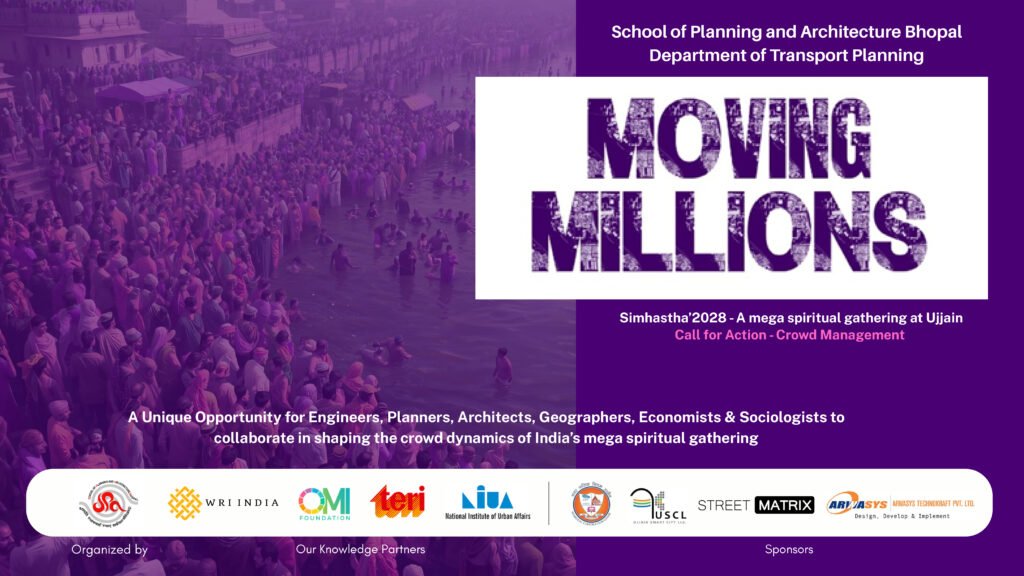
Simhastha—Ujjain’s version of the Kumbh Mela—is one of the world’s largest spiritual gatherings, and the next edition in 2028 is anticipated to attract 300 million pilgrims, nearly triple the footfall recorded in 2016. The challenge becomes even more critical for Ujjain due to its historic core, narrow streets, limited road capacity, and stressed urban infrastructure.
Focus on Two High-Pressure Zones
Participants are required to choose one of two critical study areas:
1. Ramghat along the Kshipra River
The most intense crowding occurs here during holy dips. The ghat routinely experiences:
- Extremely high pedestrian densities
- Risks of overcrowding or stampedes
- Stress on sanitation and emergency access
- Narrow, congested approach routes
2. Ujjain Junction Railway Station & Transit Nodes
As the primary gateway for lakhs of arriving pilgrims, the area witnesses heavy convergence of pedestrians, buses, autos, and IPT modes. Lack of synchronized arrivals, staging areas, and real-time flow management often trigger congestion and safety risks.
What Participants Must Deliver
Students are expected to provide data-backed, actionable proposals. Each submission must include:
- Crowd hotspot mapping & risk projections
- Entry–exit route strategies
- Emergency corridors for medical/fire scenarios
- Pedestrian cross-sections & capacity planning
- Signage, wayfinding & barrier placement plans
- Universal accessibility solutions
- Timing plans for baths or transit dispersal
Teams working on the transit nodes must additionally assess:
- Required fleet size for buses, autos, and IPT
- Peak-hour vehicle turnaround patterns
- Parking and holding area strategies
Why This Competition Matters
Crowd dynamics during mega-gatherings often shift rapidly, especially under stress. The document highlights the importance of understanding crowd turbulence, density thresholds (5 persons/m²), stop–go waves, and risk escalation—critical insights needed to prevent tragedies during high-density events.
The competition encourages students to use established frameworks like DIM-ICE (Design, Information, Management – Ingress, Circulation, Egress) for robust planning.
Who Can Participate
Open to:
- B.Arch, B.Plan, B.Tech (Civil)
- Sc Geography, MA Economics, MA Sociology
Teams of 5, with incentives for multidisciplinary combinations.
Important Dates
- Registrations Open: 26 Nov 2025
- Individual Registration Ends: 8 Dec 2025
- Proposal Submission: 10–15 Jan 2026
- Shortlisted Teams Announced: 20 Jan 2026
- Final Presentation: 30 Jan 2026
Submission Format
Each team must submit:
- 25-slide presentation (.pptx/.pdf)
- Summary document (.pdf/.doc)
- 120-second Instagram reel showcasing their concept
Judging Parameters
Submissions will be evaluated on:
- Innovation (20%)
- Effectiveness (20%)
- Viability & future adaptability (25%)
- Clarity of visuals and presentation (25%)
- Verbal presentation (10%)
Registration & Contact
For registration Link: https://docs.google.com/forms/d/e/1FAIpQLSdkoBkVlvkcS8CgMj_oFODwpuJlacpa3SSPvFhfgqJTL_WH0Q/viewform
For queries: events.tp@spabhopal.ac.in
Also Read: COA-TRC Announces 5-Day Online FDP on Designing Resilience for Built Environments