

India is set to undertake its first-ever fully digital population census, with the Government announcing that Census 2027 will begin its initial phase from April 1, 2026. The announcement was made during a press conference addressed by the Registrar General and Census Commissioner of India, Shri Mritunjay Kumar Narayan.
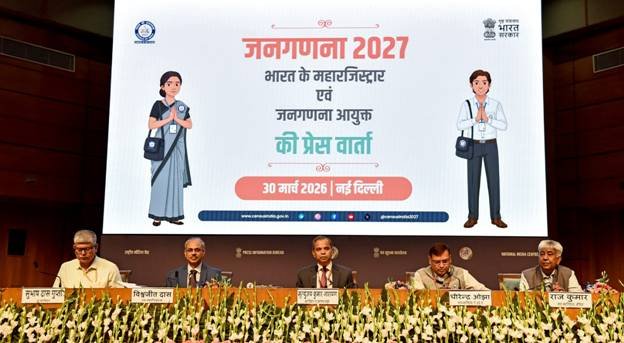
The upcoming census, the 16th in India’s history and 8th since independence, will be conducted in two phases and is being described as the world’s largest administrative and statistical exercise.
A key highlight of this edition is the introduction of digital data collection and self-enumeration, marking a significant technological shift from traditional methods. Citizens will, for the first time, be able to submit their details online through a secure web portal before the official door-to-door survey. The self-enumeration window will initially be open from April 1 to April 15, 2026 in select states and Union Territories.
Following this, the House Listing and Housing Census (Phase I) will be conducted between April and September 2026, depending on state-specific schedules. This phase will gather data on housing conditions, amenities, and household assets.
The second phase—Population Enumeration (Phase II)—is scheduled for February 2027, where detailed information related to demographics, socio-economic status, education, migration, and fertility will be collected. Notably, the government has also confirmed that caste enumeration will be included in this phase.
To facilitate this massive operation, the government has approved an outlay of ₹11,718.24 crore, covering training, digital infrastructure, and logistics. Over 3 million enumerators and supervisors will be deployed nationwide, using mobile applications on smartphones to collect and upload data in real time.
The census will be conducted across 36 States and Union Territories, covering more than 6.39 lakh villages and thousands of urban settlements. Extensive training programs have already been initiated, involving a multi-tier system of national trainers, master trainers, and field-level personnel to ensure data accuracy and efficiency.
Importantly, the government has emphasized that robust data security measures have been incorporated into the system. The self-enumeration process will generate a unique ID, which respondents must share with enumerators during verification visits.
With its digital-first approach, large-scale workforce deployment, and expanded data scope, Census 2027 is poised to redefine how demographic data is collected and utilized in India, offering critical insights for future urban planning, policy formulation, and infrastructure development.
Also Read: Samrat Samprati Museum Gandhinagar Inauguration PM Modi