

Innovative waste management model under Swachh Bharat Mission 2.0 transforms textile waste into livelihoods and sustainable products
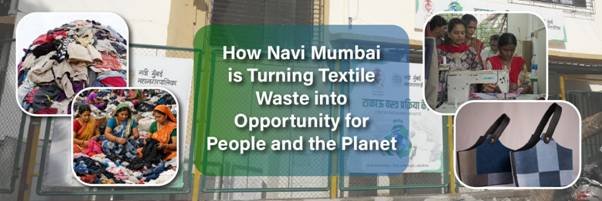
Navi Mumbai has emerged as a national frontrunner in textile waste management with the establishment of India’s first Municipal Textile Recovery Facility (TRF) in Belapur. Developed under the Swachh Bharat Mission–Urban 2.0, the initiative demonstrates how circular economy principles can be effectively integrated into municipal waste systems.
India generates approximately 7.8 million metric tonnes of post-consumer textile waste annually, making textiles a major yet often neglected component of urban waste streams. Addressing this challenge, the Navi Mumbai Municipal Corporation (NMMC) has introduced a structured system for textile recovery, reuse, and recycling, turning waste into a resource while generating employment opportunities.
The TRF operates as a comprehensive ecosystem rather than a standalone facility. It begins with decentralised collection through strategically placed textile bins across residential societies in all eight municipal wards. Currently, over 140 bins have been installed, with plans to expand to 250, ensuring wider citizen participation and accessibility.
At the facility, collected textiles undergo scientific sorting and traceability processes. Using advanced tools such as handheld fibre scanners, materials are classified into reusable, recyclable, upcyclable, downcyclable, and reject categories. This data-driven approach ensures efficient material recovery and reduces landfill dependency.
A key highlight of the initiative is its strong social impact. The facility actively involves women from self-help groups (SHGs), who are trained in textile sorting, repair, and upcycling techniques. More than 300 women have undergone skill development training, with over 150 currently earning between ₹9,000 and ₹15,000 per month through activities such as stitching and product transformation.
Recovered textiles are transformed into value-added products including bags, garments, mats, and home décor items. These products are showcased at exhibitions, creating market linkages while promoting sustainable consumption practices.
The initiative has already achieved measurable outcomes. Approximately 30 metric tonnes of textile waste have been collected, with over 25.5 metric tonnes scientifically processed. More than 41,000 items have been handled at an average rate of 500 items per day. Additionally, the program has reached over 1.14 lakh households through awareness campaigns and conducted more than 75 IEC (Information, Education, Communication) workshops.
Despite initial challenges such as public resistance to bin placement and complexities in sorting mixed fibres, the project has successfully scaled through community engagement, phased implementation, and technological integration.
Looking ahead, NMMC plans to establish a permanent, higher-capacity Textile Recovery Facility in Koparkhairane, further strengthening the city’s waste management infrastructure.
The Navi Mumbai model highlights how urban local bodies can transform waste streams into economic and environmental assets. By aligning with national missions and Sustainable Development Goal 12 (Responsible Consumption and Production), the initiative offers a scalable blueprint for cities across India.
Also Read: CRSPL and IIT Roorkee Sign MoU to Advance Ropeway Technology for Urban Mobility