

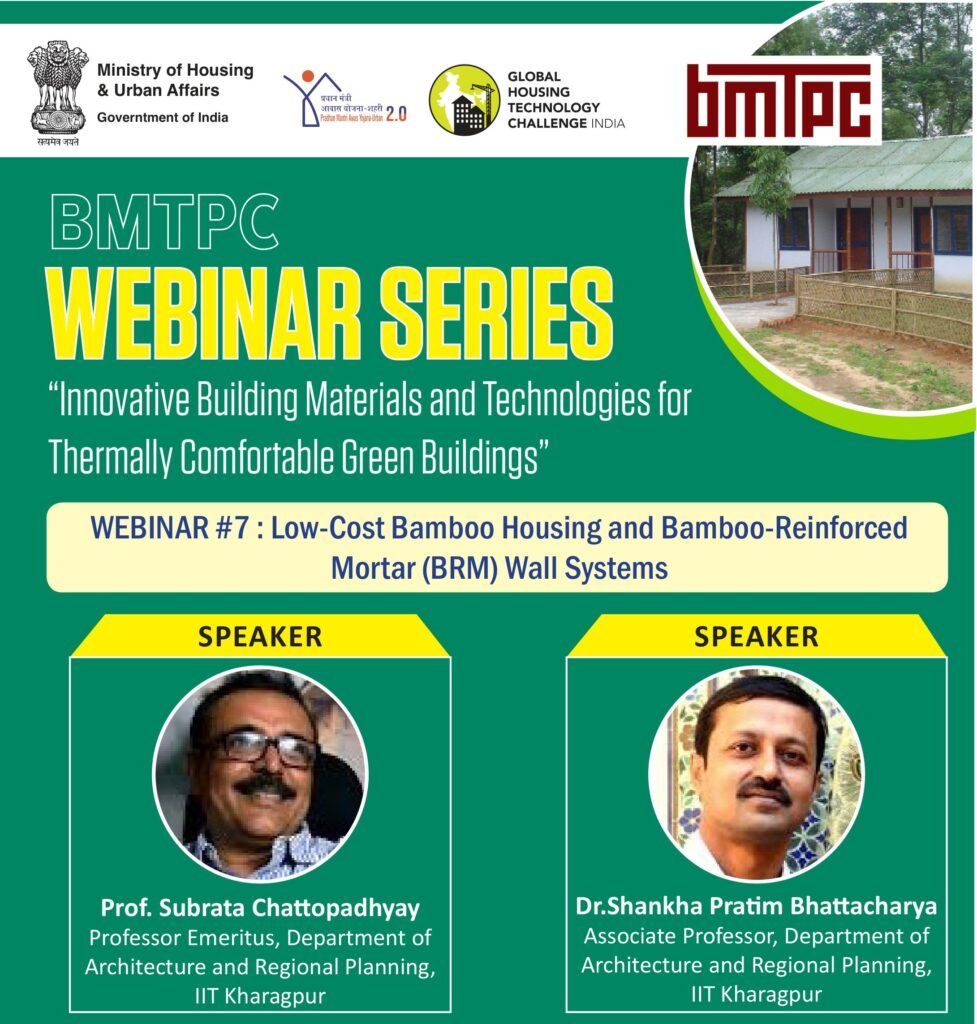
India’s push towards affordable, climate-responsive housing is witnessing renewed momentum through bamboo-based construction technologies. A recent technical webinar organised by the Building Materials and Technology Promotion Council (BMTPC) showcased a comprehensive bamboo housing prototype developed by researchers from Indian Institute of Technology Kharagpur, demonstrating its structural, thermal, and economic viability.
National Context: Bamboo as a Strategic Green Material
The initiative aligns with the objectives of the National Bamboo Mission, which aims to develop a complete bamboo value chain—from cultivation to high-value applications—while generating rural livelihoods and reducing construction-related carbon emissions. Bamboo, a rapidly renewable grass species, offers significant advantages: low embodied energy, high tensile strength, carbon sequestration capacity, and excellent thermal insulation properties. Lifecycle assessments presented during the webinar indicated that bamboo-based buildings can reduce carbon emissions by over 20 percent compared to conventional brick-and-RCC structures.
From Vernacular Practice to Engineered System
Led by Prof. Subrata Chattopadhyay and Dr. Sankha Pratim Bhattacharya, the IIT Kharagpur team addressed long-standing challenges associated with traditional bamboo construction—namely termite infestation, moisture-induced decay, weak connections, and vulnerability to cyclonic winds. The project adopted scientifically treated bamboo using a borax–boric acid solution, eliminating starch and sugars that attract insects while remaining environmentally safe.
Prototype Development and Structural Innovation
A full-scale prototype housing unit was constructed at IIT Kharagpur’s incubation facility under the Global Housing Technology Challenge framework. The system moved beyond component-level innovation to a fully integrated building solution. Key structural features included:
- Bamboo-reinforced concrete (BRC) plinth beams with embedded mild-steel connectors to prevent bamboo–concrete interface decay
- Multi-culm bamboo columns mounted on patented steel base plates, enabling axial load transfer and ease of replacement
- Bamboo-reinforced mortar (BRM) wall panels, using shredded bamboo strips as tensile reinforcement within a thin mortar matrix
- Bolted bamboo joints with steel washers, replacing traditional nails to prevent splitting and improve reliability
Laboratory testing confirmed that bamboo strips exhibited tensile strengths ranging from 80–140 MPa, with compressive performance adequate for low-rise housing applications.
Cost-Effective Walling and Thermal Performance
Among various walling systems evaluated—brick masonry, fly-ash blocks, and bamboo composites—the BRM wall system emerged as one of the most cost-effective options at approximately ₹500 per square metre. Panels could be either precast or cast in situ, allowing flexibility for rural and peri-urban deployment.
Thermal simulations and field observations showed that bamboo buildings exhibit lower thermal mass than brick-RCC structures, resulting in reduced indoor overheating and shorter cooling durations during peak summer months. Passive design measures such as larger window openings, pivoted bamboo shutters, roof-level ventilation, and green creeper-supported roofing further enhanced indoor comfort.
Disaster Resilience and Cyclone Readiness
Given the cyclone-prone conditions of eastern India, the structure was designed following the “ABCD” resilience framework—Anchorage, Bracing, Connection, and Detailing. Wind-load and buckling tests demonstrated that bundled bamboo columns significantly improve lateral load resistance, making the system suitable for vulnerable coastal and flood-prone regions.
Implications for Affordable Housing
The research team highlighted the system’s potential for adaptation under national housing schemes such as Pradhan Mantri Awas Yojana, particularly in bamboo-rich states. With an embodied energy footprint nearly one-third that of conventional construction, the technology offers a compelling pathway towards scalable, low-carbon housing.
Way Forward
Having crossed Technology Readiness Level (TRL)-7, the bamboo housing system is now positioned for wider pilot implementation and standardisation. The researchers emphasised the need for supportive building codes, skill development, and demonstration projects to mainstream bamboo as an engineered construction material rather than a temporary or informal solution.
As India confronts the dual challenges of housing shortages and climate change, such innovations underscore how indigenous materials—when combined with rigorous engineering—can deliver resilient, affordable, and environmentally responsible built environments.
Also Read: Advancing Climate and Energy Solutions in the Built Environment: Key Takeaways from BMTPC Webinar #6