

Rising like a golden sun in the geometric calm of Auroville’s Peace Area, the Matrimandir (often spelled Matri Mandir) is both an architectural landmark and the spiritual heart of the experimental township. Conceived by Mirra Alfassa (“The Mother”) as the “Temple of the Mother,” the Matrimandir was intended not as a conventional religious building but as a place for silent concentration open to seekers of any background.
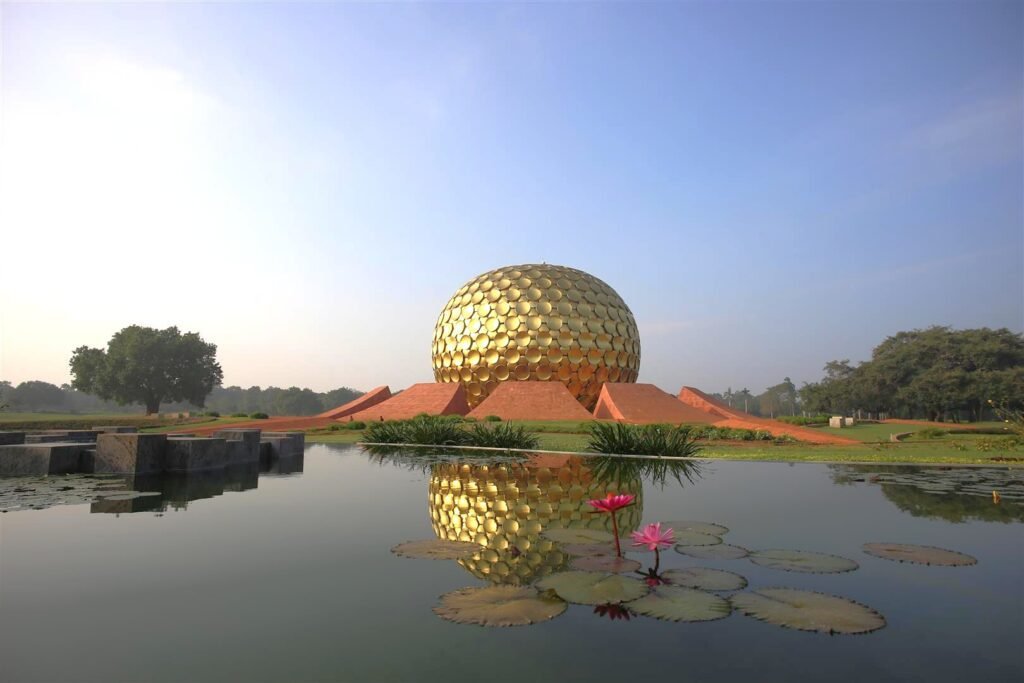
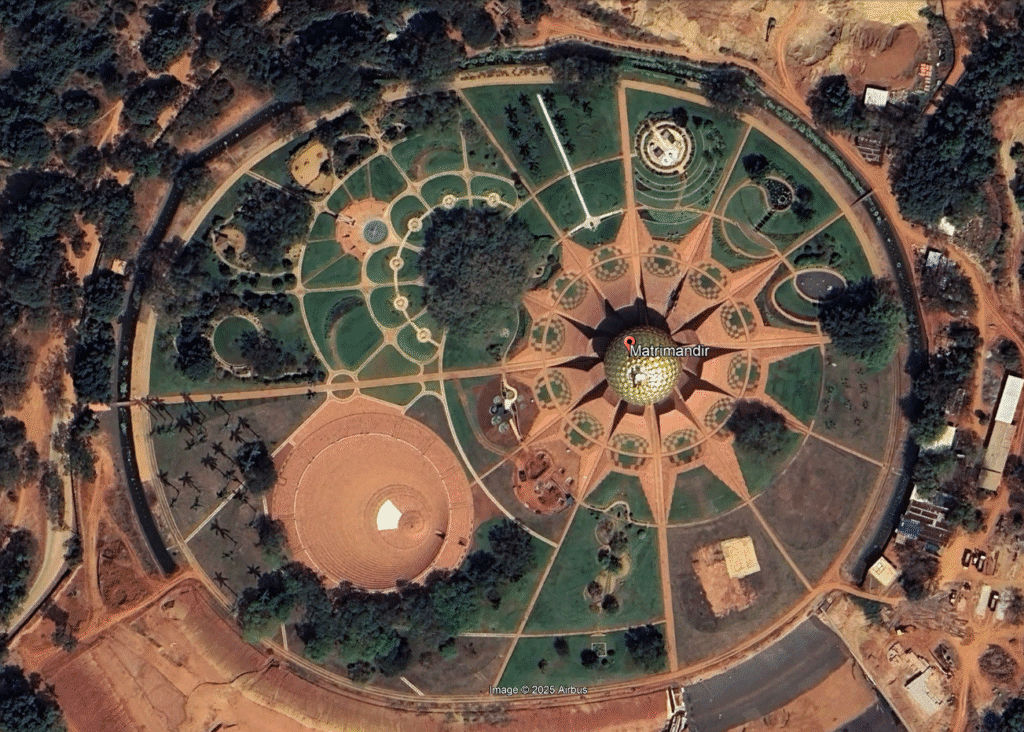
Architecturally the Matrimandir is striking for its simple yet powerful geometry: a near-perfect sphere, approximately 23.5 metres high, set within a star-like plaza of twelve petals and surrounded by twelve themed gardens. The globe’s outer shell is clad in thousands of golden discs that catch sunlight and make the structure appear to glow — a deliberate visual metaphor for the “supramental” light that the community’s founders aspired to embody. The sphere sits visually and symbolically at the centre of Auroville’s masterplan.
Beneath the golden exterior the Matrimandir conceals a carefully engineered interior. A central Inner Chamber contains what has been described as an optically perfect crystal globe suspended to receive and reflect a single, focused ray of sunlight — an element designed to aid meditation. Access ramps, concentric rings and a surrounding meditation amphitheatre form a layered composition that channels movement and attention toward the centre. The building’s complex construction spanned decades: the foundation stone was laid in 1971 and, after phased work and meticulous craftsmanship, the outer golden sphere was completed in 2008.
Beyond its technical and aesthetic achievements, Matrimandir’s importance lies in its role as a civic and symbolic anchor for Auroville. It serves as a neutral, non-sectarian focus for inner work, community gatherings and the expression of Auroville’s founding ideals — human unity, spiritual evolution and creative living. The surrounding twelve gardens, each named for a different “power,” extend the architectural idea into landscape, making the building not just an object but the centre of a designed experiential field.
In sum, the Matrimandir is a rare example of architecture where geometry, material craft and spiritual intention are fused into a single work: a luminous sphere that functions as a meditation instrument, a civic symbol and a landscape organiser for the city that surrounds it. Its decades-long construction and continued centrality to Auroville make it as important culturally as it is visually.
Also Read: The Shore Temple at Mahabalipuram: An Architectural and Historical Study