

India’s network of internationally recognised wetlands has expanded significantly, reaching 103 Ramsar Sites as of October 2026, covering more than 13.87 lakh hectares across 28 States and Union Territories. According to a Press Information Bureau (PIB) backgrounder released on 25 October 2026, the number of designated sites has increased nearly fourfold from 26 in 2014, placing India first in Asia and third globally in terms of the number of Ramsar Sites.
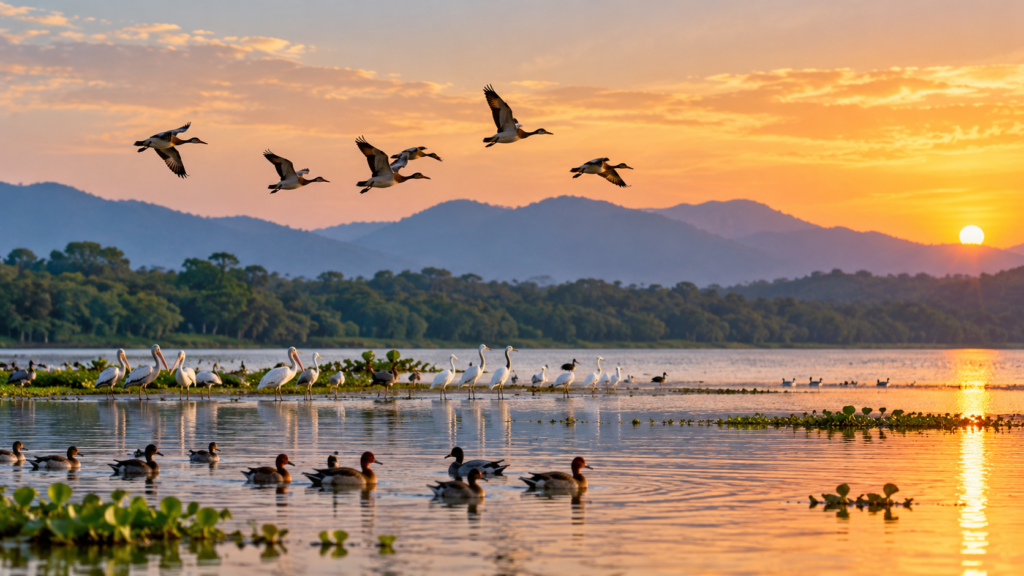
The latest additions, designated on 15 October 2026, are Sukhna Wetland in Chandigarh and Sauj Jheel in Uttar Pradesh. These sites highlight the ecological importance of diverse wetland landscapes, ranging from urban reservoirs to floodplain lakes that support migratory birds and other wildlife.
New Additions Highlight Wetland Diversity
Sukhna Wetland, a human-made reservoir created in 1958 at the foothills of the Shivalik hills, provides habitat for threatened species, including Pallas’s fish eagle, the common pochard and the black pond turtle. It also serves as a feeding and wintering ground for migratory birds along the Central Asian Flyway.
Sauj Jheel, located in Mainpuri district of Uttar Pradesh, is a shallow floodplain lake that regularly hosts more than 30,000 waterbirds. Its nesting and foraging habitats support threatened bird species such as the sarus crane and the greater spotted eagle. Beds of sacred lotus and wild sugarcane provide cover for birds, fish and amphibians.
Tamil Nadu has the highest number of Ramsar Sites in India, with 20, followed by Uttar Pradesh with 14. In 2025 alone, 11 wetlands were added to the list, taking the national total to 96. Surha Tal in Uttar Pradesh became the 100th Ramsar Site in June 2026, followed by Glaw Lake in August.
Wetlands: Essential Infrastructure for Ecological Security
Wetlands perform critical ecological and socio-economic functions. They store freshwater, recharge groundwater, reduce flood impacts and sustain fisheries and agriculture. They also provide habitats for resident and migratory birds, fish, amphibians and other wildlife.
India’s Ramsar network encompasses a wide variety of ecosystems, including high-altitude lakes, river floodplains, mangroves, coral reefs, village tanks and urban marshes. Their importance extends beyond biodiversity conservation to water security, disaster-risk reduction, climate resilience and local livelihoods.
The Sundarban Wetland in West Bengal is India’s largest Ramsar Site, covering approximately 4,23,000 hectares. Its mangrove ecosystem helps protect coastal areas from storms, cyclones, tidal surges and saltwater intrusion while supporting fisheries and wildlife, including the Royal Bengal tiger.
Other wetlands demonstrate the relationship between conservation and livelihoods. The East Kolkata Wetlands support wastewater-fed fisheries and agriculture, while Chilika Lake in Odisha provides habitat for waterbirds and the Irrawaddy dolphin and supports a diverse fish population.
Conservation Framework and Government Initiatives
India’s wetland conservation efforts are supported by the Wetlands (Conservation and Management) Rules, 2017, notified under the Environment (Protection) Act, 1986. The rules establish a regulatory framework for wetland protection and provide for State and Union Territory Wetlands Authorities. They also prohibit activities such as encroachment, waste dumping and the discharge of untreated effluents.
The National Plan for Conservation of Aquatic Ecosystems (NPCA) provides an integrated framework for the conservation and management of lakes and wetlands. The Amrit Dharohar initiative promotes the conservation values of Ramsar Sites through habitat and species protection, nature-based tourism, livelihood development and wetland carbon assessment.
Mission Sahbhagita encourages community participation in wetland conservation, while the Save Wetlands Campaign has mobilised citizen volunteers to help map wetlands. The Mangrove Initiative for Shoreline Habitats and Tangible Incomes (MISHTI) supports mangrove restoration across coastal States and Union Territories.
India has also made progress in promoting sustainable urban wetland management. Indore and Udaipur became the country’s first Ramsar-accredited Wetland Cities in January 2025, joining an international network that recognises cities committed to conserving their wetland ecosystems.
From International Recognition to Effective Management
Ramsar designation recognises a wetland’s international ecological importance, but it also brings long-term responsibilities. States and Union Territories are expected to maintain the ecological character of designated sites through appropriate management, monitoring and planning. The Ramsar Information Sheet must be updated every six years, and ecological conditions must be monitored regularly.
As India’s Ramsar network grows, the priority is to translate international recognition into measurable conservation outcomes. Scientific monitoring, integrated management plans, stronger coordination among government agencies and active participation by local communities will be essential to address pressures such as encroachment, pollution and habitat degradation.
Integrating wetland conservation into urban and regional planning is equally important. Protecting floodplains, maintaining natural drainage systems and safeguarding urban marshes can strengthen climate resilience while supporting biodiversity and water security.
India’s expanding Ramsar network represents a significant step in recognising wetlands as vital ecological assets. Sustained conservation and responsible development will determine whether these ecosystems continue to support wildlife, communities and resilient landscapes for future generations.
Also Read: India’s Ramsar Site Count Reaches 103 with Addition of Sukhna Wetland and Sauj Jheel
Join our WhatsApp Channel for fastest updates: Join now