

India’s flagship Regional Connectivity Scheme, UDAN (Ude Desh ka Aam Nagrik), marks a decade of operations in 2026, transitioning from a bold policy experiment into the backbone of India’s domestic aviation growth. Launched on 21 October 2016 under the National Civil Aviation Policy, the scheme was designed to make regional flying affordable, viable, and accessible to underserved corners of the country. Over the past ten years, India has emerged as the world’s third-largest domestic aviation market, expanding its operational airport network from 74 in 2014 to 166 today.
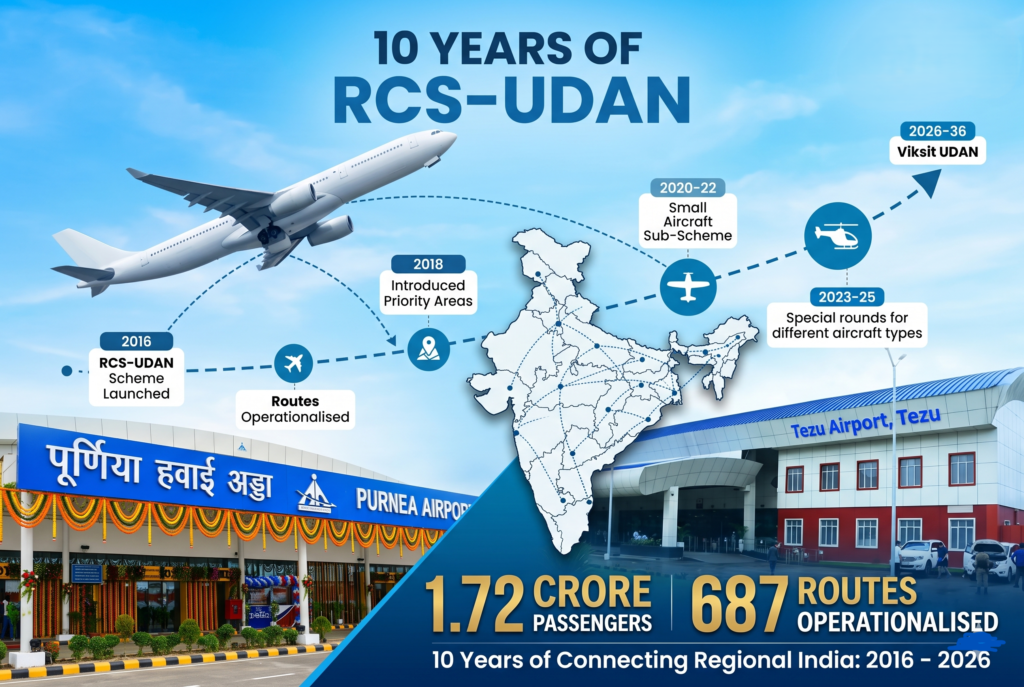
Since the inaugural flight between Shimla and Delhi took off in April 2017, the programme has delivered substantial operational milestones. The scheme has successfully operationalised 687 regional routes and activated 95 aerodromes, including 17 heliports and two water aerodromes. Over 3.68 lakh flights have been operated, ferrying more than 1.72 crore passengers across the country. To ensure these routes remain sustainable, ₹5,091.23 crore in Viability Gap Funding (VGF) has been disbursed to airlines as of 15 October 2026. This expansion has also driven significant employment, with civil aviation sectoral jobs growing from approximately 3 million in 2014 to nearly 7.7 million in 2026, and projections estimating 25 million jobs by 2040. Furthermore, in the challenging terrain of the North-Eastern States, 90 priority routes have been operationalised across 12 newly developed aerodromes.
The operationalisation of regional airstrips has driven measurable economic, healthcare, and tourism outcomes across Tier-2 and Tier-3 hubs. Purnea Airport, operationalised in 2025 with Bihar’s longest runway capable of handling A320 and B737 aircraft, now serves over 10 districts. It has reduced arduous road travel to Kolkata from 10 hours down to roughly a 2-hour flight, providing critical air links for local trade in makhana, litchi, and vegetables. Tezu Airport in Arunachal Pradesh, opened in 2021, cut the 10-hour overland journey to Guwahati to a 1-hour flight, opening direct air cargo channels for ginger, cardamom, and rice. In Jharkhand, Deoghar Airport reduced travel time from Delhi from 15 hours to just 2 hours after opening in July 2022. It now handles over 10 lakh pilgrims annually visiting Baba Baidyanath Dham and has spurred the growth of over 30 new hotels. Similarly, Rajasthan’s Kishangarh Airport, operational since 2017, enabled international marble exports to Italy, the UAE, and the USA, established a Flying Training Organisation, and triggered a 40–50% rise in local real estate values.
To build on this foundation, the Government rolled out the next phase, known as Modified UDAN or Viksit UDAN, to be implemented from FY 2026–27 to FY 2035–36 with a total outlay of ₹28,840 crore. This blueprint focuses on operational sustainability, allocating ₹12,159 crore to develop 100 new airports from existing unserved airstrips. It also earmarks ₹2,577 crore to provide three years of Operation and Maintenance (O&M) support across approximately 441 aerodromes, and ₹3,661 crore to construct 200 modern helipads. Airlines will receive continued support through a ₹10,043 crore VGF allocation over ten years, while ₹400 crore is dedicated to procuring HAL Dhruv helicopters and HAL Dornier aircraft under the Atmanirbhar Bharat initiative. To facilitate this localized infrastructure creation, States and Union Territories will nominate unserved airstrips and helipads via a dedicated Challenge Mode portal, supported by 21 MoUs signed between the Centre, participating States/UTs, and the Airports Authority of India.
Also Read: NHAI Introduces Independent Design Checks for Major Bridges and Critical National Highway Structures
Join our WhatsApp Channel for fastest updates: Join now