

New Delhi: Union Minister for Environment, Forest and Climate Change Bhupender Yadav interacted with start-ups and innovation companies to explore affordable, scalable and technology-driven solutions to tackle air pollution in Delhi-NCR. The initiative aims to translate emerging technologies into practical interventions that can deliver measurable results on the ground.
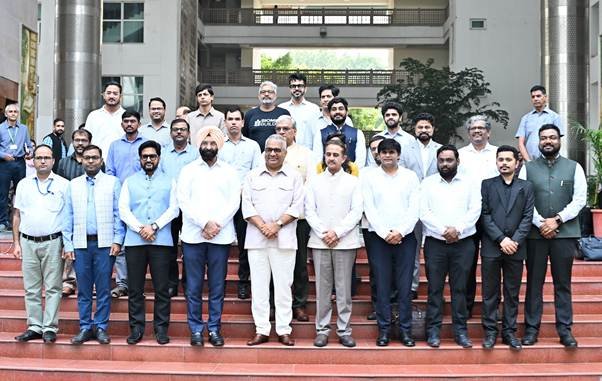
The interaction was organised as part of stakeholder engagement initiatives under the campaign ‘Saaf Hawa mein Hissedaari, Hum Sabhi ki hai Zimmedaari’. Union Minister of State for Environment, Forest and Climate Change Kirti Vardhan Singh and Delhi’s Minister for Environment, Forest and Wildlife Manjinder Singh Sirsa also attended the meeting, along with senior officials from various central and Delhi government departments and environmental agencies.
During the meeting, Yadav presented specific problem statements across nine key areas of air pollution management, encouraging innovators to develop solutions that could be deployed and scaled up across the region. The discussions focused on complementing existing measures, including the Graded Response Action Plan (GRAP), cleaner fuels, electric mobility and air-quality monitoring, with technology-enabled interventions at pollution sources.
AI, Sensors and Real-Time Monitoring in Focus
The proposed solutions covered the entire air-pollution management chain, from detection and monitoring to forecasting, enforcement and mitigation. These included tamper-proof systems for Online Continuous Emission Monitoring Systems (OCEMS), Air Pollution Control Devices (APCDs) and Pollution Under Control (PUC) testing; AI-enabled detection of industrial emission violations; and real-time monitoring of combustion efficiency and diesel generator emission-control systems.
Technologies for detecting and controlling dust at construction and demolition sites were also discussed, alongside low-cost mechanised road sweeping, road-dust resuspension monitoring, portable pothole repair and modular dust-containment systems.
The Minister emphasised the importance of integrating OCEMS data with industrial plant-operation data to identify potential malpractices. He also highlighted the role of artificial intelligence in strengthening enforcement, improving transparency and supporting more consistent policy implementation.
Other proposals included hyperlocal air-quality monitoring, city-wide pollution mapping, hotspot identification, pollution forecasting, AI-based source apportionment and predictive traffic-congestion management. Satellite, drone-based and remote-sensing technologies were presented as tools for identifying pollution sources and enabling timely interventions.
Focus on Crop Residue and Construction Waste
The meeting also addressed the management of crop residue, municipal solid waste and construction and demolition waste. Start-ups showcased systems for detecting stubble and open biomass burning, identifying vehicles without valid PUC certificates, and detecting over-aged vehicles to support enforcement.
Yadav stressed the need for environment-friendly solutions for the scientific management of agricultural residue and waste. He highlighted the importance of guidelines for paddy-straw storage, involving the Ministry of Agriculture and Farmers Welfare, the Commission for Air Quality Management (CAQM) and the Central Pollution Control Board (CPCB), along with the development of an in-situ crop-residue storage model.
Proposals also included connecting recycled construction and demolition waste products with demand from the construction sector, improving municipal waste management, and creating integrated systems for collecting, transporting and utilising paddy straw. Potential applications included bioenergy, biomass fuel, composting, environmentally friendly packaging and biochar-based products.
Call for Scalable and Economically Viable Solutions
The participating innovators demonstrated capabilities in artificial intelligence, machine learning, Internet of Things-based environmental monitoring, pollution analytics, advanced sensors and drone-based aerial mapping.
Yadav encouraged start-ups to align their technologies with clearly identified field-level requirements and explore implementation mechanisms that would allow successful solutions to be scaled across Delhi-NCR. He also underscored the need for faster and more efficient road maintenance as a measure to control road dust.
The engagement marks an effort to strengthen collaboration between government agencies, technology innovators and field-level implementing bodies through a Jan Bhagidari approach. The broader objective is to move beyond isolated technological interventions towards integrated, affordable and practical solutions for the region’s persistent air-pollution challenge.
Join our WhatsApp Channel for fastest updates: Join now