New Delhi: The Delhi Development Authority (DDA) has highlighted a series of initiatives under the Master Plan Delhi 2047 (MPD 2047) aimed at transforming the capital into a more liveable, inclusive, sustainable and economically dynamic city. Through a series of recent public communications, the DDA has outlined its focus on redevelopment of ageing neighbourhoods, revitalisation of economic spaces, land pooling, transit-oriented development, affordable housing, green mobility and conservation of Delhi’s heritage.
The proposed planning framework seeks to align urban development with the long-term vision of a future-ready Delhi, with greater emphasis on integrated infrastructure, improved connectivity, housing opportunities and efficient utilisation of urban land.
Redevelopment of ageing neighbourhoods
One of the key themes highlighted by the DDA is the redevelopment of ageing residential and commercial areas. The plan proposes reducing the minimum plot size for residential redevelopment to 3,000 sq m and for commercial redevelopment to 1,000 sq m.
The DDA has also highlighted provisions for amalgamation and reconstitution of plots, intended to facilitate comprehensive redevelopment rather than fragmented construction. Redevelopment projects can receive an incentive of up to 50% additional floor space, according to the DDA’s communication.
The objective is to enable better infrastructure, improved amenities and more liveable neighbourhoods while making more efficient use of existing urban land.
Revitalising Delhi’s economic spaces
MPD 2047 also places emphasis on strengthening Delhi’s economic areas. The DDA has proposed the redevelopment of commercial centres, vibrant mixed-use development and the possibility of group housing within commercial centres.
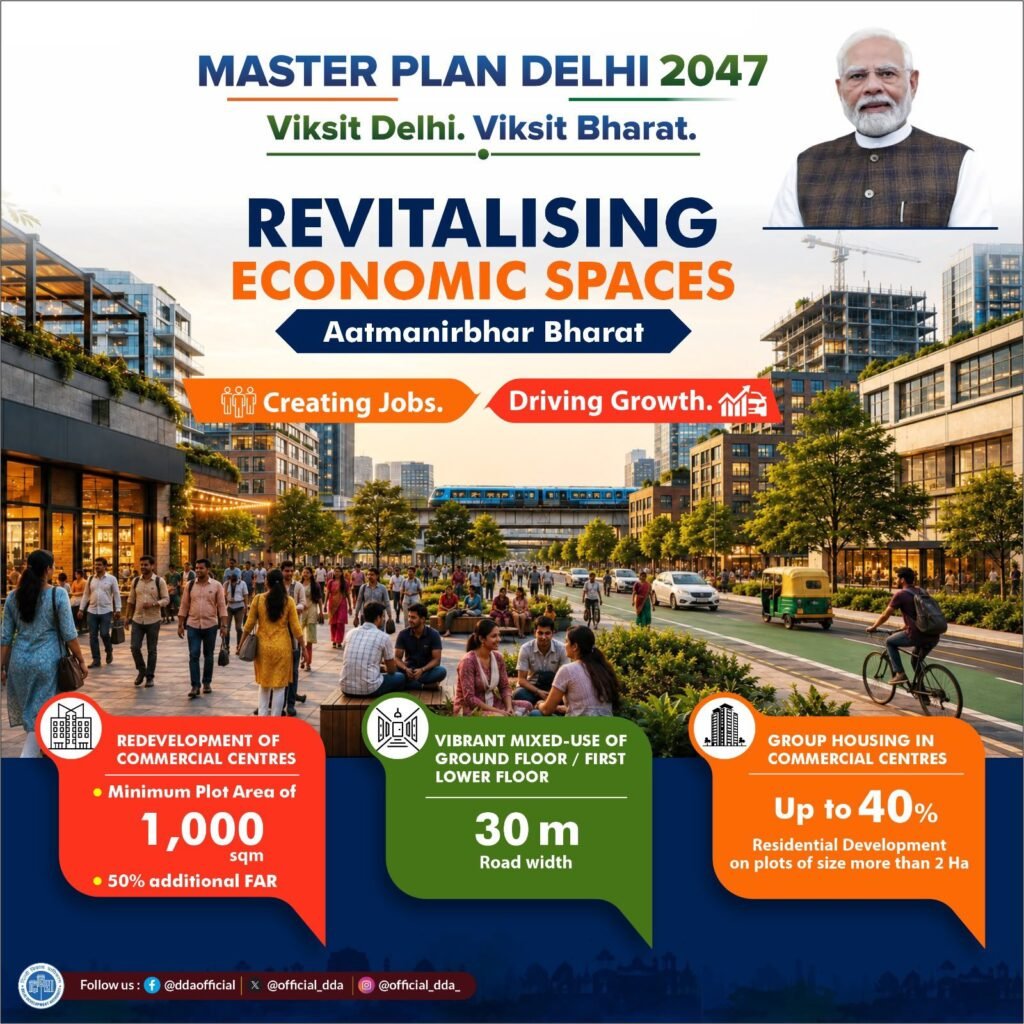
For redevelopment of commercial centres, the DDA has highlighted a minimum plot area of 1,000 sq m and 50% additional FAR. Mixed-use development of the ground floor or first floor is proposed subject to a 30-metre road width, while residential development in commercial centres could be permitted up to 40% on plots larger than 2 hectares.
According to the DDA, these measures are intended to create more competitive economic spaces, generate employment and support a stronger urban economy.
Land pooling to support planned expansion
The Land Pooling Policy is another major component highlighted by the DDA. The authority has stated that land pooling under MPD 2047 could facilitate planned development across nearly 200 sq km, with potential for approximately 12 lakh new dwelling units and around 600 km of additional road network.
The proposed model integrates residential development with schools, healthcare facilities, parks and green spaces, commercial centres and public amenities.
The DDA has also indicated that implementation has begun in specific areas. Its communication refers to an approved layout plan for Sector 8B in Zone P-II, covering approximately 47.35 hectares in the villages of Gadhi Khasro and Ibrahim Pur. The authority has outlined multiple development models intended to provide landowners with options for planned development and infrastructure delivery.
Transit-oriented development and affordable housing
The DDA is also linking housing development with public transport through Transit-Oriented Development (TOD). The objective is to bring homes, workplaces and public transport closer together, particularly around Metro corridors.
The authority has stated that TOD could benefit approximately 18 lakh low- and middle-income families through improved access to affordable housing and employment opportunities. The highlighted provisions include high-rise development with FAR of up to 500, along with 65% FAR for 60 sq m affordable residential units and provisions for mixed-use activities.
The approach is intended to promote a more compact urban form and reduce dependence on long-distance commuting, with the DDA presenting the concept through the message of “Walk to Metro, Walk to Work.”
200 km of cycling tracks and greener mobility
Green mobility is another prominent element of the DDA’s MPD 2047 communications. The authority has proposed approximately 200 km of cycle tracks along the Yamuna and other water bodies, supported by cycle parking, improved last-mile connectivity and public amenities.
The initiative is positioned as part of a broader effort to promote active mobility, healthier lifestyles and an environment-friendly urban transport system. The proposed cycling network is also intended to improve pedestrian and cyclist access to public spaces and strengthen connections between neighbourhoods and transport infrastructure.
Housing and redevelopment of informal settlements
The DDA has also highlighted the objective of improving housing conditions for residents of informal settlements. One of its communications states that more than 17 lakh people could benefit from pucca housing, while 650-plus jhuggi-jhopri clusters are envisaged for planned redevelopment.
The approach includes public-private partnership (PPP)-based models and provisions for clean drinking water, sanitation, healthcare facilities, Anganwadi centres, open green spaces and improved parking.
The broader objective is to replace inadequate living conditions with planned neighbourhoods equipped with essential infrastructure and community facilities.
Heritage conservation as part of urban development
MPD 2047 also places Delhi’s architectural and cultural heritage within the city’s future development framework. The DDA has stated that around 1,500 heritage assets are envisaged for conservation and revitalisation through Cultural Resource Management Plans.
The proposed conservation approach includes adaptive reuse of heritage properties for uses such as museums, hotels, libraries, offices and cultural spaces. The DDA has also highlighted heritage incentives, including the introduction of 50 TDR for the first time, along with facadism as a conservation approach.
Other measures include improved fire and safety standards, heritage circuits to promote tourism and local employment, and the creation of 24×7 heritage precincts and vibrant public spaces.
Towards a more integrated Delhi
Taken together, the initiatives highlighted by the DDA present MPD 2047 as a framework that seeks to combine redevelopment, housing, mobility, economic growth, environmental improvement and heritage conservation.
From unlocking land through land pooling and regenerating ageing neighbourhoods to promoting TOD, cycling infrastructure and heritage-led development, the initiatives point towards a more integrated approach to Delhi’s future urban growth.
The success of this vision, however, will depend on effective implementation, coordination among agencies, infrastructure delivery and the ability to translate planning provisions into equitable, well-designed neighbourhoods.
Also Read: From Shahjahanabad to the Master Plan: A.K. Jain Reflects on the Evolution of Delhi’s Urban Planning
Join our WhatsApp Channel for fastest updates: Join now