

The Cabinet Committee on Economic Affairs (CCEA), chaired by Prime Minister Narendra Modi, has approved the construction of a 43.218-km 6/4-lane elevated corridor along the Varuna River in Varanasi. The project, estimated at a total capital cost of ₹10,998.32 crore, will be implemented by the National Highways Authority of India (NHAI) under the Hybrid Annuity Model (HAM).
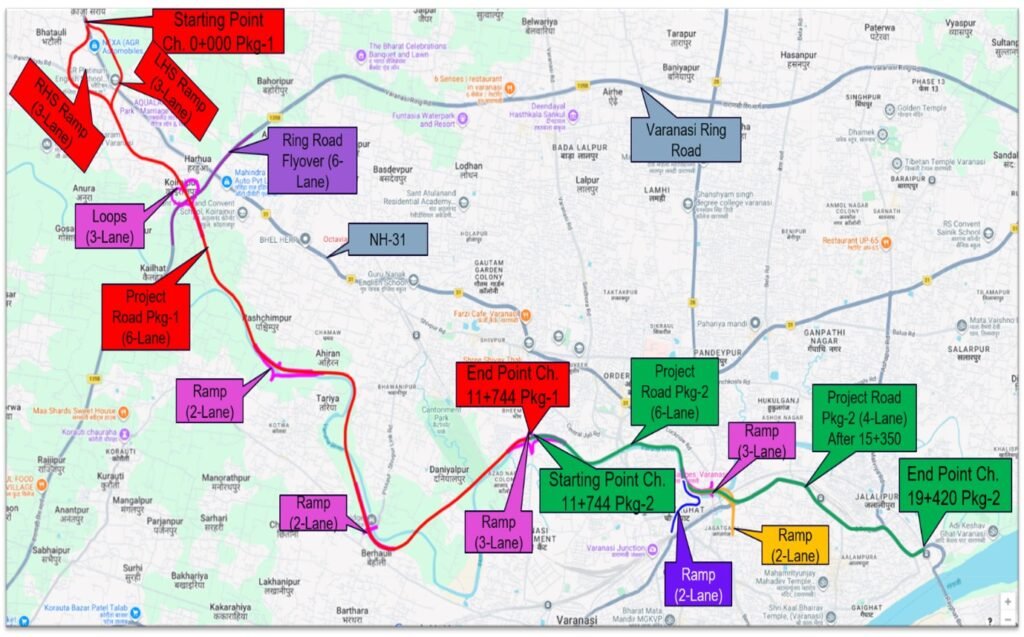
The proposed corridor will connect NH-31 with the Varanasi Ring Road, forming a key component of the Varanasi Decongestion Plan. The project includes a predominantly elevated roadway featuring main carriageways, flyovers, ramps, loops, and service roads, designed to significantly reduce traffic congestion across the city.
According to the government, the project carries a civil construction cost of ₹4,565.33 crore, while land acquisition has been estimated at ₹934.91 crore. The new access-controlled corridor is expected to transform transportation within Varanasi by offering faster, safer, and uninterrupted movement for both passenger and freight traffic.
Once completed, the corridor will provide seamless connectivity to several strategic destinations, including Kashi Railway Station, Varanasi Junction, Varanasi City Railway Station, Deen Dayal Upadhyaya Junction, Varanasi Airport, Ramnagar Port, Sampurnanand Sanskrit University, the iconic ghats of Varanasi, and the adjoining Chandauli region. It will also improve access to the Varanasi Ring Road, enhancing regional transportation links.
Designed for an operating speed of 80–100 km/h, the corridor is expected to reduce travel time between NH-31 and Kashi Railway Station from approximately 40 minutes to 20 minutes, cutting journey time by nearly 50 percent. Besides improving commuter convenience, the project aims to reduce vehicle operating costs, improve road safety, and ease pressure on the city’s existing road network.
The project also aligns with the PM Gati Shakti National Master Plan by strengthening multimodal connectivity. It will improve access to one Economic Node (Chandauli Social Economic Zone), one Social Node (Chandauli), and six major logistics nodes, facilitating efficient movement of agricultural produce, industrial goods, construction materials, and minerals across eastern Uttar Pradesh.
The government stated that the elevated corridor will serve as a modern urban transport infrastructure project that not only addresses traffic congestion but also promotes tourism, economic development, and sustainable urban growth in one of India’s most important heritage cities. A corridor map released with the approval illustrates the proposed alignment, ramps, loops, and key connectivity points across Varanasi.
Also Read: India to Launch First Hydrogen Fuel Cell Train, Marking a New Era in Green Rail Mobility
Join our WhatsApp Channel for fastest updates: Join now