The Union government’s recent directive asking Kerala to revise the Detailed Project Report (DPR) for the SilverLine semi–high-speed rail project corridor has renewed discussions around the project’s viability—especially as the Centre continues to advance far more complex railway initiatives in other regions.
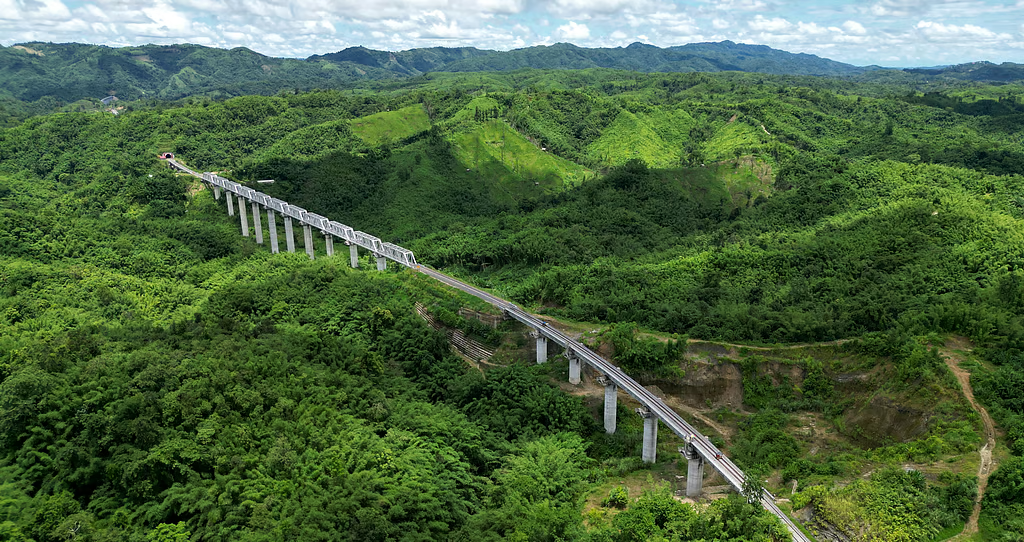
A Northeast Rail Line Built in Extreme Terrain
The Bairabi–Sairang rail link in Mizoram—an ₹8,071-crore project inaugurated by Prime Minister Narendra Modi on September 13, 2025—stands out for its unprecedented engineering challenges. In just a 52-km stretch, Indian Railways constructed:
- 55 major and 88 minor bridges
- 45 tunnels, including cut-and-cover sections spanning 15.85 km, nearly 31% of the total length
- Rail viaducts among India’s tallest, including a pier bridge higher than the Qutub Minar
The railway line traverses steep mountain slopes, deep valleys, dense forests, and a highly landslip-prone region—making it one of the toughest infrastructure projects undertaken by Indian Railways.
A survey is currently under way for Phase II, a proposed 223-km extension from Sairang to Hbichhuah near the Myanmar border. Once the DPR is prepared and approved, the project is expected to further enhance connectivity in the region.
SilverLine Compared: A Less Challenging Build, Much Wider Impact
Contrasting sharply with the Northeast project, the 530-km SilverLine requires:
- Only 11.53 km of tunnels
- 12.99 km of bridge structures
- A route largely supported by viaducts (88.41 km) and embankments (292.73 km)
Land acquisition requirements also show lower proportional impact:
- 482 ha acquired for the 52-km Bairabi–Sairang link
- 1,383 ha required for the 530-km SilverLine
In terms of beneficiaries, SilverLine’s reach is significantly broader. While the Mizoram project would serve 10.97 lakh people (2011 census), SilverLine is designed to improve mobility for 3.34 crore people across Kerala.
Transformational Potential vs Policy Resistance
Mizoram Governor V.K. Singh has noted that the Bairabi–Sairang line is set to transform the State’s economy, boost tourism, lower logistics costs, and eventually integrate with the Kaladan Multi-Modal Transit Transport Project.
Kerala officials argue that SilverLine offers similar—if not greater—transformational potential for the State’s economy and mobility landscape. However, the Centre continues to withhold approval, citing environmental and technical concerns. It has asked Kerala to revise the DPR and explore integrating SilverLine with the existing broad-gauge network, which currently includes 627 curves and supports average passenger train speeds of just 45 kmph (Vande Bharat: 73 kmph).
A senior State bureaucrat expressed concern that such suggestions appear aimed at indefinitely delaying the project for political reasons.
Also Read: Ghaziabad’s Loni Stretch of Delhi–Saharanpur Road Set for Major Upgrade; ₹32 Crore Approved