

The Ministry of Housing and Urban Affairs (Ministry of Housing and Urban Affairs) has officially launched the 10th edition of Swachh Survekshan, marking a decade of India’s largest and most comprehensive urban cleanliness assessment. The toolkit for Swachh Survekshan 2025–26 was released in Bhopal, Madhya Pradesh, by Union Minister Manohar Lal, reinforcing the programme’s role as a critical urban governance and performance management tool.
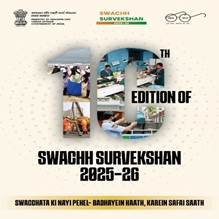
Recognised globally as the world’s largest urban sanitation survey, Swachh Survekshan has evolved beyond a ranking exercise into a strategic framework that drives visible cleanliness, service delivery improvement, and citizen participation across Indian cities. From assessing just 73 Urban Local Bodies (ULBs) in 2016, the survey now evaluates nearly 4,900 ULBs, reflecting its expanding scale and institutional depth.
Theme and Expanded Citizen Participation
The 2025–26 edition adopts the theme “Swachhata Ki Nayi Pehel – Badhayein Haath, Karein Safai Saath”, emphasising collective responsibility and community-led cleanliness initiatives. A key highlight of this edition is the significant increase in citizen feedback weightage, underscoring the growing importance of public perception in urban sanitation outcomes.
Citizens can now provide feedback round the year through multiple digital platforms, including the Vote For My City App and Portal, MyGov App, Swachhata App, and QR-code-based interfaces. This continuous engagement model aims to ensure real-time responsiveness and accountability in city-level sanitation performance.
New Assessment Frameworks and Urban Coverage
The 10th Swachh Survekshan introduces several structural enhancements:
- Expansion from Ganga towns to all river towns, bringing a broader ecological lens to urban cleanliness.
- A separate assessment matrix for coastal cities, recognising their distinct environmental and infrastructural challenges.
- Strengthened focus on Garbage Free Cities (GFC) and ODF certification, with assessments scheduled to begin from mid-February 2026.
A tightly monitored, protocol-driven assessment mechanism has been institutionalised, supported by over 3,000 trained field assessors, GPS-enabled monitoring, and fully digital evidence submission and verification processes.
Mentorship and Knowledge-Sharing Initiatives
To accelerate best-practice replication, MoHUA has also expanded its Swachh Shehar Jodi (SSJ) mentorship programme under Swachh Bharat Mission–Urban. Launched in September 2025, the initiative now connects 72 mentor cities with 200 mentee cities, fostering peer learning and capacity building in urban waste management. A new award category has been introduced to recognise high-performing city pairs across population segments MoHUA launches 10th Swachh Surv….
A Decade of Urban Transformation
Over the past ten years, Swachh Survekshan has helped define national benchmarks for visible cleanliness, waste segregation, sanitation access, and grievance redressal. With its enhanced citizen-centric approach and data-driven assessment model, the 10th edition further positions cleanliness as a shared civic responsibility and a cornerstone of sustainable urban development.