

A Tribute Article
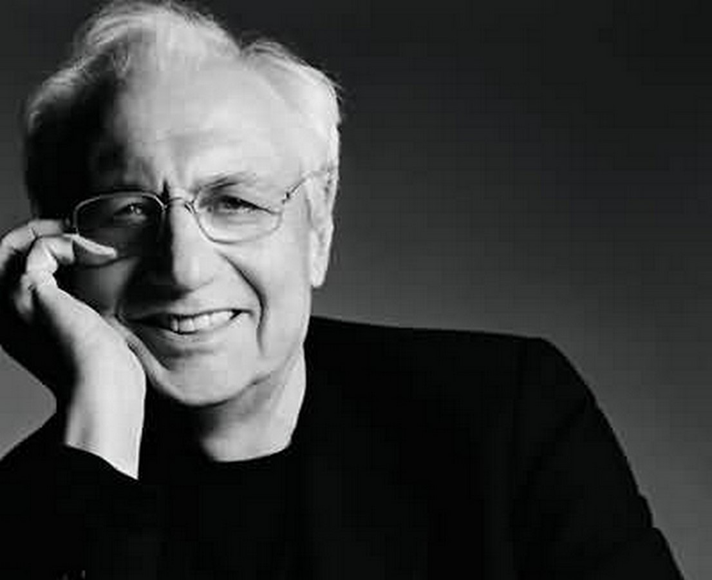
Few architects in history have reshaped the world’s imagination the way Frank O. Gehry did. With his passing, the global architectural community pauses to celebrate a legacy that stands defiantly against conventional boundaries. Gehry’s work remains a testament to the belief that architecture is not merely about shelter or function—it is about emotion, movement, and the transformative power of form. His buildings do not simply occupy landscapes; they animate them.
Early Life and Formative Influences
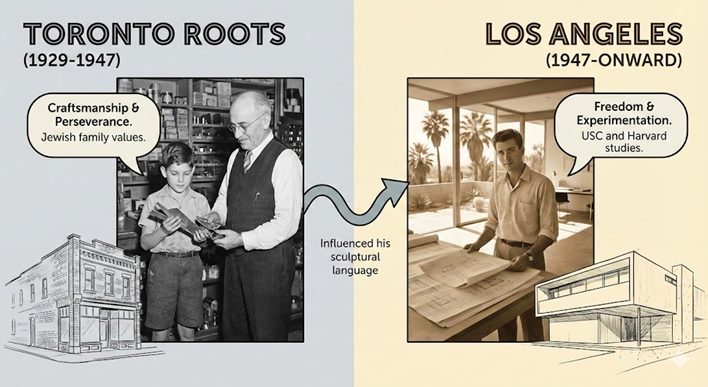
Frank Gehry was born in 1929 in Toronto, Canada, to a modest Jewish family whose values of craftsmanship and perseverance shaped his early worldview. His childhood fascination with shaping metal scraps—borrowed from his grandfather’s hardware store—was an unexpected prelude to the shimmering titanium masterpieces he would later design. When his family moved to Los Angeles in 1947, the young Gehry encountered a culture of freedom, optimism, and experimentation. This shift from the structured urban grid of Toronto to the loose, creative environment of Southern California deeply influenced his architectural language.
Gehry studied architecture at the University of Southern California (USC), supporting himself through multiple jobs, and later attended the Harvard Graduate School of Design to explore city planning. Although he did not build a career as an urban planner, these experiences sharpened his sensitivity to urban context, civic life, and people-centered design principles that quietly underpinned even his most sculptural works.
Evolution of His Architectural Journey
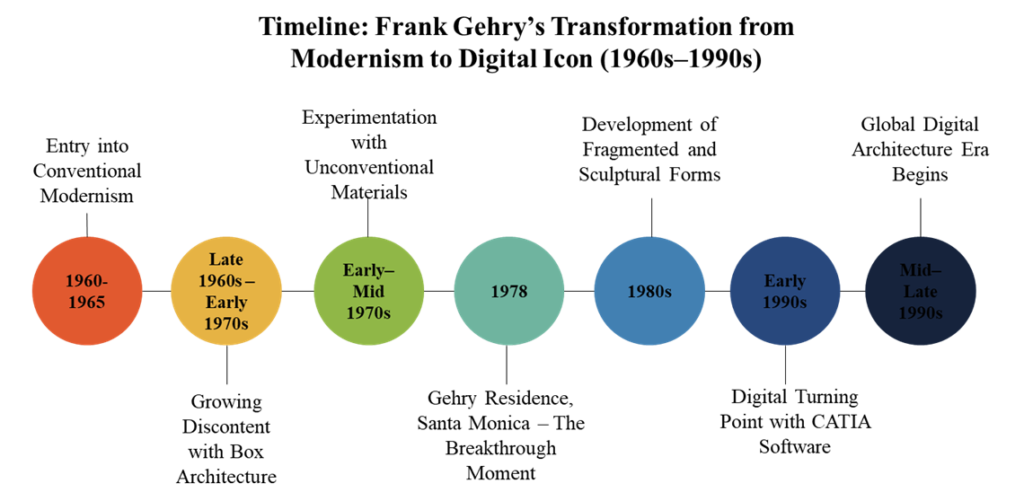
Gehry began his career within the realm of conventional modernism, but he soon found himself frustrated by the repetitive, boxlike aesthetics of the mid-century period. This discontent gave rise to experimentation. His early works in the 1960s and 70s used unconventional materials—corrugated metal, chain-link fences, plywood—not out of rebellion but out of a desire to democratize architecture. He believed architecture could be expressive without being expensive. The turning point came with his Gehry Residence (1978) in Santa Monica, where he wrapped a suburban bungalow in raw, industrial materials, creating a living laboratory of deconstruction. It shocked neighbors, confused critics, and catapulted Gehry into the international spotlight as an architectural rule-breaker.
The 1990s marked a technological revolution in Gehry’s practice. By adapting CATIA, an advanced 3D aerospace software, he enabled architecture to break free from rectilinear constraints. Suddenly, curves, folds, and fluid geometries became not only conceptual but buildable. This moment changed the global trajectory of architectural design and paved the way for his most iconic works.
Themes and Philosophy: What His Architecture Stood For
Gehry’s work was driven by the idea that architecture should evoke emotion and curiosity. For him, a building was a living organism with a personality.
- Architecture as a sculptural art form – Gehry refused to see architecture as a static arrangement of walls. His designs resemble moving sculptures—dynamic, flowing, unpredictable.
- Embracing imperfection and spontaneity – He believed in the beauty of rawness, asymmetry, and the unexpected. Many of his forms emerged from spontaneous hand sketches and rough cardboard models.
- Material innovation as expression – Titanium sheets, polished stainless steel, glass sails, and fractured stone became languages through which he spoke.
- Human experience at the center – Despite the complexity of his forms, Gehry devoted equal attention to how people would feel inside them—the warmth, the acoustics, the movement of light.
- The “Fish” motif – Gehry was deeply inspired by fish—symbols of movement, fluidity, and ancient mythology. This motif appears subtly and explicitly across his works.
- Urban regeneration – His architecture was not isolated art; it was a catalyst for economic and cultural revival.
Gehry’s philosophy was rooted in one belief:
Architecture must inspire.
Everything else—structure, technology, function—took shape around that core.
Also Read: Le Corbusier: Architect and Pioneer of Modernism
Masterpieces That Rewrote Global Skylines
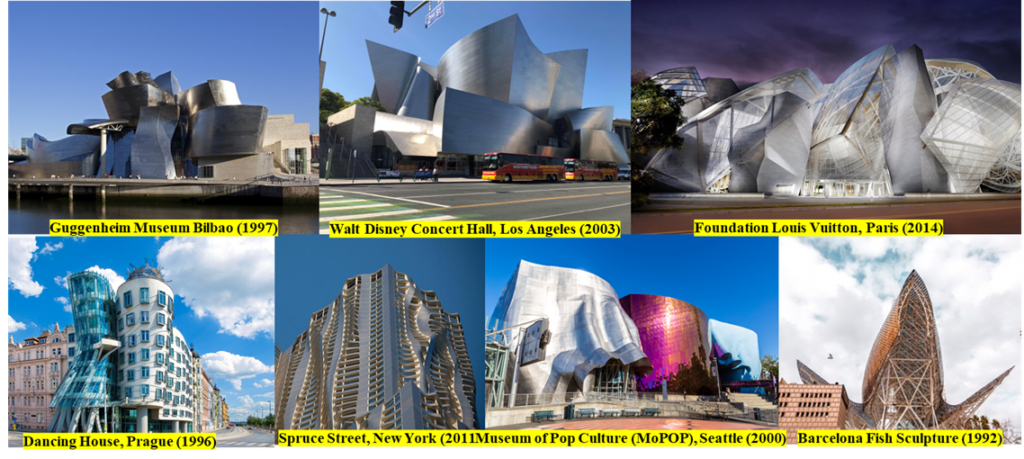
- Guggenheim Museum Bilbao (1997) – A breathtaking composition of titanium curves, this project was more than a building—it was a phenomenon. The “Bilbao Effect,” a term coined after the museum’s opening, demonstrated how iconic architecture could transform a struggling industrial city into a global cultural destination. Gehry blended form, light, river reflections, and urban context into one fluid masterpiece.
- Walt Disney Concert Hall, Los Angeles (2003) – One of the most acoustically perfect halls ever built, designed in close collaboration with Yasuhisa Toyota. The shimmering stainless-steel exterior wraps around an interior of warm Douglas fir, creating a poetic relationship between instrument-like precision and artistic chaos. This building revived downtown LA and became a cultural anchor.
- Foundation Louis Vuitton, Paris (2014) – Gehry reinvented the idea of a museum by creating a structure that resembles a ship with giant glass sails. The building’s transparent forms play with sunlight, water, and greenery, making it a sanctuary for art and nature.
- Dancing House, Prague (1996) – This project challenged the rigid European block typology. The two volumes—nicknamed “Fred and Ginger”—appear to dance gently along the Vltava River, symbolizing movement and cultural dialogue.
- Spruce Street, New York (2011) – A residential skyscraper with a flowing, rippled façade that changes character depending on the sun. It reintroduced sculptural form into high-rise housing.
- Museum of Pop Culture (MoPOP), Seattle (2000) – A vibrant, color-shifting, guitar-inspired building that embodies the rebellious energy of American pop culture.
- Barcelona Fish Sculpture (1992) – A monumental golden fish that reflects Gehry’s fascination with organic forms and the shimmering play of light on water.

Major Contributions to World Architecture
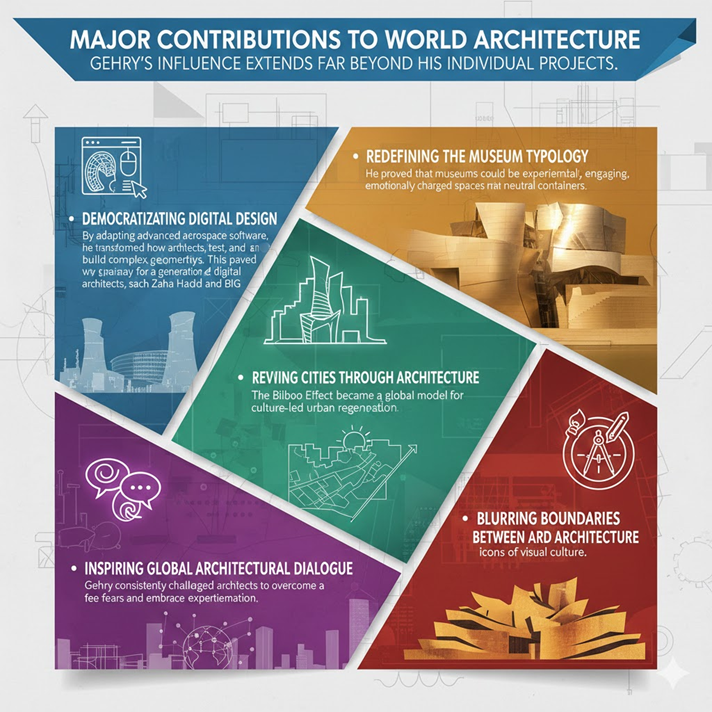
Gehry’s influence extends far beyond his individual projects.
- Democratizing digital design: By adapting advanced aerospace software, he transformed how architects conceive, test, and build complex geometries. This paved the way for a generation of digital architects, such as Zaha Hadid and BIG.
- Redefining the museum typology: He proved that museums could be experiential, engaging, and emotionally charged spaces rather than neutral containers.
- Reviving cities through architecture: The Bilbao Effect became a global model for culture-led urban regeneration.
- Inspiring global architectural dialogue: Gehry consistently challenged architects to overcome their fears and embrace experimentation.
- Blurring boundaries between art and architecture: His buildings became internationally recognized icons of visual culture.
Style: A Comprehensive Understanding
Critics often grouped Gehry under “Deconstructivism,” but his style was more personal than academic. His buildings display:
- Fluidity rather than fragmentation
- Organic curves rather than rigid geometry
- Emotion rather than abstraction
- Material storytelling rather than monotone minimalism
His signature materials—titanium, zinc, stainless steel—were not merely aesthetic choices but tools to capture light, reflect surroundings, and create visual poetry.
Also Read: Zaha Hadid: Iconic Architect Who Redefined Fluid Architecture
The Man Behind the Architect
Despite international fame, Gehry remained approachable, witty, and surprisingly humble. He preferred working with his hands rather than dictating through computers. He loved sketching quickly with thick black markers, trusting intuition more than strict methodology. He believed in collaboration—with artisans, engineers, acousticians, artists, and communities.
In interviews, he often laughed at his own work, insisting that he was simply trying to “make something beautiful to live with.” Yet his creations changed the world.
A Legacy That Lives Through His Buildings
The true impact of Frank O. Gehry will be measured not only in the brilliance of his projects but in the courage he inspired in others. He taught architects that the built environment could be imaginative, daring, joyful, and emotionally resonant. His legacy is one of freedom: the freedom to draw outside the lines, to question the ordinary, and to trust bold ideas.
Today, cities around the world shine with the energy of Gehry’s imagination. His buildings—alive with movement, light, and artistic expression—ensure that his legacy will continue to shape architectural discourse for generations.
“With the passing of Frank O. Gehry on 5th December, architecture did not lose a designer—it lost a fearless dreamer who taught buildings how to feel.”
References
- Goldberger, P. (2015). Building Art: The Life and Work of Frank Gehry. Alfred A. Knopf.
- Jodidio, P. (2017). Frank O. Gehry. Taschen.
- Betsky, A. (1993). The Complete Works of Frank O. Gehry. Thames & Hudson.
- Arnell, P., & Bickford, T. (1985). Frank Gehry: Buildings and Projects. Rizzoli.
- Foster, H. (2016). The Art-Architecture Complex. Verso Books.
- Lewis, R. (2001). “Digital Craft: Gehry’s CATIA Innovations.” Architectural Review.
- Sudjic, D. (1997). “A New Language of Architecture.” The Guardian.
- Ouroussoff, N. (2005). “Gehry’s Vision and Its Impact.” The New York Times.
- The Gehry Partners Official Archive
- Guggenheim Museum Official Publications
- Walt Disney Concert Hall – LA Philharmonic Documentation