

India’s freight transportation landscape is witnessing a significant shift with the rollout of the Trucks-on-Trains (ToT) service on the Dedicated Freight Corridor network, led by Indian Railways. The initiative integrates road and rail logistics to reduce highway congestion, fuel consumption, and carbon emissions, while improving freight efficiency across long distances.
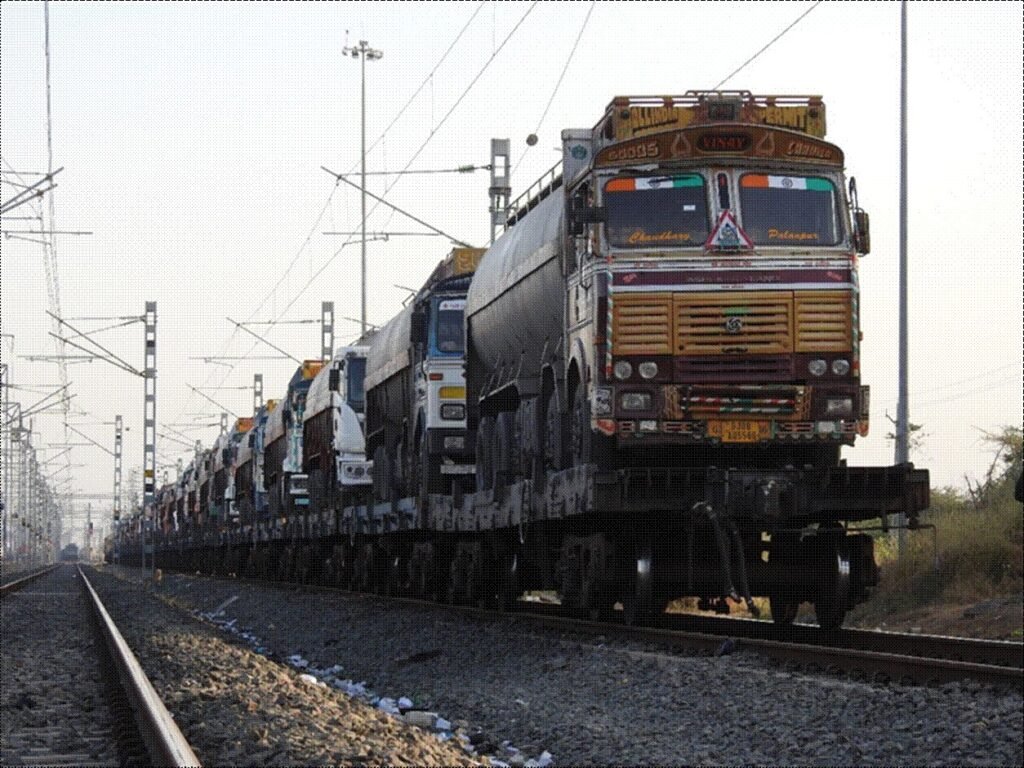
According to a recent release by the Press Information Bureau (PIB), the ToT service allows fully loaded trucks to be carried on specially designed flat wagons along electrified Dedicated Freight Corridors (DFCs). Trucks avoid long-haul highway travel and complete only short first- and last-mile road journeys, making freight movement faster, safer, and more predictable.
Faster Transit and Lower Logistics Costs
At present, the service operates on the Western Dedicated Freight Corridor between New Palanpur (Gujarat) and New Rewari (Haryana), covering approximately 636 kilometres. This shift has reduced end-to-end transit time from nearly 30 hours by road to around 12 hours by rail, significantly improving turnaround times for logistics operators.
The pricing model is based on transparent weight slabs, with freight charges starting from ₹25,543 per wagon for trucks up to 25 tonnes. Empty trucks are carried at even lower rates, while milk tankers are exempt from GST—making the service especially attractive for the dairy and FMCG sectors. Open Indent booking, introduced in January 2024, has further enhanced operational flexibility for transporters.
Growing Adoption and Commercial Viability
Operational data for FY 2024–25 (April–December) indicates strong uptake of the service, with 545 rakes transporting over 3 lakh tonnes of freight and generating revenue of nearly ₹37 crore. Since inception, Trucks-on-Trains has completed more than 1,955 trips, handled over one million tonnes of freight, and earned cumulative revenue exceeding ₹131 crore.
Major freight clusters in western India, particularly those linked to dairy and FMCG supply chains, have shown strong adoption. The relaunch of the service through a Memorandum of Understanding with the Gujarat Cooperative Milk Marketing Federation (Amul) in June 2023 played a key role in anchoring regular volumes.
Environmental and Road Safety Benefits
One of the most critical outcomes of the ToT model is the modal shift of long-haul freight from road to rail. Each freight train replaces dozens of trucks on highways, helping reduce traffic congestion, accident risks, and road maintenance costs. On the Palanpur–Rewari stretch alone, nearly 48,875 trucks have been effectively removed from highways for the core journey.
This shift has resulted in estimated diesel savings of around 88 lakh litres and prevented over 23 crore kilograms of carbon dioxide (CO₂) emissions. With the entire DFC network fully electrified, environmental gains are expected to increase further as India’s power mix becomes greener.
Part of India’s Multimodal Logistics Vision
The Trucks-on-Trains service is a core component of the broader multimodal logistics strategy being implemented by Dedicated Freight Corridor Corporation of India Limited. Alongside high-capacity freight corridors, multimodal terminals, and logistics parks, the initiative aims to deploy road and rail where each mode is most efficient and sustainable.
As infrastructure expansion continues, the service is expected to be extended to additional corridors and terminals, offering Indian businesses faster, cleaner, and more reliable access to national markets. For planners and policymakers, Trucks-on-Trains represents a structural shift towards a more resilient and environmentally responsible freight transport system.
Also Read: Centre Sanctions Over 10,000 km of Rural Road Projects Across Six States Under PMGSY-IV