

The Union Cabinet, chaired by Prime Minister Narendra Modi, has approved three new corridors under Delhi Metro Phase V(A), marking a significant expansion of mass rapid transit in the national capital. The approval covers a cumulative length of 16.076 km and aims to strengthen connectivity across Central, South, and West Delhi while improving airport access and easing urban congestion.
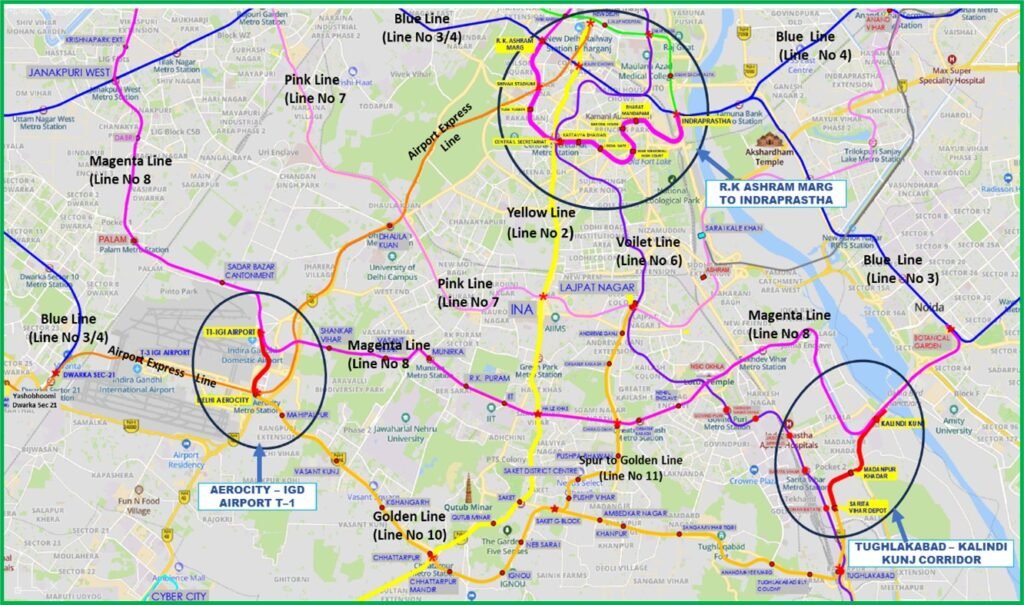
The Approved Corridors
The three corridors sanctioned as part of Phase V(A) include:
- R.K. Ashram Marg–Indraprastha (9.913 km)
- Aerocity–IGI Airport Terminal 1 (2.263 km)
- Tughlakabad–Kalindi Kunj (3.9 km)
The total project cost is estimated at ₹12,014.91 crore, to be financed through contributions from the Government of India, the Government of Delhi, and international funding agencies. Cabinet approves three new corr…
Central Vista and Airport Connectivity
A key highlight is the R.K. Ashram Marg–Indraprastha corridor, which will extend the Botanical Garden–R.K. Ashram Marg stretch and directly serve the Central Vista area, currently undergoing large-scale redevelopment. According to official estimates, the corridor is expected to benefit around 60,000 office-goers and nearly two lakh daily visitors, offering doorstep metro access to major government complexes and public institutions.
The Aerocity–IGI Airport T1 and Tughlakabad–Kalindi Kunj sections will extend the Aerocity–Tughlakabad corridor, significantly improving airport connectivity for South Delhi neighbourhoods such as Saket, Chhatarpur, Tughlakabad, and Kalindi Kunj.
Stations and Alignment
The Phase V(A) extensions will comprise 13 stations, of which 10 will be underground and three elevated.
- Stations on the R.K. Ashram Marg–Indraprastha section include R.K. Ashram Marg, Shivaji Stadium, Central Secretariat, Kartavya Bhawan, India Gate, War Memorial–High Court, Baroda House, Bharat Mandapam, and Indraprastha.
- The Tughlakabad–Kalindi Kunj section will include Sarita Vihar Depot, Madanpur Khadar, and Kalindi Kunj, while Aerocity will be further linked to IGI Airport Terminal 1. Cabinet approves three new corr…
Urban Mobility and Environmental Impact
These extensions—part of the Magenta Line and Golden Line—are expected to reduce road congestion, cut vehicular emissions, and lower fossil fuel consumption, contributing to improved air quality and ease of living in the capital.
At present, the Delhi Metro Rail Corporation operates a network of about 395 km across 12 lines with 289 stations in Delhi-NCR. The system handles an average of 65 lakh passenger journeys daily, with a record 81.87 lakh journeys logged on 8 August 2025. Phase IV construction—spanning 111 km—is already underway and is targeted for staged completion by December 2026. Cabinet approves three new corr…
With the Cabinet’s latest approval, Phase V(A) is set to further consolidate Delhi Metro’s role as the backbone of urban mobility, supporting economic activity while promoting sustainable transport across the capital.
Also Read: Bhopal Metro Inaugurated: Orange Line Priority Corridor Opens