

India has formally submitted the nomination dossier of Meghalaya’s iconic living root bridges to UNESCO, marking a major step toward securing World Heritage status for one of the world’s most unique examples of living cultural landscapes. The nomination, titled “Jingkieng Jri / Lyu Chrai Cultural Landscape,” has been filed for consideration under the 2026–27 World Heritage evaluation cycle.
The dossier was submitted by India’s Ambassador and Permanent Representative to UNESCO, Vishal V. Sharma, to the Director of UNESCO’s World Heritage Centre, Lazare Assomo Eloundou.
A Living Cultural Landscape of Indigenous Knowledge
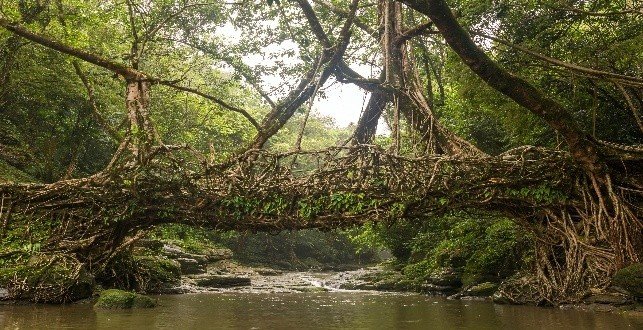
The nominated cultural landscape spans the Khasi and Jaintia Hills and represents a centuries-old tradition developed and sustained by the indigenous Khasi and Jaintia communities. Unlike conventional bridges, living root bridges are grown from the aerial roots of rubber fig trees and carefully guided over decades to form strong, functional crossings.
These structures are not only feats of bio-engineering but also expressions of a deep cultural philosophy rooted in harmony between humans and nature. The practice reflects indigenous land management systems, community-based governance, and long-term ecological stewardship.
Symbol of Sustainable Architecture and Ecology
At the heart of the nomination are the living root bridges themselves, which embody the indigenous worldview of coexistence with nature and reverence for Mei Ramew (Mother Earth). Able to withstand extreme rainfall and floods, the bridges demonstrate resilience, sustainability, and climate-adaptive design—principles increasingly relevant to contemporary architecture and infrastructure planning.
Collaborative Effort and National Commitment
Ambassador Sharma acknowledged the leadership of the Prime Minister and the Union Minister for Culture, along with the role of the Government of Meghalaya, the Archaeological Survey of India, the Ministry of External Affairs, and, most importantly, the local communities who continue to protect and nurture this living heritage.
The submission underscores India’s broader commitment to conserving living cultural landscapes and contributing to global heritage preservation through UNESCO frameworks.
If approved, Meghalaya’s living root bridges would join the list of globally recognised heritage sites, bringing international attention to indigenous knowledge systems and sustainable architectural traditions rooted in ecology.
Also Read: Bamboo Housing Systems: IIT Kharagpur–BMTPC Prototype Shows a Viable Low-Carbon Alternative