

The Ministry of Culture has reiterated the importance of systematic digital documentation of India’s village heritage as a foundation for cultural preservation and rural development. The emphasis was made during a one-day Capacity-Building Programme (Level I) organised under the National Mission on Cultural Mapping (NMCM) at the Indira Gandhi National Centre for the Arts (IGNCA) in New Delhi.
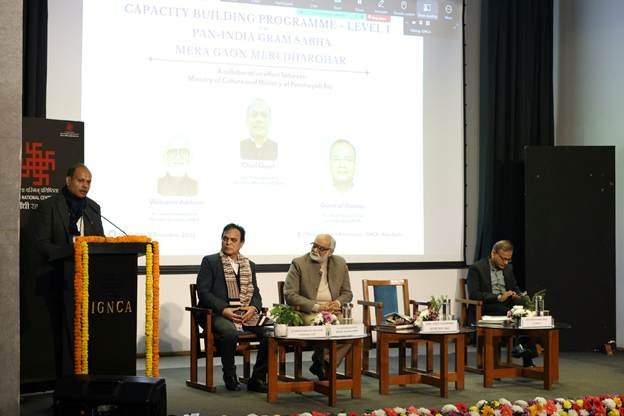
The programme was conducted as part of a nationwide preparatory initiative linked to the All-India Gram Sabhas scheduled for 26 January 2026. Implemented through IGNCA, NMCM aims to create a comprehensive national database of India’s tangible and intangible cultural assets, with particular focus on villages through its flagship initiative “Mera Gaon Meri Dharohar (MGMD)”.
Inaugurating the programme, Shri Vivek Agarwal, Secretary, Ministry of Culture, described the initiative as a critical step towards ensuring a strong and inclusive digital presence for India’s villages. He outlined a five-point framework to strengthen the MGMD portal, which included developing a clear understanding of the platform, reviewing its categories and limitations, using corrective mechanisms through the ‘Contribute’ feature, collecting data using Participatory Rural Appraisal (PRA) methods, and enriching the portal with validated field-level information. Referring to the approach as “heritage through PRA,” he encouraged cross-departmental collaboration to improve both data quality and outreach.
Shri Rajesh Kumar Singh, Joint Secretary, Ministry of Panchayati Raj, highlighted the pivotal role of Panchayati Raj Institutions in cultural mapping, citing their extensive grassroots networks and on-ground experience. He stressed the need for timely implementation, continuous monitoring, and sustained guidance at the local level to ensure comprehensive documentation and meaningful outcomes.
Delivering the welcome address, Dr. Sachchidanand Joshi, Member Secretary, IGNCA, underlined the urgency of preserving the original character and cultural spirit of Indian villages amid rapid urbanisation. Linking heritage documentation with the national vision of Viksit Bharat, he observed that restoring village identities and cultural memory is essential to broader efforts of cultural decolonisation and sustainable development.
The concluding session was attended by senior officials from the Ministry of Panchayati Raj, who reflected on the gradual disappearance of intangible cultural traditions and urged trainers and participants to approach documentation with renewed commitment. The programme reinforced the role of digital heritage mapping as a tool not only for preservation but also for heritage-led rural revitalisation and economic engagement.
Also Read: Bhopal Metro Inaugurated: Orange Line Priority Corridor Opens