

Tirupati Municipal Corporation (TMC) has emerged as a national trendsetter under the Swachh Bharat Mission-Urban 2.0 (SBM-U 2.0). Through its Comprehensive Upcycling Initiative, Tirupati has redefined waste management—transforming discarded materials into valuable resources while fostering social welfare and sustainable livelihoods.
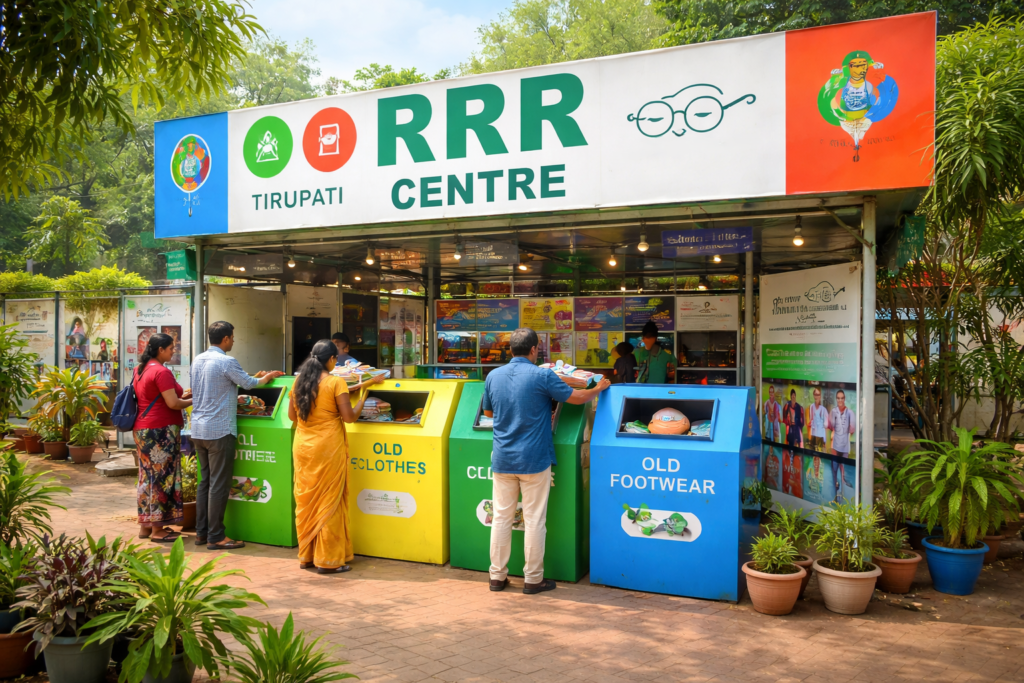
Anchored in the principle of “Swachh Aadat se Swachh Bharat,” the initiative integrates environmental responsibility with community participation. Instead of viewing waste as a disposal challenge, Tirupati has positioned it as an economic and social opportunity.
Smart Upcycling Infrastructure
At the core of the initiative is a structured upcycling system linked to permanent RRR (Reduce-Reuse-Recycle) Centres. Specially designed drop boxes—installed in RWAs, apartment complexes, and gated communities—feature separate chambers for books, clothes, and footwear.
This ensures 100% source-level segregation, eliminating secondary sorting while preserving material quality. A dedicated weekly collection mechanism transports materials efficiently to RRR Centres for processing.
The design reflects operational clarity:
- Targeted placement in high-yield residential clusters
- Scheduled logistics for timely collection
- Seamless integration with decentralized RRR infrastructure
From Waste to Welfare
At RRR Centres, materials are sorted into usable and non-usable categories. Items in good condition are redistributed to:
- Old age homes
- Orphanages
- Homeless shelters
- Economically weaker sections
Books are repurposed to strengthen libraries in municipal and government schools, reinforcing educational access and reading culture among young students.
Empowering SHGs Through Value Addition
Damaged textiles are not discarded. Instead, they are channelled to Self Help Group (SHG) members who receive skill training supported by the Ministry of Textiles and the Textiles Committee, Mumbai. These SHGs convert old garments into eco-friendly, marketable products such as:
- 275 doormats
- 1,025 foot mats
- 2,500 cloth bags
- 0.5 tonnes of automobile cleaning cloths
These products have been successfully sold in the open market, creating sustainable livelihoods while reducing landfill dependency.
Footwear follows a similar lifecycle—either locally repaired and redistributed or sent to authorized upcycling and recycling units, including facilities in Bengaluru.
A Replicable Urban Governance Model
With strong public participation, Tirupati’s initiative has achieved measurable outcomes:
- Reduced landfill burden
- Strengthened social welfare delivery
- Enhanced SHG income generation
- Institutionalised source segregation
- Advanced circular economy principles at city scale
The initiative demonstrates that effective municipal governance combined with citizen engagement can transform waste management from a sanitation function into a socio-economic catalyst.
As Tirupati steadily advances toward becoming a garbage-free city, its model presents a scalable framework for other Indian urban local bodies under SBM-U 2.0.
Also Read: NHAI to Develop India’s First ‘Bee Corridors’ Along National Highways