

Jaipur | In a major push towards sustainable resource management and low-carbon growth, NITI Aayog has launched three comprehensive reports focusing on strengthening India’s circular economy ecosystem for End-of-Life Vehicles (ELVs), waste tyres, electronic waste, and lithium-ion batteries. The reports were unveiled during the International Material Recycling Conference (IMRC) 2026, organised by the Material Recycling Association of India (MRAI) in Jaipur.
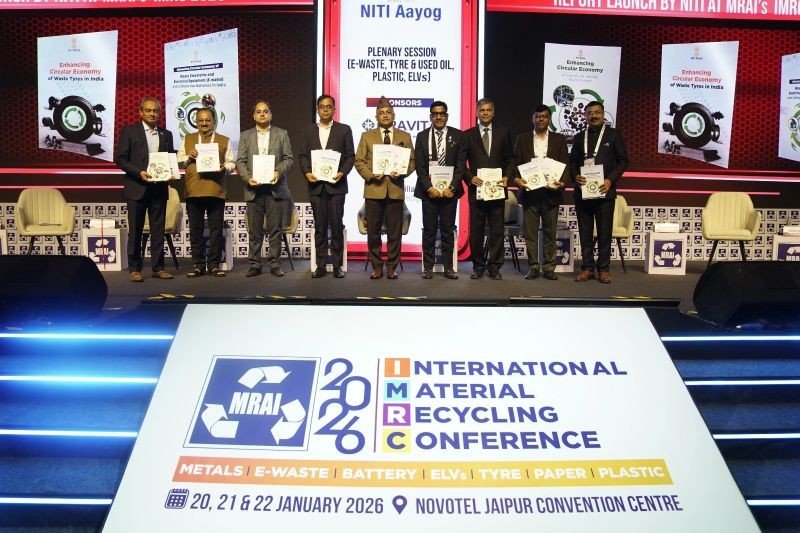
The reports provide an in-depth assessment of existing challenges and policy gaps in recycling-intensive sectors that are rapidly expanding due to urbanisation, digitalisation, and the transition to clean mobility and energy systems.
Strategic Importance for India’s Urban and Industrial Transition
Aligning with the Prime Minister’s vision of Viksit Bharat @2047, NITI Aayog underlined that a resource-efficient, circular economy is no longer optional but a strategic necessity for India’s cities and industries. With rapid growth in electric mobility and electronic consumption, waste generation is projected to rise sharply over the next decade.
According to the reports:
- Electric vehicle (EV) sales have increased from 50,000 units in 2016 to 2.08 million units in 2024, with a national target of 30% EV penetration by 2030.
- Lithium-ion battery demand is expected to surge from 29 GWh in 2025 to 248 GWh by 2035.
- End-of-Life Vehicles (ELVs) are projected to increase from 23 million in 2025 to 50 million by 2030.
- E-waste generation is estimated to rise from 6.19 million metric tonnes in 2024 to 14 million metric tonnes by 2030.
These trends pose serious challenges for India’s urban infrastructure, environmental health, and material security if not managed through structured circular systems.
Focus Areas and Key Recommendations
The three reports collectively recommend:
- Strengthening Extended Producer Responsibility (EPR) frameworks across sectors
- Formalisation of recycling and dismantling industries to curb informal and unsafe practices
- Infrastructure development for scientific collection, processing, and recovery of critical materials
- Policy and regulatory coordination among ministries, state governments, and urban local bodies
- Unlocking economic value through material recovery, job creation, and revenue generation
The reports were developed through extensive consultations with line ministries, regulators, industry stakeholders, recyclers, and knowledge partners, ensuring that recommendations are both practical and implementable.
Implications for Cities, Infrastructure and Planning
For planners, urban local bodies, and infrastructure agencies, the findings are particularly significant. Effective circular economy frameworks can:
- Reduce pressure on landfills and urban waste systems
- Improve material security for construction, mobility, and energy sectors
- Support climate-resilient and low-carbon urban development
- Enable cities to transition towards sustainable, regenerative resource cycles
By addressing ELVs, tyres, e-waste, and batteries together, the reports adopt a systems-based approach, essential for India’s rapidly growing urban and industrial landscape.
Access to Reports
The three reports are available on the official NITI Aayog website and include:
- Enhancing Circular Economy of End-of-Life Vehicles (ELVs) in India
- Enhancing Circular Economy of Waste Tyres in India
- Advancing Circular Economy of E-Waste and Lithium-ion Batteries in India
Also Read: IGBC Green Karnataka Summit 2026 to Focus on Climate-Resilient Urban Development