

The National Highways Authority of India (NHAI) has announced the development of India’s first dedicated ‘Bee Corridors’ along National Highways. The initiative marks a transition from ornamental roadside plantations to biodiversity-driven landscape planning aimed at strengthening pollinator conservation.
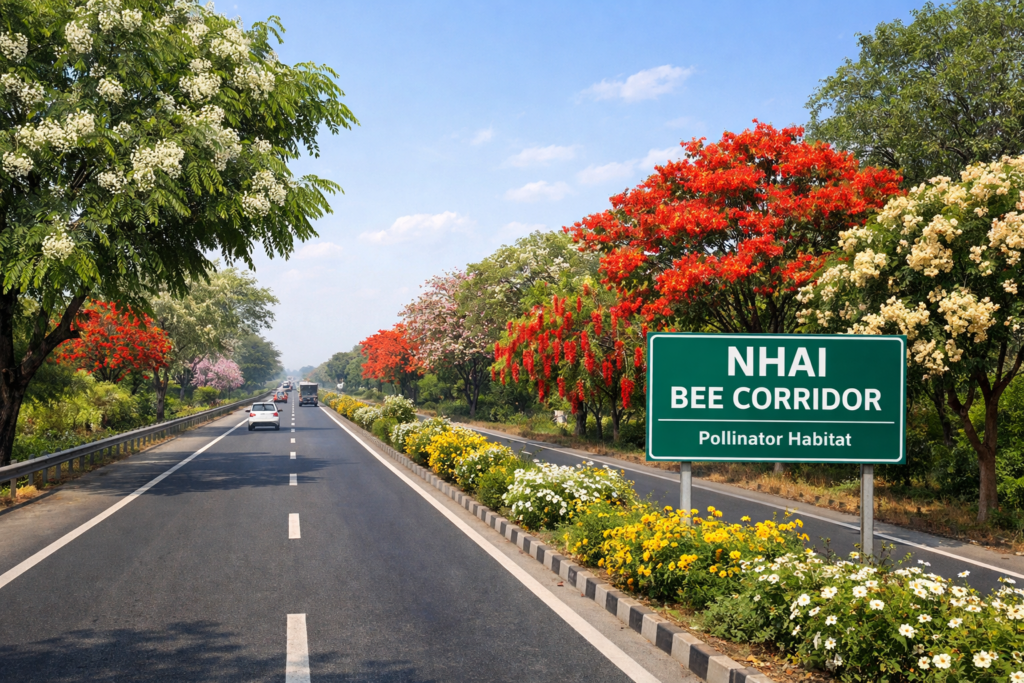
According to an official release by the Press Information Bureau, the Bee Corridor will consist of continuous linear stretches of bee-friendly vegetation comprising flowering trees and plants that provide nectar and pollen throughout the year. This approach responds to growing ecological stress on honeybees and other pollinators, which has adversely impacted pollination services, agricultural productivity, and ecological balance.
Shift from Decorative to Ecological Plantations
Under this initiative, NHAI will align its plantation strategy to create dedicated pollinator corridors featuring a mix of trees, shrubs, herbs, and grasses. The planting strategy will retain wild elements, including nectar-rich species, flowering weeds, dead wood, and hollow trunks—essential habitats for pollinators.
Native species such as Neem, Karanj, Mahua, Palash, Bottle Brush, Jamun, and Siris will be planted along highway stretches. The species selection will ensure staggered flowering across seasons, maintaining a near-continuous blooming cycle throughout the year.
Implementation Strategy
The Bee Corridors will be developed based on agro-climatic suitability along National Highway stretches and vacant NHAI land parcels. Field offices will identify sections where clusters of flowering trees can be planted at intervals of approximately 500 metres to 1 kilometre, aligning with the average foraging distance of honeybees and wild bees.
During 2026–27, NHAI plans to:
- Develop at least three pollinator corridors across different regions.
- Plant around 40 lakh trees, with nearly 60 percent under the Bee Corridor initiative.
Ecological Significance
The Bee Corridor initiative represents an emerging model of infrastructure-led ecological restoration. By embedding biodiversity within transport networks, NHAI aims to enhance pollinator habitats, support agricultural ecosystems, and reinforce environmentally responsible highway development.
The initiative signals a broader shift in public infrastructure planning—where highways are no longer viewed merely as transport arteries but as ecological corridors contributing to landscape resilience.
Also Read: Cabinet Approves ₹18,509 Crore Railway Multitracking Projects Across Four States