

The Commission for Air Quality Management (CAQM) has intensified enforcement actions across the National Capital Region (NCR) while simultaneously revoking Stage III restrictions under the Graded Response Action Plan (GRAP) following a sustained improvement in air quality.
Extensive Inspections and Enforcement Measures
During its 124th meeting held on 21 January 2026, the Enforcement Task Force (ETF) of CAQM reviewed inspection and enforcement activities carried out between 7 and 19 January 2026 across key pollution-generating sectors. According to official data, 330 inspections were conducted covering industries, diesel generator (DG) sets, construction and demolition (C&D) sites, and road dust hotspots.
Out of these inspections, 90 violations were identified—majority within the industrial sector—leading to 72 enforcement recommendations, including closures, sealing of DG sets, and issuance of show-cause notices. Notably, closure of nine Ready Mix Concrete (RMC) plants was recommended for non-compliance with pollution control norms.
Special inspection drives were also undertaken on 150 road stretches in Noida and Faridabad, revealing multiple locations with high to moderate visible dust levels. Notices were issued to municipal authorities, and Action Taken Reports (ATRs) have been received from several zones. In a separate drive in North Delhi, inspections recorded 47 incidents of biomass and municipal solid waste burning, highlighting persistent gaps in on-ground enforcement.
Since the start of CAQM’s enforcement campaign, over 25,000 units and projects have been inspected, resulting in 1,643 closure directions, underscoring the scale of regulatory intervention required to manage NCR’s air quality.
Stage III GRAP Revoked After AQI Improvement
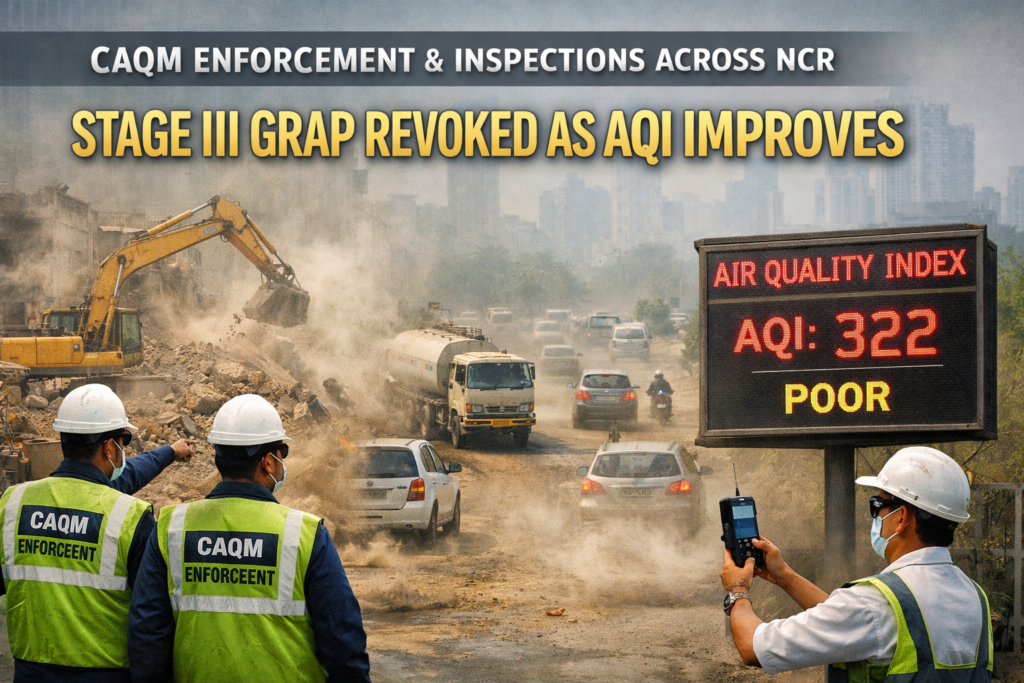
In a parallel development, the Sub-Committee on GRAP under CAQM revoked all Stage III restrictions across Delhi-NCR with immediate effect on 22 January 2026. The decision followed a consistent decline in the Air Quality Index (AQI), which improved from 378 on 20 January to 322 on 22 January, as reported by the Central Pollution Control Board (CPCB).
Based on forecasts from the India Meteorological Department (IMD) and Indian Institute of Tropical Meteorology (IITM), CAQM observed that AQI levels are likely to remain within the moderate to poor category in the coming days. Considering the disruptive impact of Stage III measures on construction activity, transport, and livelihoods, the committee unanimously decided to lift these restrictions.
However, Stages I and II of GRAP remain in force, and authorities have been directed to strictly monitor compliance to prevent any resurgence in pollution levels. CAQM has also clarified that project sites closed due to specific violations will not be allowed to resume operations without explicit approval from the Commission.
Planning and Governance Implications
Urban planners, municipal bodies, and infrastructure agencies are expected to treat the relaxation of restrictions as conditional and temporary. CAQM has reiterated that coordinated inter-agency action, strict compliance, and proactive dust and waste management are essential to sustain air quality gains during the winter season.
The Commission will continue to closely monitor air quality trends and may re-impose stricter measures if conditions deteriorate.
Also Read: CAQM Inspects Road Stretches in Faridabad to Strengthen Dust Control Measures