

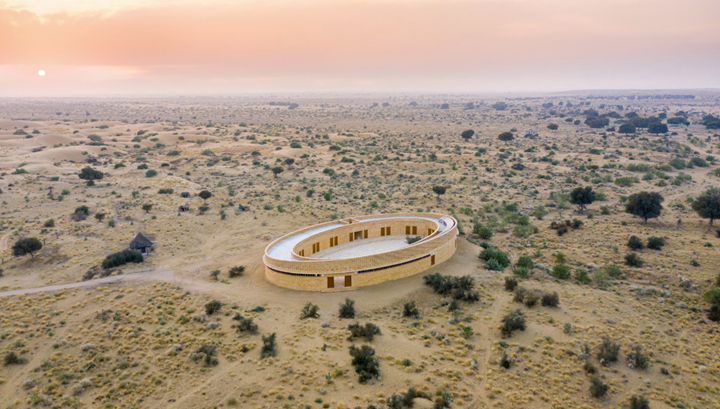
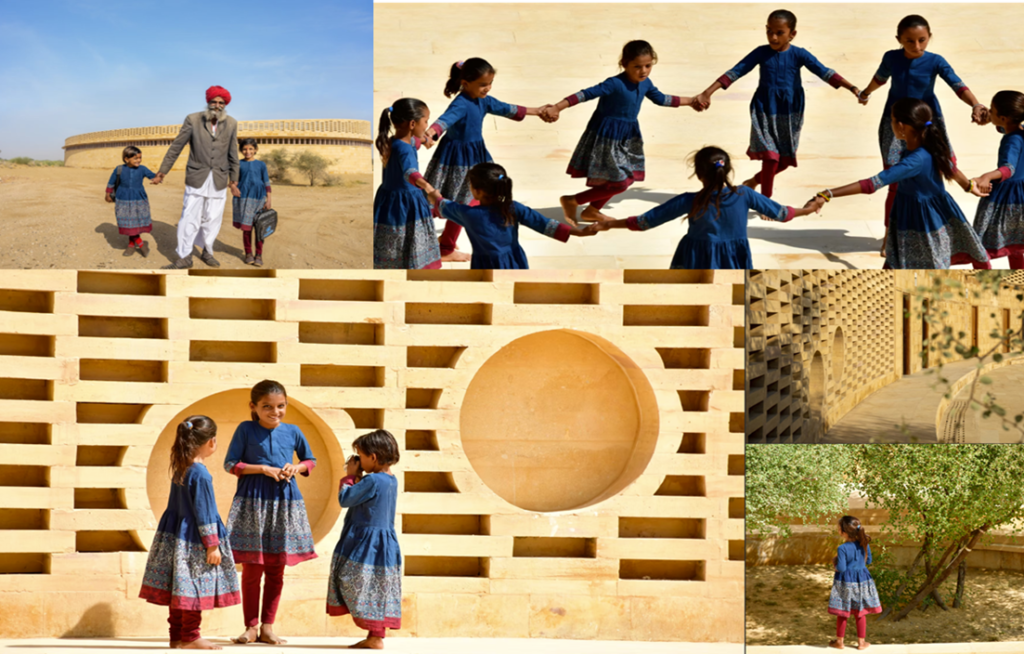
Amid the scorching vastness of the Thar Desert, where the golden dunes shift endlessly under a relentless sun, stands a structure of such quiet power and poetic grace that it commands admiration from the moment it comes into view. The Rajkumari Ratnavati Girls School, designed by Diana Kellogg Architects, is more than just a building—it is architecture as an act of social transformation, a physical embodiment of dignity, inclusivity, and hope. More than 400 girls in the Jaisalmer district study here, many of them first-generation learners, and the building’s very form speaks of the empowerment it aims to nurture. Every curve, every shadow, every stone has been shaped with the intention of creating a sanctuary for learning in one of the harshest climates on earth.
(AIA NY Architecture Honor Awards; Architectural Record (2020))
The Ellipse: A Form Born from Desert Winds and Feminine Symbolism
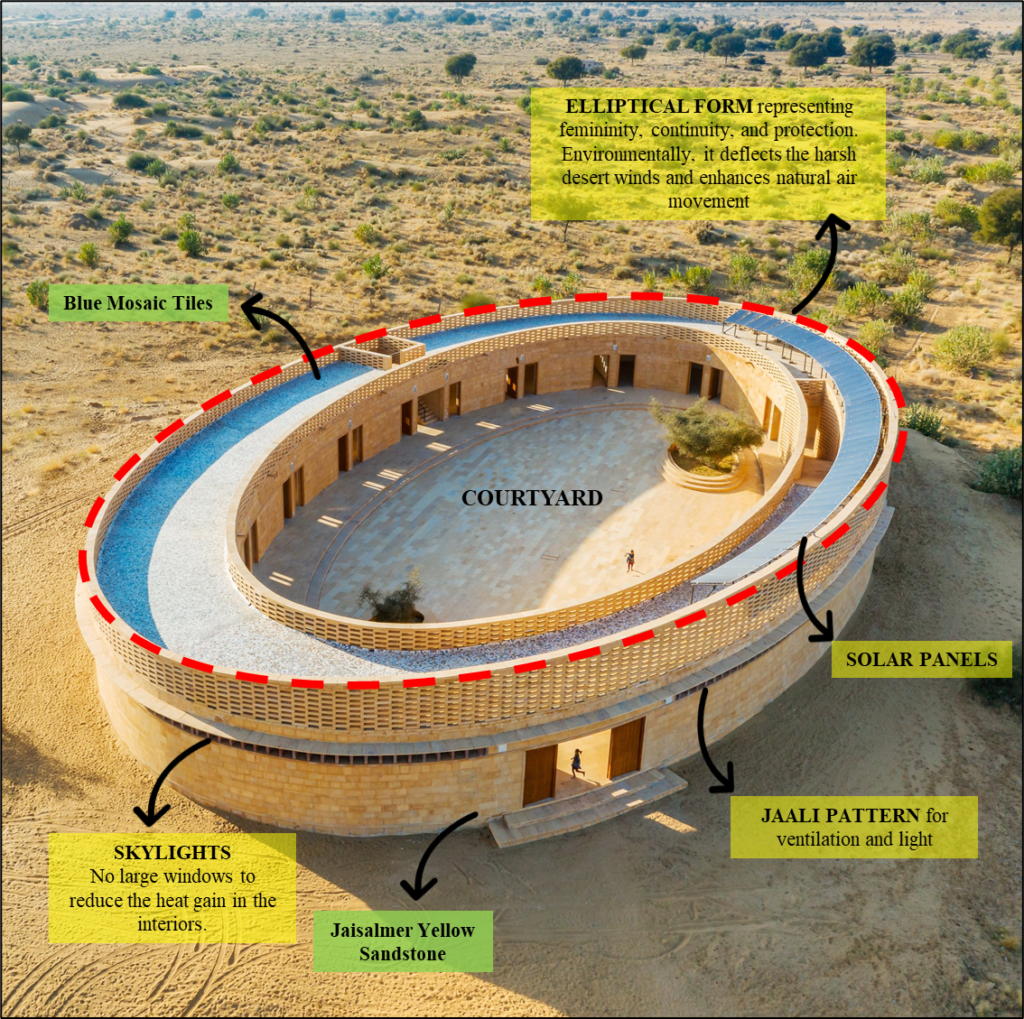
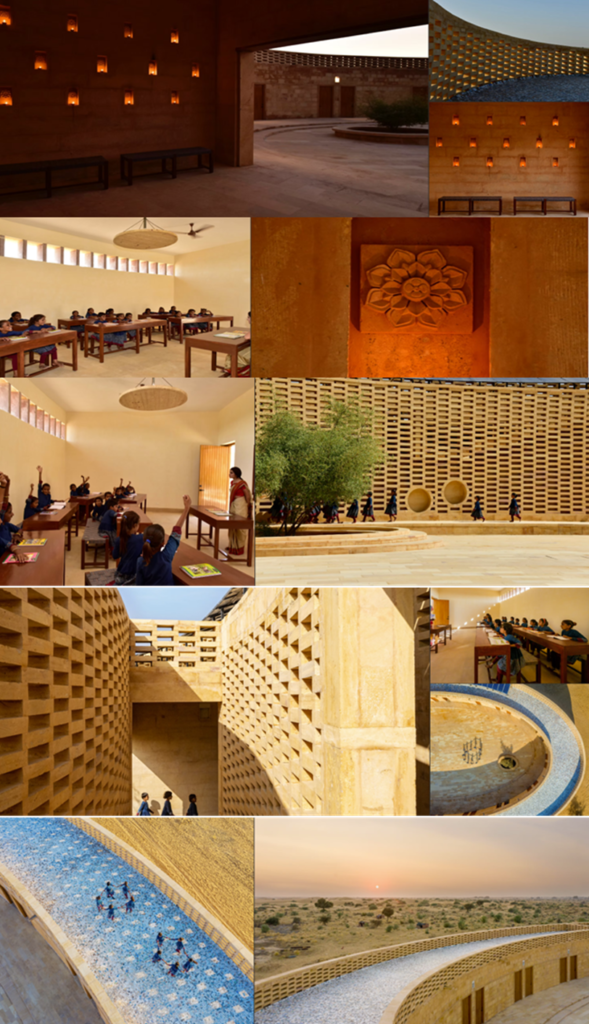
The school’s signature elliptical form is the first architectural element that captures the imagination. Unlike the rigid orthogonal geometries commonly found in educational buildings, this form feels organic, fluid, and intuitively harmonious with its surroundings. Its symbolism is deep and intentional: Diana Kellogg chose the ellipse as a geometry traditionally associated with femininity, continuity, and protection—a gesture that wraps the students in a visual metaphor of care and empowerment. At the same time, the curving shape echoes the rolling dunes of the Thar Desert and the flowing lines of Rajasthani vernacular settlements, embedding the school within centuries of cultural memory. Functionally, this form plays a remarkable environmental role. Its curvature deflects the harsh desert winds and enhances natural air movement through and around the structure, creating a surprisingly comfortable interior environment even at the peak of summer.
(Archilovers project description; Architectural Record (2020))
Materiality that Breathes, Ages, and Belongs
Constructed entirely from locally quarried Jaisalmer yellow sandstone, the school appears almost to have been carved out of the desert itself. This material choice is both environmentally strategic and deeply cultural. Jaisalmer stone possesses exceptional thermal mass, meaning it naturally absorbs heat during the day and releases it slowly after sunset, which significantly moderates the indoor temperature without mechanical cooling. Its golden hue blends with the desert in a way that makes the building feel grown rather than erected, as though it has always belonged to this land. Perhaps most beautiful is the way local artisans—often fathers of the very girls enrolled—have hand-shaped and carved the stone blocks, embedding the structure with craftsmanship, pride, and community involvement. Each jali lattice reflects centuries-old traditions, passed down through generations, now serving a new purpose for a new age. (Culture now project narrative; Architectural Record)
A Masterclass in Passive Cooling in a 45°C Desert
Graphic to insert here: Section diagram showing wind movement, courtyard cooling, and shaded canopy
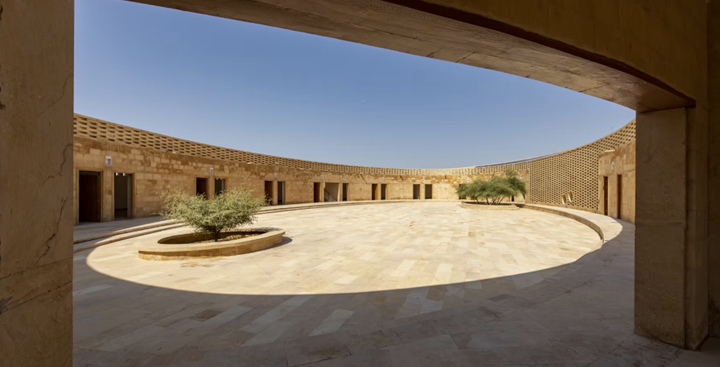
Despite standing in a region infamous for temperatures soaring above 45°C, the school relies almost entirely on passive environmental design. Its architecture engages with nature rather than fighting it. The elliptical structure guides prevailing winds through the building, while strategically placed openings and stone jali screens accelerate ventilation. As these hot winds pass through the shaded interiors and the cool earth around the courtyard, they lose their intensity, creating a comfort zone that feels miraculous in the desert heat. At the heart of the building lies the central courtyard, a timeless Indian typology that here becomes a microclimatic heart, ensuring continuous shading, airflow, and natural illumination. The solar panel canopy suspended above the courtyard performs dual functions: it generates sustainable energy while also forming a protective second roof that diffuses sunlight and reduces heat gain. Each element—form, material, and void—works together in a climatic choreography that makes the school a model of desert sustainability.
( Architect Magazine; AIA NY Project Narrative)
Light, Shadow, and the Poetry of Stone
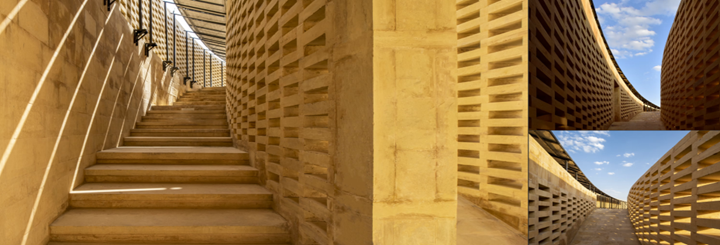
Inside the school, light itself becomes a design material. As the sun moves across the sky, the jali screens cast shifting patterns on the stone floors—intricate lattices that animate the spaces with a soft, ever-changing glow. These screens, hand-carved by local craftsmen, balance tradition with innovation. They reduce glare, cut direct solar radiation, and create a pressure difference that encourages wind to move faster through the openings, naturally cooling the interiors. Walking through these corridors is like moving inside a living sculpture—one shaped not only by the architect’s vision but also by the sun, the wind, and the hands of artisans who transformed raw stone into breathable walls. (Culture now; Archilovers)
Interiors That Celebrate Culture, Craft, and Community
The interior spaces extend the building’s philosophy of community and cultural continuity. Classrooms are furnished with locally crafted rosewood furniture, some of which incorporates traditional charpai weaving techniques, connecting the children to familiar household craftsmanship. Along one of the walls, a series of hand-carved sandstone medallions paired with diya niches forms a symbolic tapestry of gratitude and memory, honoring donors and community members who contributed to the project. These interiors are not minimalistic abstractions; they are culturally textured spaces where learning happens in an environment deeply tied to Rajasthani identity. (Culture Now project description)
Water, Energy, and Environmental Wisdom
In a region where water scarcity defines life, the school becomes a model of environmental stewardship. Traditional rainwater harvesting methods have been reinterpreted to collect and store precious monsoon rainfall, while greywater systems ensure that not a drop goes to waste. The solar canopy powers essential building functions, reducing dependency on the unreliable electrical grid. In this sense, the school is not only a place of academic learning—it is itself a lesson in sustainability, teaching students the ecological intelligence needed for the future of desert living. (Steam news Engineering Feature)
A Global Beacon of Architectural Excellence
Graphic to insert here: Award badges and publication features
The Rajkumari Ratnavati Girls School has garnered global attention for its cultural sensitivity, sustainability, and sculptural beauty. It received the AIA New York Honor Award and has been featured in leading design publications around the world, celebrated as a rare example of architecture that is simultaneously socially impactful, environmentally attuned, and aesthetically transcendent.
[Reference: AIA NY Awards; Architect Magazine]
Conclusion: A School That Teaches Even When Empty
The power of the Rajkumari Ratnavati Girls School lies in its refusal to be ordinary. It proves that architecture can dignify and uplift, even in the most remote and challenging environments. It stands as a symbol of empowerment for the girls it serves, a triumph of design for the community it nurtures, and a benchmark for sustainable architecture worldwide. In the silence of the desert, this building speaks of resilience, of culture, of intelligence, and of hope. Long after the school day ends, its very walls continue to teach.
(Image Source: dk architects)