

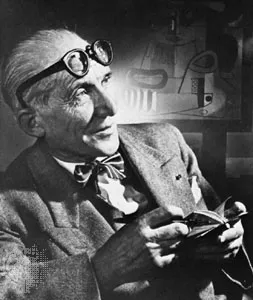
Charles-Édouard Jeanneret (1887–1965), known as Le Corbusier, was born in La Chaux-de-Fonds, Switzerland. He left formal schooling at 13 to study enameling and engraving at the local École des Arts Décoratifs, where his teacher Charles L’Éplattenier recognized his talent and apprenticed him in architecture. Le Corbusier traveled Europe (1907–11) studying historic architecture, then moved to Paris and became a leader of the International Style. He and painter Amédée Ozenfant founded the Purism movement and edited the journal L’Esprit Nouveau. In 1923 he published Vers une architecture, famously declaring that “a house is a machine for living in”. (He adopted the name “Le Corbusier” by 1920 and later became a French citizen.) Over his career he wrote prolifically on architecture and urbanism and designed dozens of buildings worldwide.
Major Works
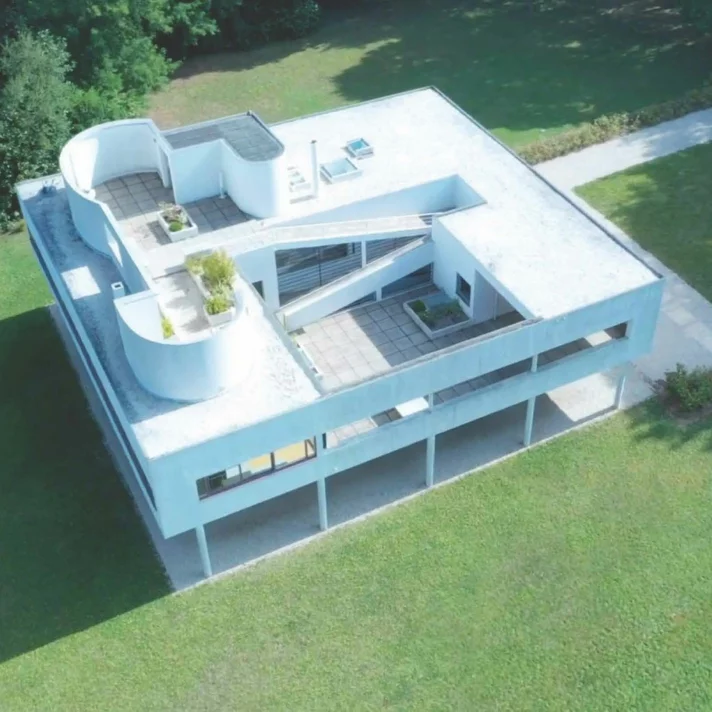
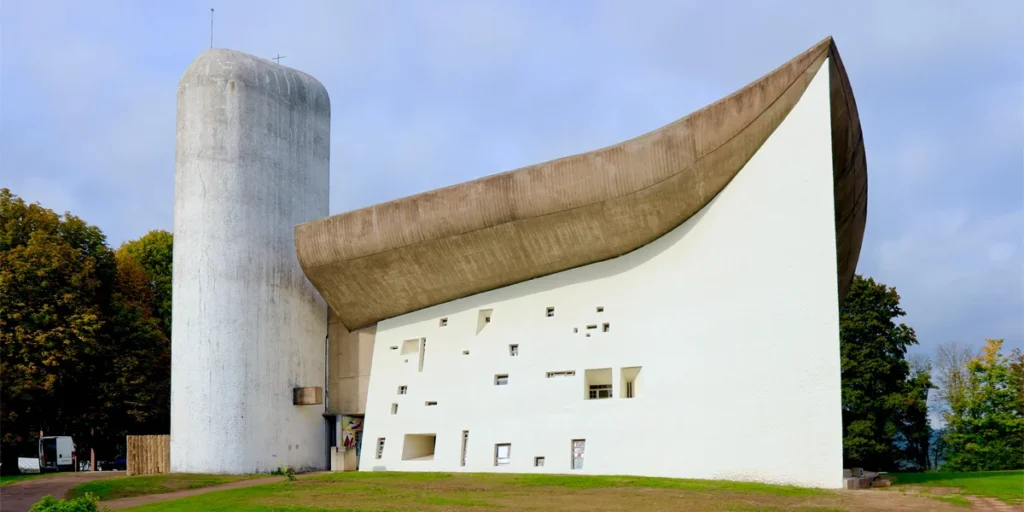
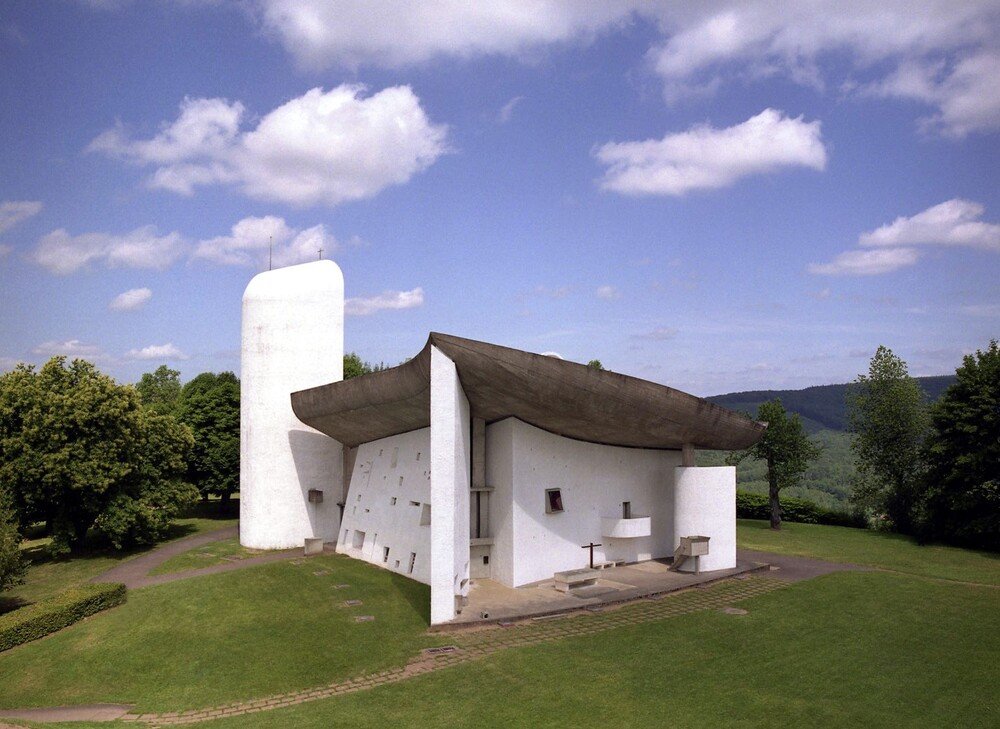
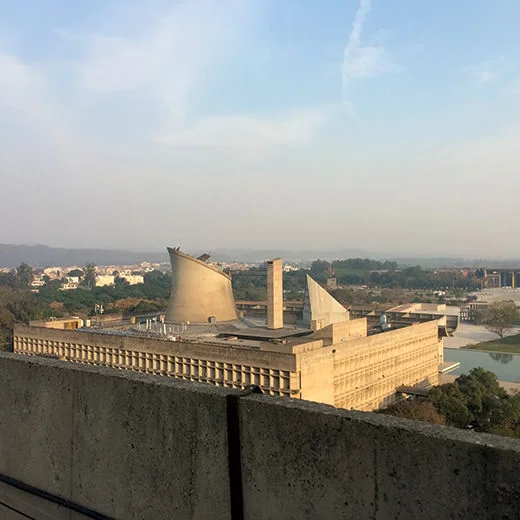
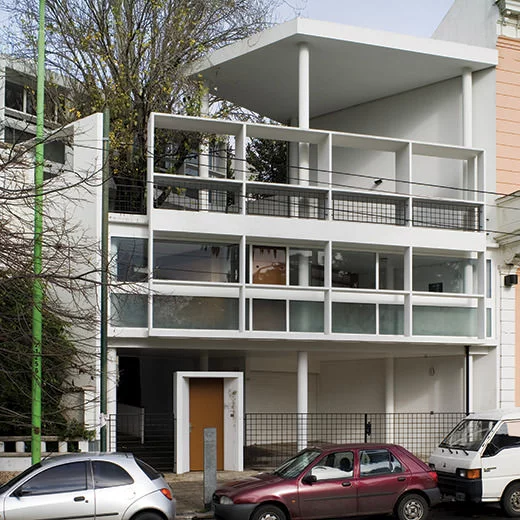
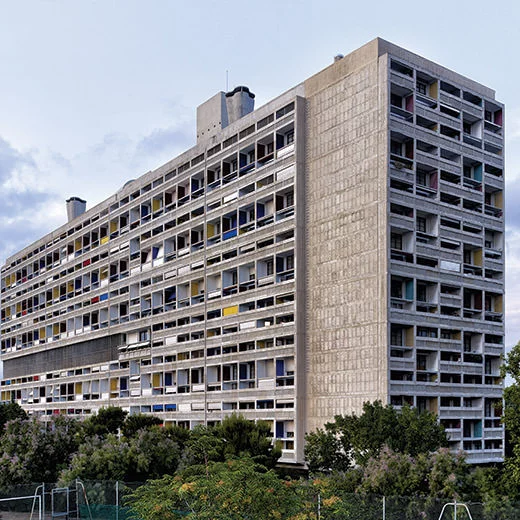
Le Corbusier’s key buildings exemplify his modernist ideals. Villa Savoye (Poissy, France, 1928–1931) is a rural country house on pilotis with open-plan interiors and ribbon windows, embodying his Five Points of Architecture. UNESCO calls Villa Savoye “an icon for the Modern Movement”. Unité d’Habitation (Marseille, France, 1947–1952) is a large housing block on pilotis containing 330 apartments (23 storeys) with shops, hotel, rooftop terrace and communal facilities. It became the founding prototype of Brutalist, communal housing. Notre-Dame du Haut (Ronchamp, France, 1950–1955) is a small concrete chapel with sculptural curved walls and colored windows; its bold form “bears witness to a turning point in 20th century architecture”. In India, Le Corbusier master-planned Chandigarh (1951–1965), a new capital city, and designed its Capitol Complex (the Assembly, Secretariat and High Court buildings). The complex, completed in 1952–53, is UNESCO-listed as “the largest monumental complex designed and built by Le Corbusier”. Another major work is the Dr. Curutchet House (La Plata, Argentina, 1949–1955) – his only Latin American project – which integrates all his principles (pilotis, free plan/façade, roof garden) and helped spread modernism abroad.
| Work | Location | Dates | Architectural Significance |
|---|---|---|---|
| Villa Savoye | Poissy, France | 1928–1931 | Icon of Modernism; embodies Le Corbusier’s Five Points. |
| Unité d’Habitation | Marseille, France | 1947–1952 | Prototype of communal high-density housing (330 apartments); founding work of Brutalism. |
| Notre-Dame du Haut | Ronchamp, France | 1950–1955 | Landmark pilgrimage chapel with sculptural concrete form; revolutionary religious architecture. |
| Capitol Complex, Chandigarh | Chandigarh, India | 1951–1965 | Planned modern capital city; assembly, secretariat, court buildings; “largest monumental complex”. |
| Dr. Curutchet House | La Plata, Argentina | 1949–1955 | Only Corbusier house in Latin America; uses pilotis, free plan/façade, roof garden. |
Architectural Philosophy
Le Corbusier championed functionalism, precision and new forms. He articulated the Five Points of Architecture – (1) pilotis (slender supports lifting the building), (2) a free façade, (3) an open floor plan, (4) horizontal ribbon windows, and (5) roof gardens – as the basis of his style. Villa Savoye “embodies all 5 points of a new architecture”. He viewed houses as “machines for living in”, optimizing light, air and space. Le Corbusier also developed the Modulor, an anthropometric scale of proportions, to harmonize his designs with human dimensions (used in the Unité and Curutchet House).
In urban planning, he promoted the Radiant City (Ville Radieuse) ideal: a utopian plan of high-rise residential towers amid green parkland, with strict zoning of functions (residential, commercial, civic). He was a founder of the Congrès Internationaux d’Architecture Moderne (CIAM) in 1928 and a principal author of the Athens Charter (1933), which argued for functional city zoning. UNESCO notes that concepts from the Charter were realized in his work: the Unité d’Habitation embodied the Athens Charter’s aims for collective housing, and Chandigarh’s Capitol is “the most complete” realization of his Radiant City principles. Le Corbusier’s city plans always emphasized order, geometry, sunlight and traffic separation.
Le Corbusier surveys the site of Chandigarh in 1951. His plan organized the new capital by sectors (residential, governmental, etc.) and placed the monumental Capitol Complex (Assembly, Secretariat, Court) at its head.
Also Read: Sir Edwin Lutyens: Architect of Imperial Grandeur and Timeless Urban Design
Influence and Legacy
Le Corbusier was enormously influential during his life and after. He “revolutionized architecture by demonstrating… the invention of a new architectural language” and effectively launched modern trends like Purism, Brutalism and expressive sculptural design. UNESCO observes that many of his works “immediately assumed an iconic status” and had “world-wide influence”. For example, the Curutchet House inspired Latin American Modernism, the Tokyo National Museum (1950) helped cement modernism in Japan, and Chandigarh’s buildings symbolized India’s new independent identity. Seventeen Le Corbusier sites are now UNESCO World Heritage properties (inscribed 2016).
Even as he was lauded with major awards (Royal Gold Medal 1953, AIA Gold Medal 1961), some of Le Corbusier’s ideas sparked debate. His abstract high-rise city schemes were criticized (notably by Jane Jacobs and others) for overlooking street life and local context. Nevertheless, his rigorous vision – with its emphasis on function, technology and bold form – became a touchstone for generations of architects. By showing that architecture could be a precise, socially ambitious art of living, Le Corbusier left an indelible mark on the built world.
Sources: Authoritative architectural literature and archives were consulted, including the UNESCO World Heritage dossier on Le Corbusier’s workwhc.unesco.orgwhc.unesco.org, the Encyclopædia Britannica biographybritannica.com, and the Fondation Le Corbusier archivesfondationlecorbusier.frlecorbusier-worldheritage.org. These detail his life, major projects and philosophy, as well as scholarly assessments of his global impact.