

Gateway to the Eastern Himalayas
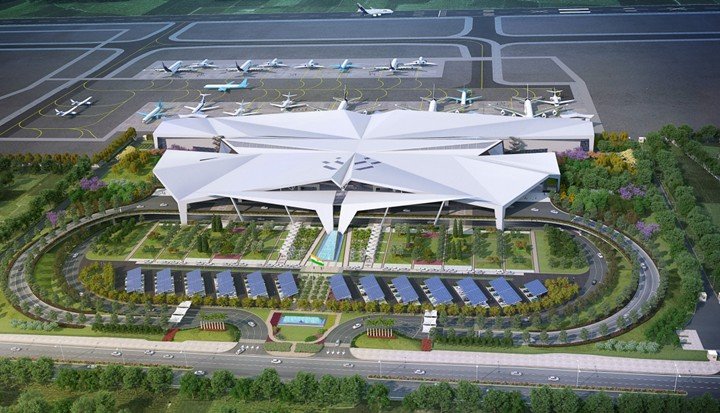

Lokpriya Gopinath Bordoloi International Airport (LGBI), Guwahati, has long served as the primary aerial gateway to North‑East India. Strategically located near the Brahmaputra River and within a fragile ecological landscape defined by wetlands, hills, and floodplains, the airport occupies a crucial role not only in regional connectivity but also in shaping the urban and environmental narrative of Assam. The inauguration of the New Integrated Terminal Building (Terminal 2), designed by Architect Nuru Karim (NUDES), marks a decisive shift in Indian airport architecture—where infrastructure transcends functionality to become a cultural, ecological, and spatial experience.
From Capacity Saturation to Visionary Expansion: Project Timeline
By the early 2010s, Guwahati Airport’s existing terminal—designed to handle approximately 850 passengers at peak hour—had reached saturation due to rapid growth in air traffic across the North‑East. Daily aircraft movements touched nearly 75, with more than 5 million annual passengers by the mid‑2010s, necessitating immediate expansion. The formal planning process commenced in 2015–16, followed by the Ministry of Environment, Forests, and Climate Change’s approval of the Terms of Reference in October 2016 for a full Environmental Impact Assessment. Detailed design development, sustainability integration, and seismic safety planning were undertaken between 2017 and 2019. Construction progressed in phases through the early 2020s, culminating in the operationalization of the new terminal in 2024–25. International recognition soon followed, with Terminal 2 receiving global architectural and design awards in 2025.
Scale, Capacity, and Engineering Statistics
The New Integrated Terminal Building spans approximately 90,000 square meters, with an additional 7,500 square meters of service basement area. Designed to handle 3,100 passengers at peak hour—2,900 domestic and 200 international—the terminal aligns with IATA Level of Service ‘B’ in its initial years, transitioning to Level ‘C’ at saturation.
The project, executed by the Airports Authority of India, represents an investment of nearly INR 1,232 crore. Supporting infrastructure includes a multi-level car parking facility for over 1,500 vehicles, dedicated bus bays, a four-lane approach road with canopy cover, and segregated circulation for passengers, staff, and VIP movement.
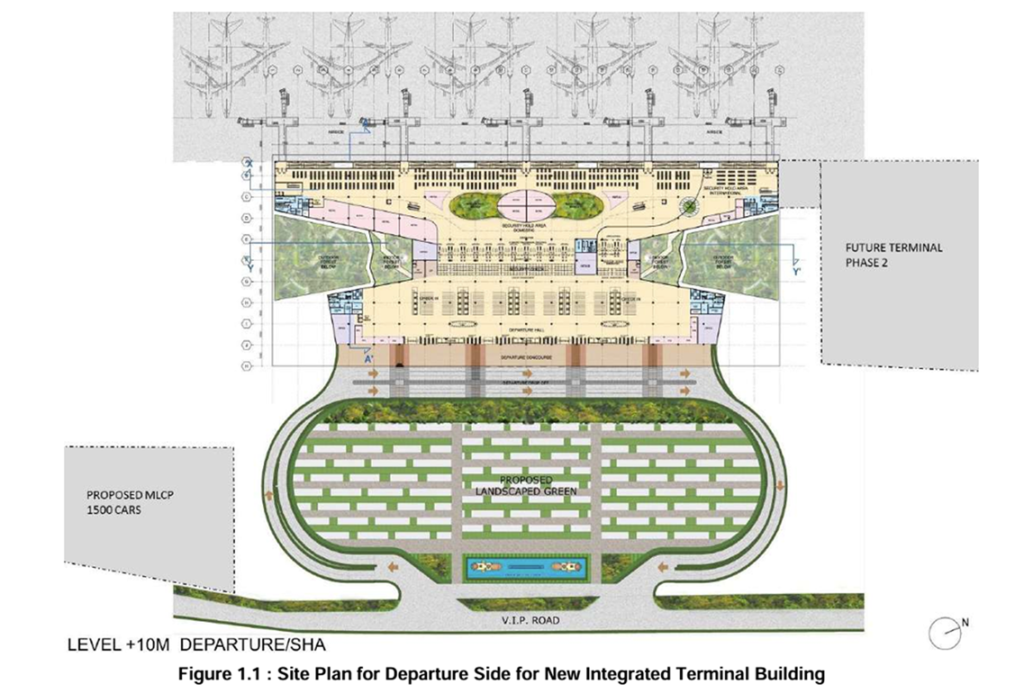
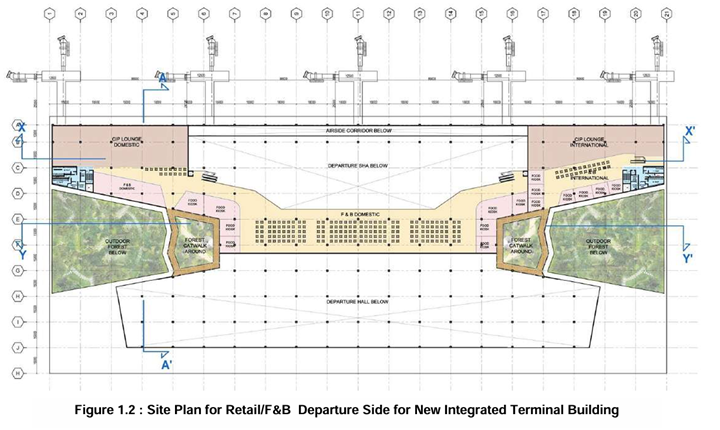
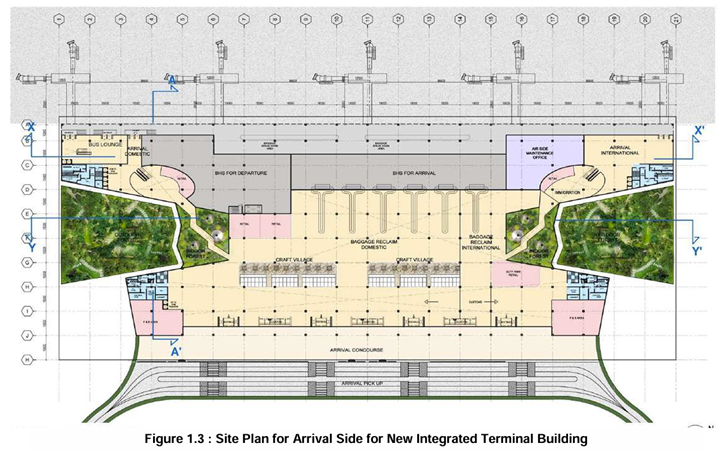
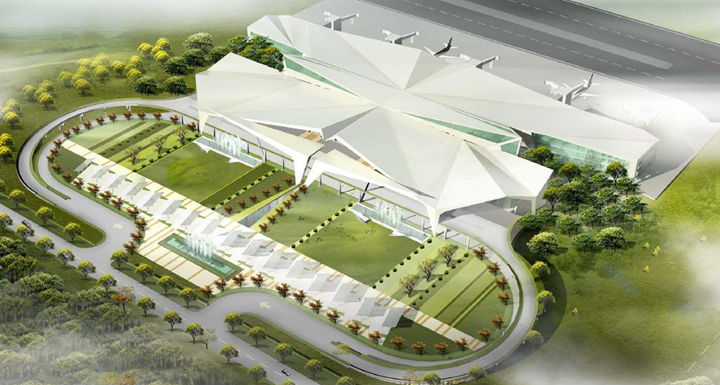
Layout Plans showing the spatial scale and operational capacity of the New Integrated Terminal Building. (Image source: AAI)
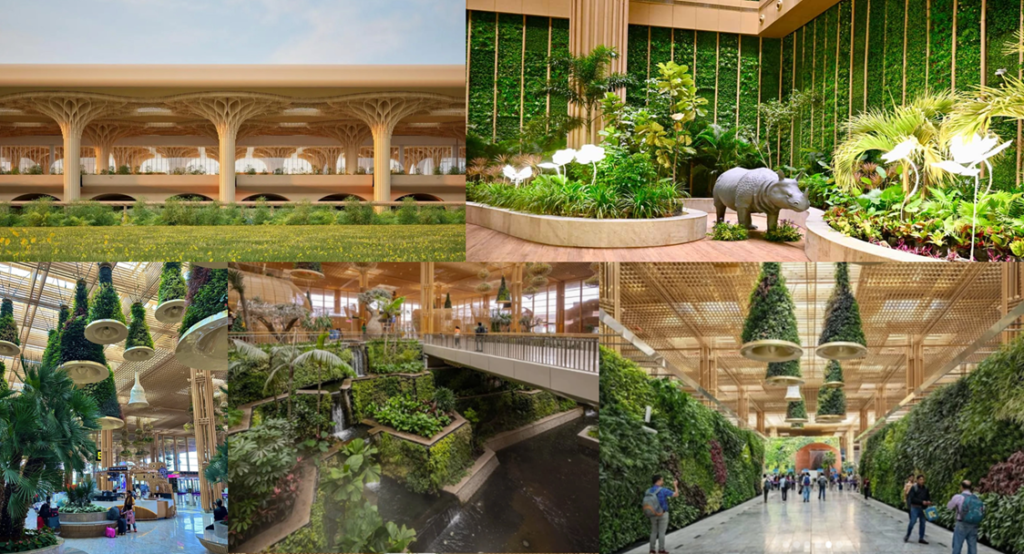
Architecture Rooted in Place: Nature as Design Language
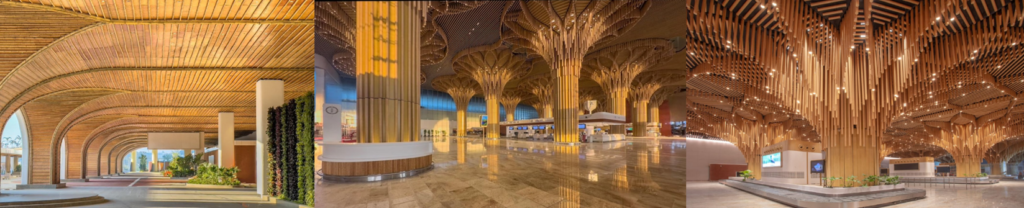
Guwahati Airport Terminal 2 has been widely recognized as India’s first nature-themed airport terminal. The architectural concept draws inspiration from Assam’s landscapes, ecology, and cultural motifs. The most striking interior feature is the series of sculptural columns inspired by the ‘Kopou Phool’—the fox‑tail orchid that symbolises Assamese womanhood and spring festivities such as Bohag Bihu.
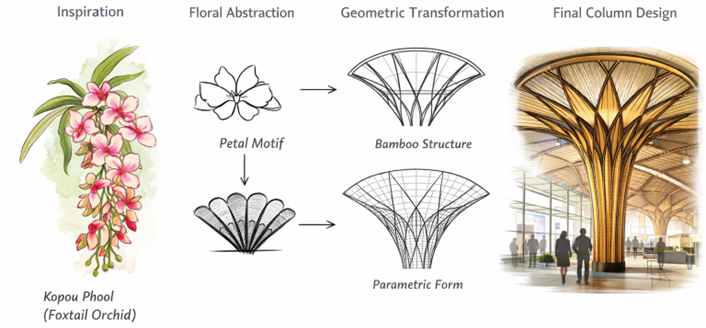
The roof form evokes the undulating topography of the Eastern Himalayas, while interiors integrate bamboo textures, earthy palettes, and filtered daylight to create a sense of calm transition between land and sky. Rather than relying on overt ornamentation, the design employs abstraction and parametric geometry to reinterpret vernacular elements within a contemporary aviation environment.
Sustainability, Climate Response, and GRIHA Integration
Sustainability forms a core pillar of the terminal’s design. The building has been planned to achieve a 4-Star GRIHA rating under GRIHA Version 2015, integrating passive and active energy‑efficiency strategies.
The terminal’s total electrical demand is estimated at approximately 7.5 MW, supplied through a 33 kV grid connection supported by two 10 MVA transformers. A solar photovoltaic plant of around 540 kW capacity has been installed, contributing to on-site renewable energy generation and reducing dependency on conventional power sources.
Water management is addressed through an integrated system requiring about 710 kilolitres per day of fresh water, supplemented by recycled water to reach a total operational demand of nearly 1,010 KLD. Sewage generated—approximately 810 KLD—is treated in a 1,000 KLD Membrane Bioreactor-based Sewage Treatment Plant, with treated water reused for HVAC systems, flushing, and landscaping.
Environmental Sensitivity and Regional Ecology
The airport lies within a sensitive ecological context, with the Brahmaputra River flowing approximately 2.2 km to the north and the Deepor Beel Ramsar wetland located about 3 km away. Environmental studies confirm that aircraft noise contours do not significantly impact the Deepor Beel Bird Sanctuary, and mitigation measures such as green buffers and controlled waste management have been incorporated.
Guwahati falls under Seismic Zone V, the highest seismic risk category in India. Accordingly, the terminal structure has been engineered with advanced seismic design provisions, ensuring resilience against earthquakes while maintaining long-span spatial efficiency.
Passenger Experience and Interior Planning
The terminal integrates departure, arrival, and security hold areas with clear wayfinding, generous queuing spaces, and visual connectivity. Facilities include advanced baggage handling systems, immigration counters, duty-free retail, food and beverage courts, lounges, and accessibility‑compliant infrastructure for persons with reduced mobility.
A centralised Building Management System optimises lighting, HVAC, and energy use, while extensive glazing and controlled daylight reduce reliance on artificial lighting. The interior planning balances commercial viability with spatial comfort, avoiding congestion even during peak operational hours.
Economic Catalyst for the North‑East
Beyond architecture, Terminal 2 functions as a regional growth engine. During construction and operation, the project has generated significant direct and indirect employment. Enhanced passenger capacity strengthens Guwahati’s role as an inter-regional hub, improving access to tourism circuits, trade corridors, and cultural destinations across Assam and neighbouring states.
Cargo handling capacity at the airport has also recorded new milestones in recent years, reinforcing Guwahati’s strategic importance in logistics and perishable goods movement within the North‑East.
Recognition on the Global Stage
The terminal’s synthesis of parametric design, cultural symbolism, and environmental responsiveness has earned it international acclaim, including recognition at global architecture and design awards in 2025. Jurors have highlighted its ability to embed regional identity within a high-performance infrastructure typology—an approach increasingly relevant for future public architecture in India.
Redefining Indian Airport Architecture
Guwahati International Airport’s Terminal 2 stands as more than an expansion project. It represents a paradigm shift in how large-scale infrastructure can respond to place, ecology, and culture without compromising efficiency or safety. Rooted in Assam’s natural and cultural landscapes, engineered for resilience, and celebrated globally for its design excellence, the terminal sets a new benchmark for context-responsive airport architecture in India and the Global South.