

There is a peculiar kind of chaos that defines many residential colonies in Delhi. It does not erupt from high-density markets or unregulated slums. It emerges quietly in the narrow strip of land between the compound wall and the asphalt road — a strip that belongs to everyone and, in practice, to no one. This ambiguous edge has become one of the most contested and mismanaged parts of our neighbourhoods.
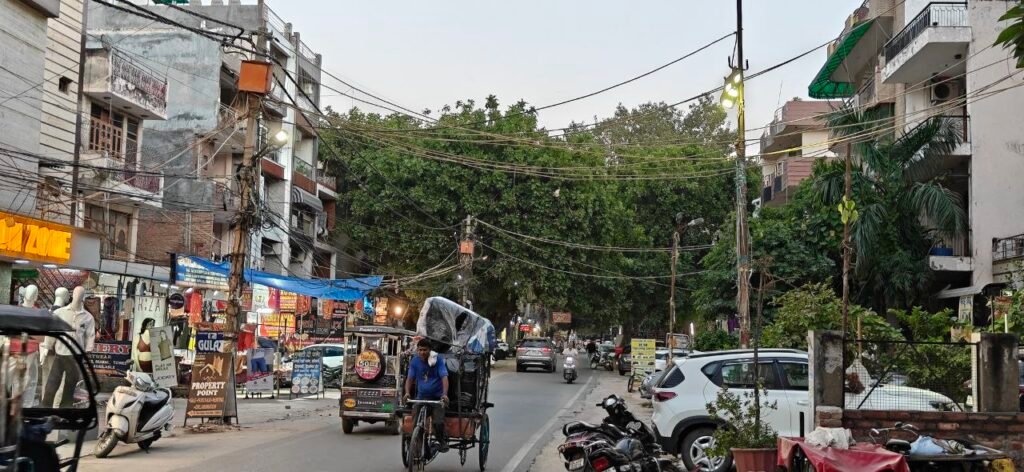
Walk through almost any plotted colony and the pattern repeats itself. Footpaths are uneven, abruptly raised or lowered to accommodate individual driveways. Kerbs disappear without warning. Two-wheelers are parked diagonally across pedestrian paths. Cars are stationed permanently in what was meant to be public movement space. Trees are encircled with improvised brickwork to create territorial markers. Metal grills, planters, ramps, loose stones and even construction debris are used to informally claim space. Overhead wires sag from façade to façade, completing the visual clutter.
None of these elements appear dramatic in isolation. Together, they create a streetscape that feels defensive, fragmented and perpetually in dispute.
The core problem is not merely encroachment; it is ambiguity. The space outside residential gates is legally public, but socially treated as semi-private. Residents sweep it, light it, and often believe they have first rights over it. When someone else parks there, conflict begins. When a shop extends its display rack a few feet outward, resentment grows. When one homeowner builds a ramp that blocks drainage flow to the neighbour’s frontage, accusations follow.
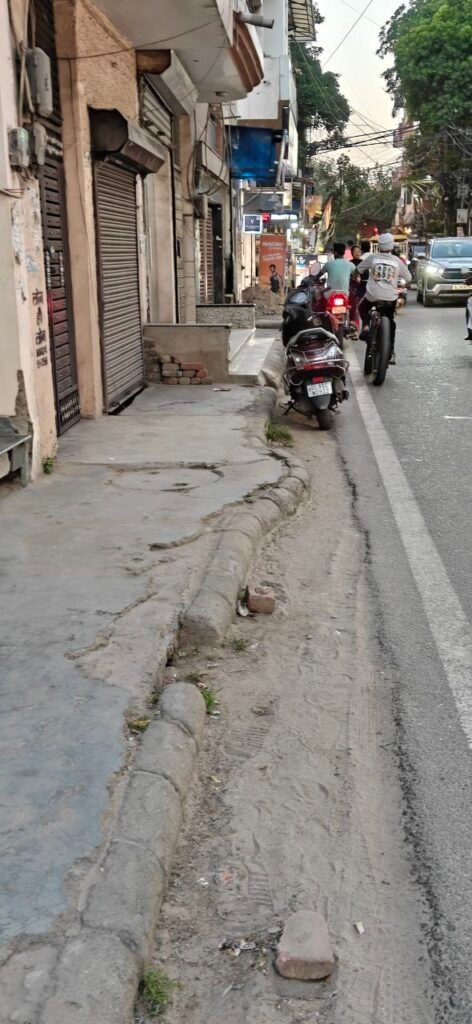
Because the boundary between public and private is not clearly defined or consistently maintained, everyone improvises. And improvisation, repeated plot by plot, produces disorder at the street scale.
In many colonies, the footpath is no longer a continuous pedestrian surface but a patchwork of individual modifications. Each property owner has altered the level to suit personal convenience. The result is a hazardous, discontinuous surface that excludes elderly residents, children, and persons with disabilities. Walking becomes secondary; vehicles dominate by default.
Also Read: Nehru Place: History, Present, and the Urban Life of a Planned Marketplace
Parking, in particular, exposes the structural failure of these streets. With limited off-street provision and weak enforcement, the frontage becomes the most convenient storage space for private vehicles. What was once intended as shared civic space turns into a contested parking bay. Pedestrians are pushed onto the carriageway. Cyclists negotiate with moving cars. Street vendors squeeze into leftover pockets. The street becomes an arena of negotiation rather than a system of order.
Commercial spillover intensifies the pressure. Small shops installed in residential buildings extend signage, merchandise racks and temporary sheds into the street. Without a coherent framework, each addition appears incremental and harmless. Collectively, they erode spatial clarity and visual coherence. The colony begins to look temporary, even when it is decades old.
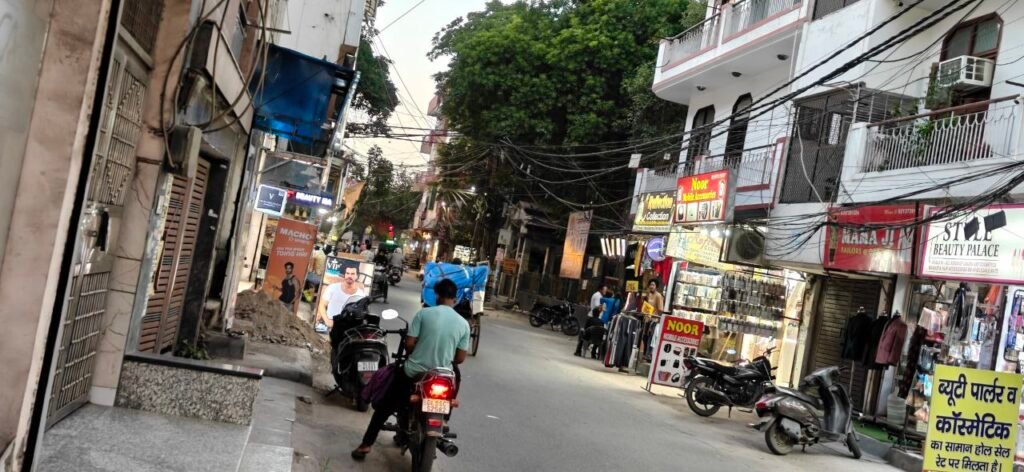
Perhaps the most damaging consequence is social rather than physical. These semi-public spaces are where neighbourly relations are tested daily. Arguments over parking, drainage, boundary lines and encroachments become routine. A strip of concrete becomes a trigger for hostility. When spatial norms are unclear, social norms deteriorate.
Authorities cannot claim ignorance. The uneven footpaths, exposed services, illegal extensions and unmanaged parking are visible conditions. Yet interventions are episodic and fragmented — a repaired patch here, a resurfaced stretch there — without addressing the continuity of the street as a whole. Maintenance contracts focus on engineering tasks, not on the lived experience of the corridor.
Residents, on the other hand, often justify individual alterations as necessities. A ramp is required to bring the car inside. A planter is installed to prevent strangers from parking. A low boundary wall is built to “protect” the frontage. Each action is rational at the household scale but destructive at the neighbourhood scale.
The uncomfortable truth is that Delhi’s residential colonies suffer from a deficit of collective discipline. We invest heavily in building interiors and façades but neglect the shared ground that connects us. The threshold between home and city is treated as leftover space rather than as civic infrastructure.
This is not a cosmetic issue. Poorly managed edges affect drainage, accessibility, safety, emergency vehicle access, and environmental performance. They also shape the psychological quality of a neighbourhood. A coherent, level, obstruction-free frontage communicates care and shared responsibility. A fragmented and encroached edge communicates indifference.
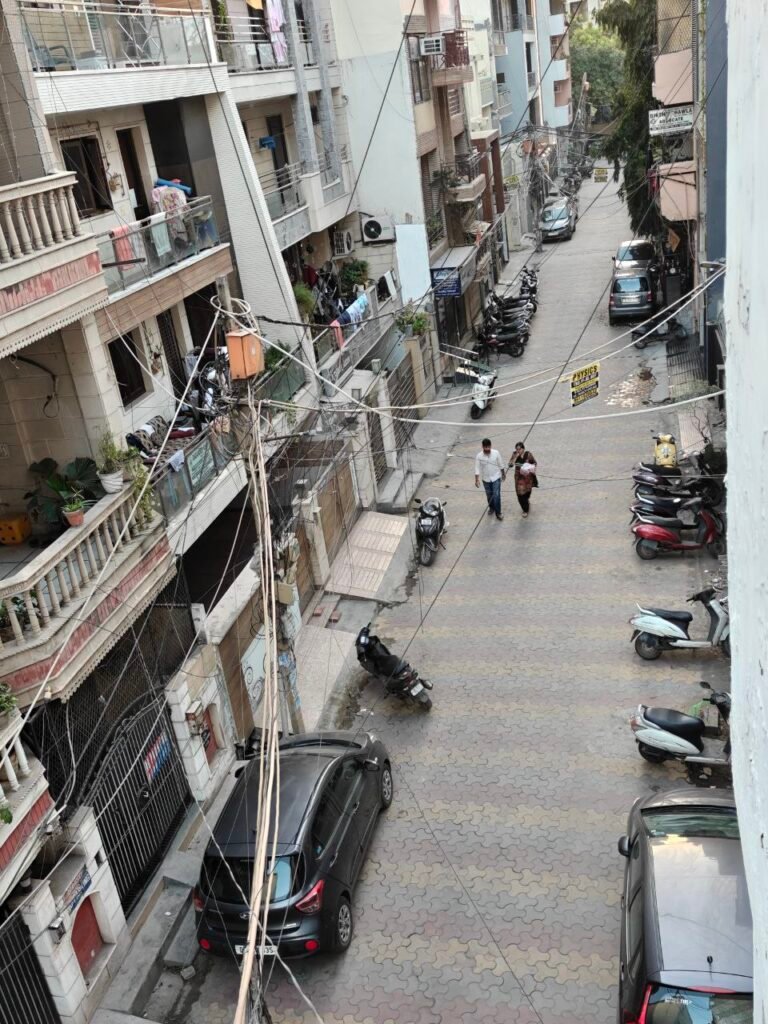
If Delhi is serious about improving liveability, attention must shift from monumental infrastructure to everyday streets. Clear demarcation of pedestrian space, consistent kerb levels, rational parking management, regulated commercial spillover and coordinated service infrastructure are not luxuries. They are basic requirements of a functioning urban society.
More importantly, residents must reconsider their relationship with the space outside their gates. It is not an extension of private property. It is a shared civic asset. Without collective restraint and institutional enforcement, this semi-public strip will continue to produce friction — spatially and socially.
Cities are judged not only by their skylines but by the dignity of their sidewalks. In Delhi’s colonies, that judgment is currently harsh. The chaos outside our gates is not inevitable. It is the product of neglect, ambiguity and fragmented responsibility. And until we confront it with seriousness, neighbourhood harmony will remain as uneven as the footpaths themselves.
Also Read: Jail Road, West Delhi: A 2-km Urban Corridor That Carries Commerce, Culture, and Chaos
This article is based on on-ground observations by The APN across several West Delhi colonies, documenting uneven footpaths, encroachments, parking chaos and undefined frontage spaces that are affecting daily life and neighborhood harmony.