

The India Habitat Centre recently hosted the ninth session of the “Architecture Matters IX” series, curated by Professor K.T. Ravindran in collaboration with the Raza Foundation. The talk, titled “Act of Space: People, Place, and the Written Word”, brought together architects, sociologists, and thinkers to explore how cities are shaped not only by built forms but also by language, memory, and human interaction.
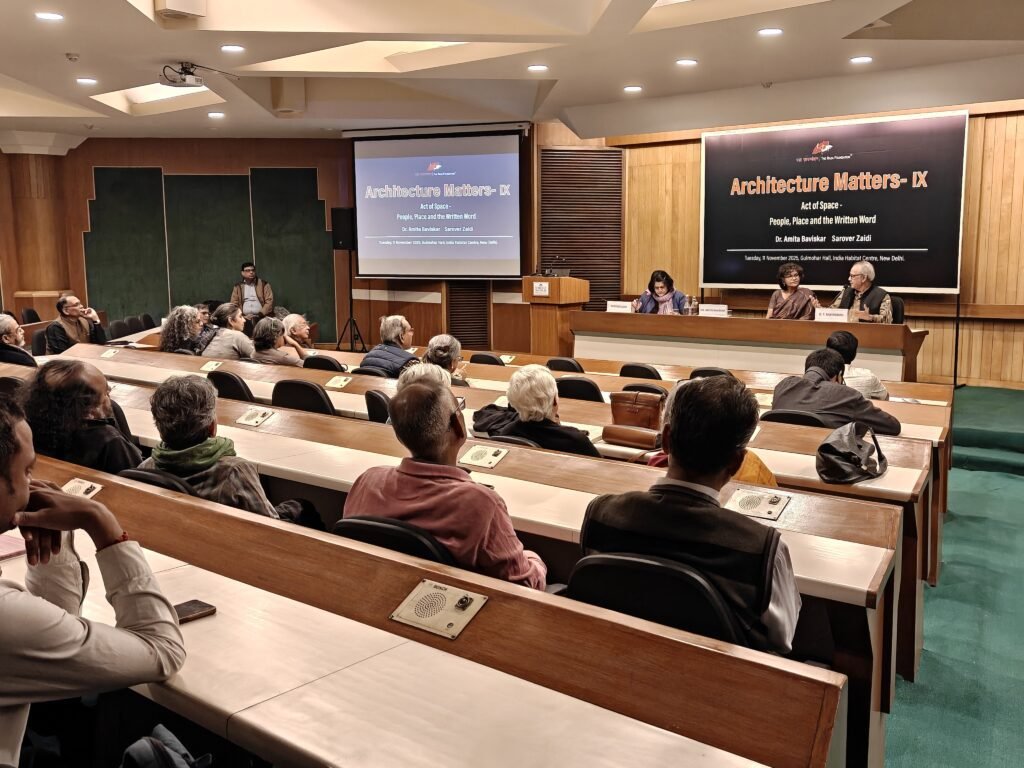
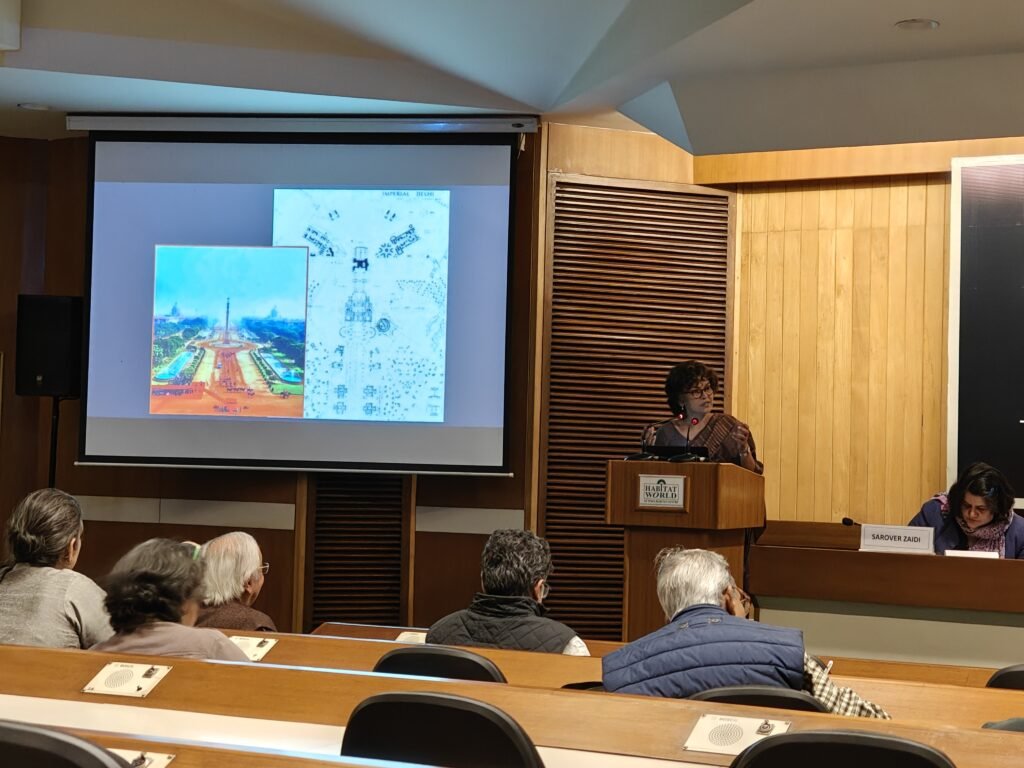
The session featured two distinguished speakers — Professor Amita Baviskar, sociologist and environmental scholar from Ashoka University, and Professor Sarover Zaidi, anthropologist and educator at the Jindal School of Art and Architecture. Together, they delved into how urban life, culture, and architecture intertwine to construct meaning, belonging, and social order in contemporary Indian cities.
The City as Text and the Power of the Written Word
Professor Amita Baviskar spoke on how the city itself can be read as a text — an inscription of power, class, and aspiration. Drawing from Michel de Certeau’s concept of “the practice of everyday life”, she reflected on how ordinary citizens — the walkers, vendors, and laborers — continuously rewrite this urban text through their daily movements and adaptations.
“The city is not just designed by architects or planners,” she emphasized, “but is continuously remade through everyday acts of living — walking, selling, protesting, and surviving.”
Baviskar also questioned whose stories get written into the city’s records — highlighting how the powerful written words in legal documents, court judgments, and urban plans determine who has the right to inhabit space. She cited examples of working-class families displaced under the guise of “public interest” and drew attention to the idea of “bourgeois environmentalism” — where urban elites impose their notion of cleanliness and order, often at the expense of the poor.
In a poignant segment, she read translations of short Hindi stories written by young women from Delhi’s informal settlements as part of the Ankur Writers Collective. These narratives — of resilience, domestic spaces, and humor in hardship — illustrated how writing becomes an act of spatial reclamation for those often rendered invisible in city planning.
Horizons and Courtyards: The Languages of Architecture
Professor Sarover Zaidi followed with a talk titled “Horizons and Courtyards: The Languages of Architecture”, tracing her decade-long research from Bhendi Bazaar in Mumbai to sites across India. She explored how the built environment functions as a form of language — one that carries histories, politics, and emotions.
Zaidi discussed how architectural forms migrate and transform across regions — from the Indo-Islamic influences in Mumbai’s Mughal Masjid built by the Iranian diaspora, to the contested urban fabric beneath the JJ Flyover, where modern infrastructure literally overshadows older Muslim neighborhoods.
“Architecture,” she said, “is both performance and resistance. When communities build new towers in Bhendi Bazaar, they are not just redeveloping; they are rewriting their own horizon — reclaiming visibility and dignity.”
She connected the idea of the “horizon” to political and philosophical thought — from the Indian Ocean world’s histories of exchange to modern-day reconfigurations of power seen in Ayodhya and Central Vista, where architecture becomes a symbol of ideology and control. Her presentation intertwined personal fieldwork, historical narrative, and philosophical reflection, illustrating how built forms can both liberate and dominate.
Dialogue and Reflections
Professor Ravindran, moderating the discussion, praised both speakers for expanding the meaning of architecture beyond its physicality.
“The power of the written word,” he noted, “touches the subjectivity of space in ways no drawing can. Language gives architecture its song — its rhythm in culture.”
The ensuing discussion brought thought-provoking questions from architects, students, and urbanists in the audience. One participant asked how embodied cultural practices of city life could be integrated into policy frameworks. Both speakers agreed on the challenge, pointing out that capital and bureaucracy often determine which forms of architecture endure — while the lives of the marginalized remain transient, undocumented, and yet profoundly human.
Another architect questioned how practicing architecture today, amid shifting political and environmental realities, can remain ethical and relevant. Zaidi responded that while it is a “tough time to practice,” it is a crucial time to teach — to continue conversations that reconnect architecture to social life and responsibility.
A Space for Thinking, Not Just Building
The “Architecture Matters” series, now nearing its tenth edition, has emerged as a unique platform in Delhi’s intellectual landscape — one that moves beyond showcasing projects to fostering dialogue on habitation, culture, and meaning. As Ravindran described, “These talks are not about solutions, but about stimulating thought.”
Through this series, the Raza Foundation and India Habitat Centre continue to create a rare civic space where architecture meets philosophy, art, literature, and lived experience — reminding us that cities are not merely built; they are continuously imagined, narrated, and inhabited.