

The submission deadline for ‘TOD-Reimagined design competition for Reimagining Sustainable Mobility in Transit-Oriented Development (TOD) Areas of Pune’ has been extended to February 15, 2026, providing participants additional time to refine and submit their proposals.
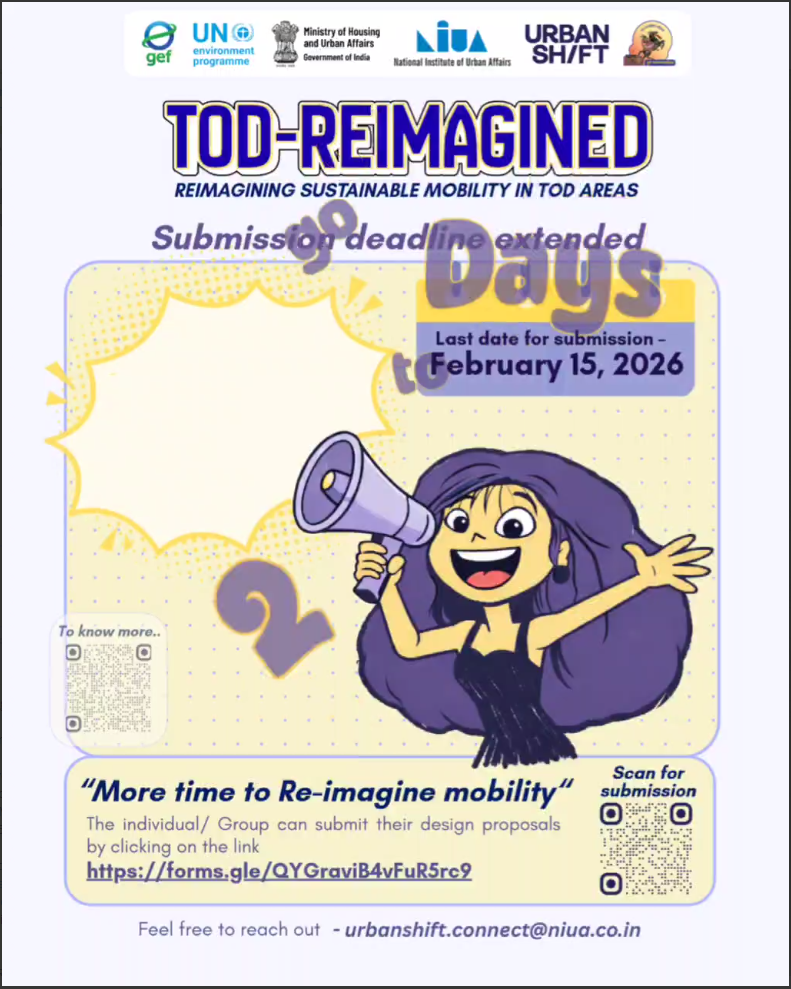
The national-level competition is being facilitated under the UrbanShift India initiative by the National Institute of Urban Affairs (NIUA), with support from the Ministry of Housing and Urban Affairs, Government of India, and international partners including UNEP and GEF. The initiative aims to encourage innovative, people-centric, and future-ready solutions for sustainable mobility within TOD influence zones.
Who Can Participate
The competition is open to all, including:
- Students and academic institutions
- Architects, urban designers, and planners
- Professional firms and consultancies
- NGOs, startups, and tech innovators
- Multidisciplinary teams and individual citizens
Participants are invited to propose inclusive and implementable design solutions that enhance walkability, cycling, public transport integration, and overall urban livability in TOD areas of Pune.
Key Highlights
- Theme: Reimagining Sustainable Mobility in TOD Areas
- Geographic Focus: Pune
- Prize Money: Cash awards up to ₹1,00,000
- Last Date for Submission: February 15, 2026
How to Submit
Design proposals can be submitted online through the official submission portal:
🔗 https://forms.gle/QYGraviB4vFuR5rc9
For any queries or clarifications, participants may write to:
📧 urbanshift.connect@niua.co.in
With the extended timeline, the organisers encourage wider participation and urge professionals, students, and institutions to leverage this opportunity to contribute meaningfully towards shaping sustainable, people-first urban mobility frameworks for Indian cities.
Participants are also encouraged to share the competition details across their professional and academic networks to amplify outreach and collaboration.
Also Read: Bamboo Housing Systems: IIT Kharagpur–BMTPC Prototype Shows a Viable Low-Carbon Alternative