

The Ministry of Railways has announced an ambitious, time-bound plan to double the train handling capacity of major Indian cities over the next five years, responding to sustained growth in passenger travel demand across the country. The initiative aims to significantly upgrade terminal infrastructure, operational efficiency, and sectional capacity in 48 key urban centres, with benefits expected to accrue progressively leading up to 2030. Indian Railways
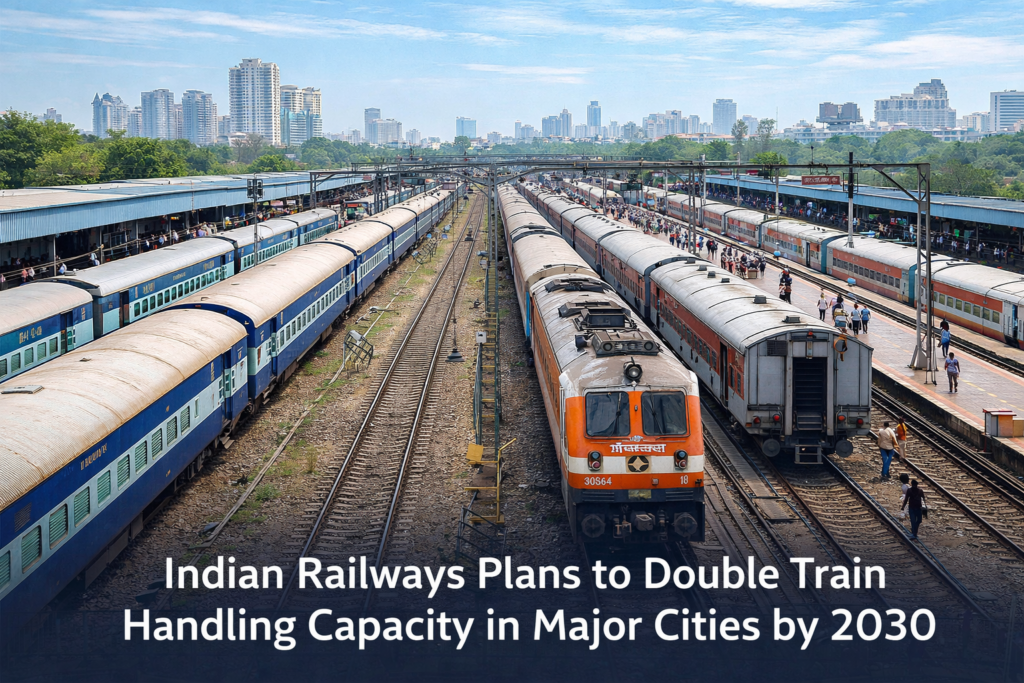
According to the Press Information Bureau (PIB), the current capacity of major cities to originate and terminate trains will be expanded through a multi-pronged infrastructure strategy. This includes augmentation of existing terminals with additional platforms, stabling lines, pit lines, and enhanced shunting facilities, alongside the development of new terminals in and around urban areas to decongest central railway stations.
A critical component of the plan is the creation and expansion of maintenance infrastructure, including mega coaching complexes, to support higher train volumes and ensure operational reliability. Simultaneously, sectional capacity enhancements—such as signaling upgrades, traffic facility works, and multi-tracking—will be undertaken to manage increased train movement across busy rail corridors.
Importantly, capacity expansion will not be limited to principal terminals alone. Stations located around major terminals will also be upgraded to ensure balanced load distribution across the urban rail network. For instance, in Pune, stations such as Hadapsar, Khadki, and Alandi have been identified for capacity enhancement alongside platform and stabling upgrades at Pune Junction. This integrated planning approach reflects a broader urban-regional mobility strategy rather than isolated station-level interventions.
The proposed measures will cater to both suburban and non-suburban rail services, acknowledging their distinct operational and passenger requirements. A comprehensive city-wise plan—covering works already sanctioned, proposed, or under planning—will define clear timelines and measurable outcomes, categorized into immediate, short-term, and long-term actions.
Union Minister for Railways, Information & Broadcasting, and Electronics & Information Technology, Ashwini Vaishnaw, emphasized the broader impact of the initiative, stating that the expansion of coaching terminals and sectional capacities is essential to meet rising passenger demand and reduce congestion. He noted that these upgrades will not only modernize railway infrastructure but also strengthen nationwide connectivity and operational resilience.
Beyond station-centric upgrades, all Zonal Railways have been instructed to plan capacity enhancement across their divisions, addressing operational bottlenecks at stations, yards, and rail sections. This systemic approach aligns with India’s long-term goals for sustainable urban transport, transit-oriented development, and integrated regional mobility planning.
As urban populations continue to grow and intercity travel intensifies, the Railways’ capacity-doubling programme represents a critical investment in India’s transport infrastructure—one that will shape urban form, accessibility, and economic connectivity over the coming decade.
Also Read: Cabinet Clears Three New Corridors Under Delhi Metro Phase V(A), Adding 16.07 km to Network