

The Ministry of Housing and Urban Affairs (MoHUA) organised a preparatory workshop on the Clean Himalayan and Hill Cities Initiative on 16 December 2025 at Vigyan Bhawan, New Delhi, aimed at developing a focused, strategic, and outcome-driven roadmap to achieve visible and sustainable cleanliness in Himalayan and hill cities.
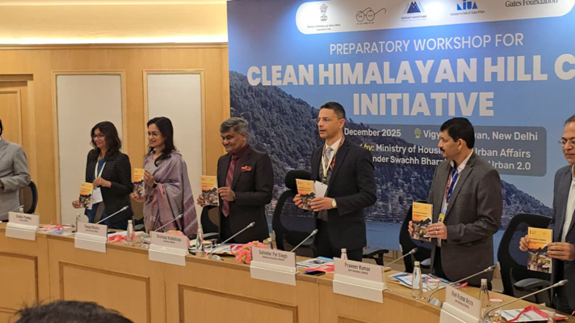
Presided over by Shri S. Katikithala, Secretary, MoHUA, the workshop brought together a wide spectrum of stakeholders including urban experts, technical agencies, private sector partners, technology solution providers, academic institutions, civil society organisations, and senior representatives from 13 Himalayan and North-Eastern hill cities. Select hill and foothill cities of West Bengal—Darjeeling, Kurseong, Kalimpong, Mirik, and Siliguri—were also included under the initiative.
The Clean Himalayan and Hill Cities Initiative was formally announced during the National Urban Conclave 2025 held on 8–9 November 2025, reaffirming the Swachh Bharat Mission–Urban (SBM-U) vision of achieving Garbage Free Cities through context-sensitive and region-specific solutions for hill cities.
Himalayan and hill states—including Jammu & Kashmir, Ladakh, Himachal Pradesh, Uttarakhand, Sikkim, Assam, Arunachal Pradesh, Meghalaya, Manipur, Mizoram, Nagaland, Tripura, and parts of West Bengal—face unique urban challenges due to fragile ecosystems, steep terrain, dispersed settlements, and extreme climatic conditions. While significant progress has been made under SBM-U, structural and geographical constraints continue to impact long-term solid waste and sanitation outcomes in these regions.
The workshop featured a series of thematic sessions focusing on practical and replicable solutions for hill cities. These included presentations on community-led waste management models, decentralised sanitation systems, and resource recovery initiatives that have demonstrated success on the ground. Inspiring community leaders from hill cities shared experiences related to mountain clean-up drives, plastic-free pilgrimage routes, and sanitation initiatives around religious and tourist destinations.
Technology-driven approaches tailored to hilly and cold regions were also discussed, covering integrated waste management systems, onsite sanitation solutions for colder climates, decentralised wastewater management, and advisories on the offtake and reuse of treated sewage sludge. The workshop emphasised the importance of cross-sector collaboration, highlighting how partnerships among government bodies, civil society, private players, and global development agencies can accelerate sustainable sanitation outcomes in hill cities.
Global best practices in community-driven waste management and decentralised sanitation were showcased, offering adaptable models relevant to the Himalayan context. An interactive roadmap ideation session enabled States and cities to collectively identify geographic challenges, priority sites, and actionable interventions for achieving visibly cleaner hill cities MoHUA Holds Preparatory Worksho….
During the workshop, MoHUA also launched key knowledge products to support climate-responsive urban sanitation in hilly regions. These included “Mountains of Change: Transforming Waste Management in Hilly Areas,” a compendium of best practices, along with advisories on Onsite Sanitation for Colder Regions and Promoting Offtake of Treated Sewage Sludge.
Following the workshop, participating States and Union Territories will undertake detailed assessments to identify priority focus areas and prepare comprehensive action plans for submission to MoHUA. The proposed interventions are expected to be rolled out in early 2026, with the objective of delivering tangible and visible improvements in sanitation and waste management across Himalayan and hill cities.
Also Read: National Urban Conclave 2025: A Defining Moment in India’s Urban Transition