
The National Museum in New Delhi is one of India’s most significant cultural landmarks, and its origins can be traced back to the 1920s when the Gwyer Committee proposed the creation of an Imperial Museum in the new capital. In Lutyens and Baker’s master plan for New Delhi, the intersection of Kingsway (now Kartavya Path/Rajpath) and Queensway (now Janpath) was reserved for four key institutions: the Records Office in the northwest, the War Museum in the northeast, the Medical Museum in the southwest, and the Imperial Museum in the southeast. Of these, only the Records Office—now the National Archives—was built, but the vision for a museum of national scale remained alive.
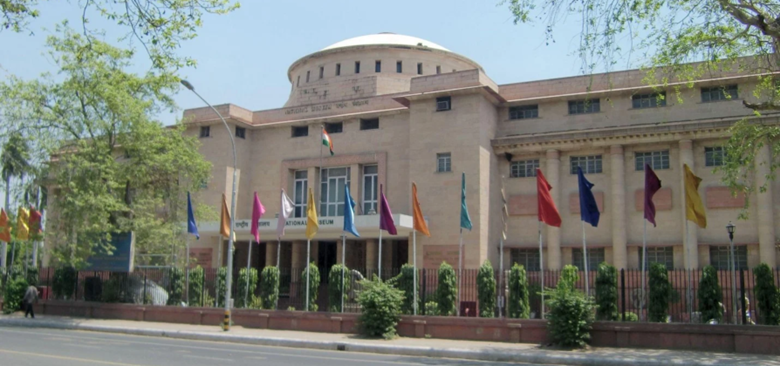
The first National Museum exhibition opened in 1949 at Rashtrapati Bhavan, inaugurated by Prime Minister Jawaharlal Nehru. Its success convinced the government to establish a permanent institution, and in 1955 the museum was relocated to its present site at the junction of Janpath and Maulana Azad Road. This site had already been identified in the British plan for a future museum, making it a continuation of the city’s original cultural vision. Nehru inaugurated the new building, which became one of the earliest architectural accomplishments of independent India. A second phase of the building was added in 1989 to expand its capacity.
Also Read: Hagia Sophia Grand Mosque: A Sacred Convergence of Empires, Faiths, and Architecture
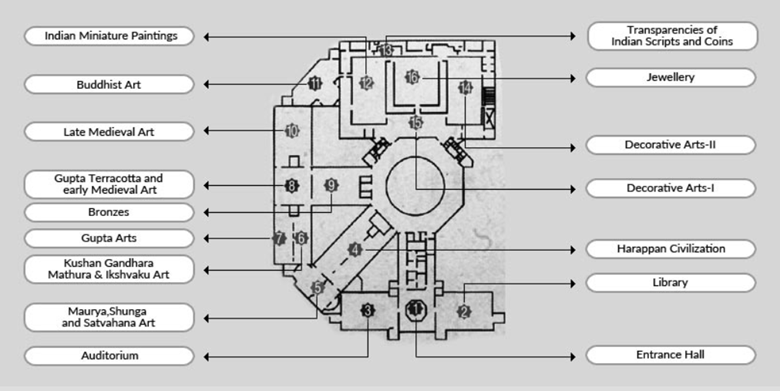
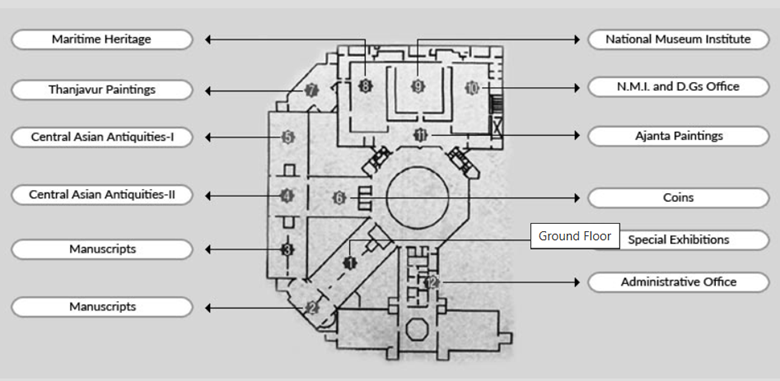
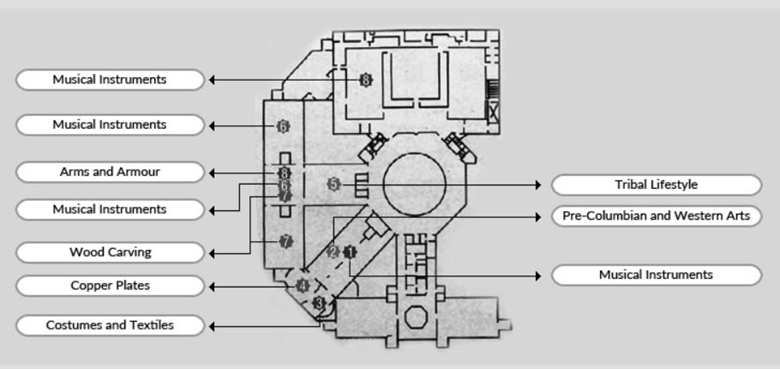
The building was designed by Ganesh Bhikaji Deolalikar, the first Indian to head the Central Public Works Department (CPWD) and also the architect of the Supreme Court of India. Deolalikar created a modernist structure with Indian sensibilities, conceived not as a modest government office but as a civic showpiece that symbolized the aspirations of a new nation. The museum is organized around a central courtyard, with galleries radiating outward to create simple and flexible circulation routes. The original master plan envisioned an octagonal structure to be built in three phases, of which two were completed. Its robust construction, wide structural bays, and generous floor-to-floor heights were designed to accommodate large objects, changing exhibitions, and future technical upgrades. The courtyard design also responded to Delhi’s climate by reducing solar gain and offering shaded buffer spaces.
Architectural Style & Character
Deolalikar used a modernist architectural vocabulary blended with Indian sensibilities. The design emphasizes clean lines, symmetry, and durable construction. The courtyard plan also serves a climatic function by reducing heat gain and allowing daylight into circulation spaces. This was a practical and forward-thinking response to Delhi’s environment before modern façade technologies became common.

From its inception, the National Museum also advanced modern museology under its first director, Grace Morley. She introduced professional display systems, lighting arrangements, and storage methods, all of which were supported by the clarity of Deolalikar’s architecture. The building allowed curators flexibility to adapt galleries as narratives changed, while visitors enjoyed intuitive navigation and the openness created by the central court.
Also Read: Designing for Childhood: A Visit to National Bal Bhavan
Today, the museum is at the threshold of a new chapter. The Government of India has announced that the collections will be relocated to the historic North and South Blocks, which currently house the nation’s most important ministries. The existing museum covers 35,000 square metres, but the new institution will span 1.67 lakh square metres, making it the largest museum in the world. Once the ministries are shifted to the new Central Secretariat buildings, the Grade-I heritage structures of North and South Block will be carefully renovated and adapted to house the Yuge Yugeen Bharat National Museum. This transformation is described as “giving the hill back to the people,” symbolizing India’s democratic spirit and placing citizens at the centre of its most iconic precinct. The central plaza between the two blocks will become a public cultural space, hosting installations, performances, and activities that will keep the complex alive even after museum hours.
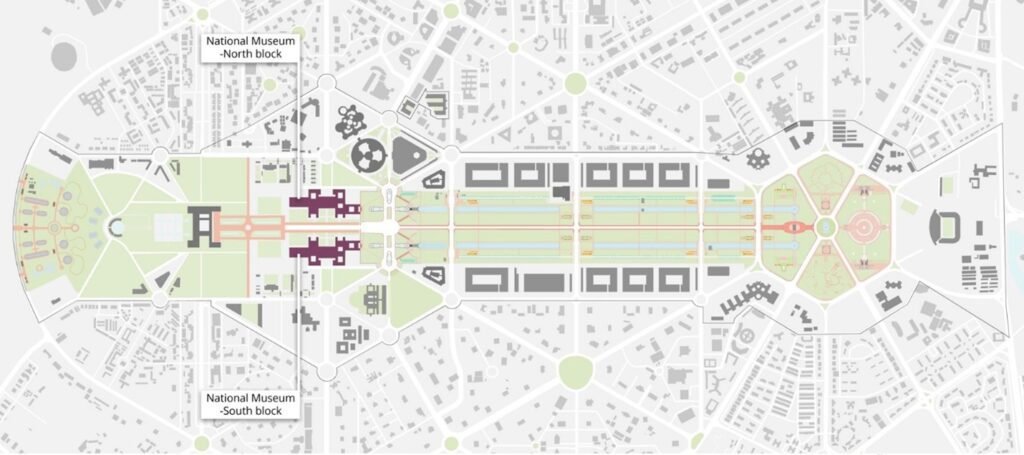
The National Museum in Delhi thus reflects the country’s evolving cultural identity—from its colonial-era conception, through Deolalikar’s post-independence architectural vision, to its forthcoming transformation as the world’s largest museum. While the Janpath building will remain a landmark of early modern Indian architecture, the new Yuge Yugeen Bharat National Museum promises to reimagine how India presents its rich history and achievements to the world.
References & Sources
- National Museum official website – History and institutional details.
- Press Information Bureau (Govt. of India) – Yuge Yugeen Bharat announcements.
- The Print – Articles on G.B. Deolalikar and early museum planning.
- Scroll.in – National Museum as a civic architectural showpiece.
- Pilar Maria Guerrieri, Negotiating Cultures: Delhi’s Architecture and Planning.
- UNESCO – National Museum, New Delhi: Achievements and Problems.
- Wikimedia Commons – Museum plan and archival drawings.
- Government of India Central Vista project documentation.